
The fundamental advantage of a vacuum furnace is absolute process control. By removing the atmosphere from the heating chamber, it eliminates uncontrolled variables like oxygen and other contaminants. This allows for exceptionally clean, repeatable heat treatment that results in superior material properties, minimal distortion, and a bright, unblemished surface finish on the final part.
A vacuum furnace transforms heat treatment from a process vulnerable to atmospheric variables into a precise, repeatable science. Its core value lies not just in heating metal, but in creating a chemically pure environment where thermal processes can be controlled with unprecedented accuracy.
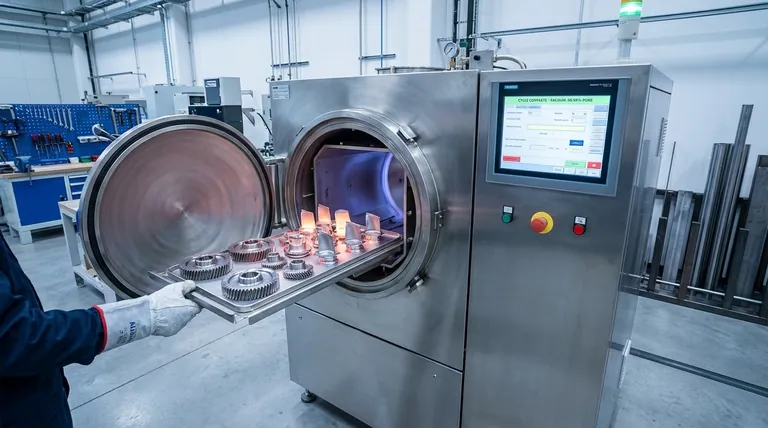
The Foundation: A Chemically Pure Environment
The defining feature of a vacuum furnace is the low-pressure environment it creates. Removing air and other gases before and during the heating cycle solves several critical problems inherent in traditional atmosphere-based heat treatment.
Eliminating Oxidation and Decarburization
At high temperatures, the oxygen in the air aggressively reacts with a metal's surface, causing oxidation (scaling). The carbon within steel can also react with the atmosphere, leading to decarburization, which softens the surface layer and compromises the part's wear resistance and fatigue life.
A vacuum furnace completely prevents these reactions. By operating in a near-perfect vacuum, there is virtually no oxygen or other reactive gases present, ensuring the part emerges from the furnace with a clean, bright surface that requires no post-process cleaning.
Achieving Surface Purity and Degassing
The vacuum doesn't just protect the part from the outside environment; it actively cleans the part itself. The low-pressure environment effectively pulls volatile contaminants, oils, and trapped gases out of the material's surface and internal structure.
This degassing effect is critical for high-performance applications, as it improves the internal integrity and performance of the metal.
Preventing Hydrogen Embrittlement
For certain high-strength steels and reactive metals like titanium, exposure to hydrogen at high temperatures can lead to hydrogen embrittlement. This phenomenon causes a severe loss of ductility and can lead to premature, catastrophic failure of the component under stress.
A vacuum environment is free of hydrogen, completely mitigating this risk and ensuring the material retains its intended mechanical properties.
Unprecedented Control Over Thermal Processes
Beyond creating a clean environment, vacuum technology enables a level of thermal precision and uniformity that is difficult to achieve in conventional furnaces.
Precision Temperature Uniformity
Heating in a vacuum occurs primarily through radiation, which is highly uniform and predictable. This ensures the entire workpiece, regardless of its geometry, reaches the target temperature at the same time.
This temperature uniformity minimizes thermal stress and distortion, leading to dimensionally accurate parts and a significantly higher product pass rate.
Rapid and Controlled Cooling (Quenching)
Modern vacuum furnaces are integrated systems that include high-pressure gas quenching. After the heating cycle, the chamber is rapidly backfilled with an inert gas like nitrogen or argon, which is circulated at high velocity to cool the part.
This allows for precise control over the cooling rate, which is a critical factor in determining the final hardness and microstructure of the metal. It's a clean, dry, and highly controllable alternative to traditional oil or water quenching.
Repeatability Through Automation
Vacuum furnaces are highly automated, with computer controls managing every stage of the process—from the initial pump-down to the heating cycle, soak time, and quench parameters.
Once a process recipe is validated, it can be executed identically for every subsequent batch. This high degree of repeatability is essential for industries like aerospace, medical, and tool manufacturing, where consistency is non-negotiable.
Understanding the Trade-offs
While powerful, a vacuum furnace is not the universal solution for all heat-treating needs. Objectivity requires acknowledging its specific limitations.
Higher Initial Investment
Vacuum furnace systems are complex and represent a significantly higher capital investment compared to most conventional atmosphere furnaces. The cost includes the furnace chamber, robust vacuum pumps, and sophisticated control systems.
Batch Processing Constraints
Vacuum furnaces are inherently batch processors. This makes them ideal for high-value components but potentially less efficient for continuous, high-volume production of low-cost parts, where a conveyor-style atmosphere furnace might be more economical.
Maintenance Complexity
The integrity of the system depends on the performance of its vacuum pumps, seals, and instrumentation. Maintaining this equipment requires specialized knowledge and a rigorous preventative maintenance schedule to ensure a reliable, leak-free vacuum.
Making the Right Choice for Your Application
Selecting the right heat treatment technology depends entirely on your material, part complexity, and performance requirements.
- If your primary focus is surface finish and material purity: A vacuum furnace is the definitive choice for applications like medical implants, aerospace components, or high-end tooling where zero oxidation or contamination is permitted.
- If your primary focus is process repeatability for high-value parts: The precise, automated control of a vacuum furnace ensures consistent metallurgical properties batch after batch, justifying the investment by minimizing scrap and rework.
- If your primary focus is high-volume, low-cost processing: A traditional atmosphere furnace may be more cost-effective for simple carbon steel parts where a small amount of surface scaling is acceptable or can be removed in a secondary operation.
Ultimately, choosing a vacuum furnace is a decision to prioritize control and quality above all else.
Summary Table:
| Advantage | Description |
|---|---|
| No Oxidation/Decarburization | Prevents surface scaling and carbon loss for clean, bright finishes without post-cleaning. |
| Surface Purity and Degassing | Removes contaminants and gases from materials, enhancing internal integrity and performance. |
| Prevention of Hydrogen Embrittlement | Eliminates hydrogen exposure, maintaining ductility and preventing failure in sensitive metals. |
| Precision Temperature Uniformity | Ensures even heating through radiation, reducing thermal stress and distortion for accurate parts. |
| Controlled Gas Quenching | Allows rapid, adjustable cooling with inert gases for optimal hardness and microstructure control. |
| High Repeatability and Automation | Computer-controlled processes deliver consistent results batch after batch, ideal for critical industries. |
Ready to elevate your heat treatment process with precision and purity? At KINTEK, we leverage exceptional R&D and in-house manufacturing to provide advanced high-temperature furnace solutions tailored to your needs. Our product line includes Vacuum & Atmosphere Furnaces, Muffle Furnaces, Tube Furnaces, Rotary Furnaces, and CVD/PECVD Systems, all backed by strong deep customization capabilities to meet your unique experimental requirements. Whether you're in aerospace, medical, or tool manufacturing, our vacuum furnaces ensure superior material properties and repeatable outcomes. Contact us today to discuss how we can optimize your laboratory's efficiency and quality!
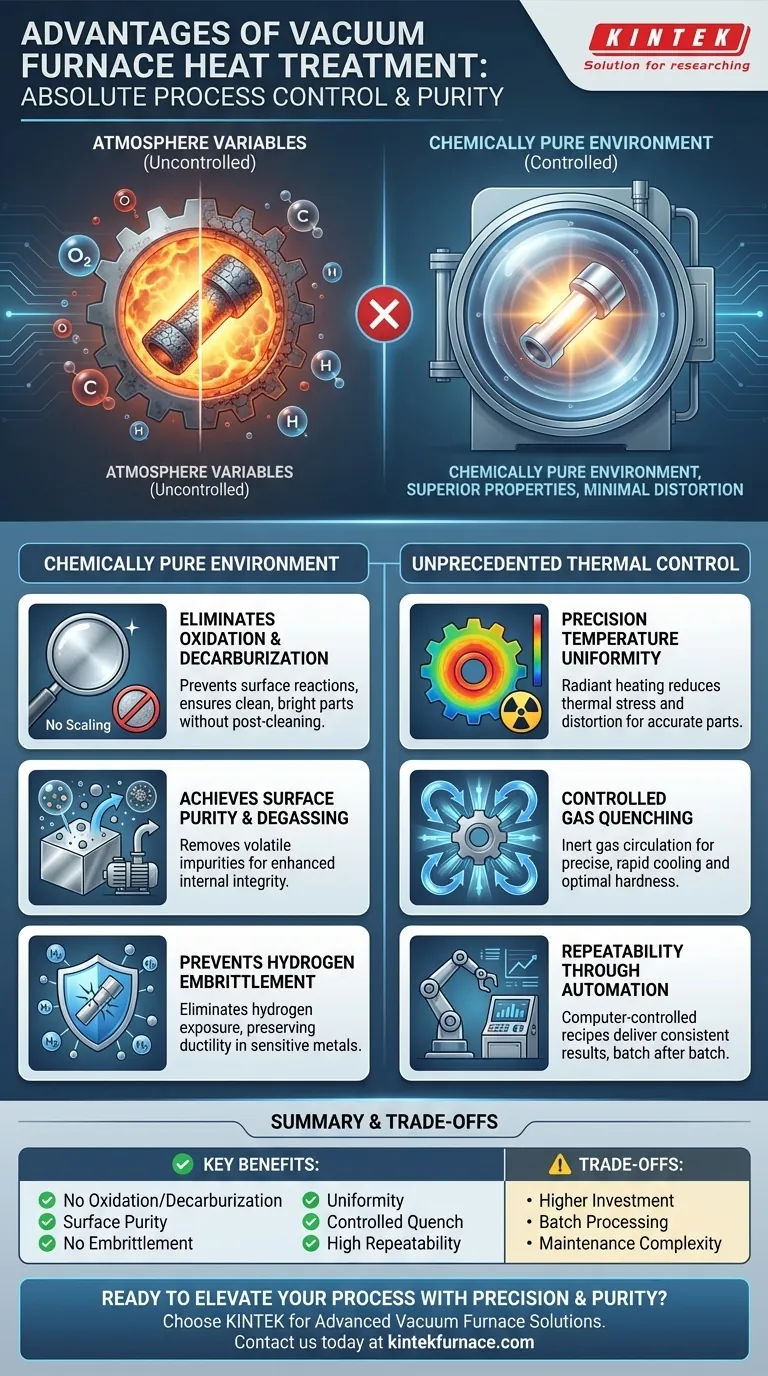
Visual Guide
Related Products
- Vacuum Heat Treat Furnace with Ceramic Fiber Liner
- 2200 ℃ Graphite Vacuum Heat Treat Furnace
- Vacuum Heat Treat Sintering Furnace with Pressure for Vacuum Sintering
- Vacuum Heat Treat Sintering and Brazing Furnace
- Molybdenum Vacuum Heat Treat Furnace
People Also Ask
- How does vacuum heat treating affect the grain structure of metal alloys? Achieve Precise Microstructure Control
- What are the benefits of using vacuum heat treating furnaces for metal alloys? Achieve Superior Metal Properties and Performance
- What is one of the most important uses of vacuum heat treating furnaces in aerospace? Achieve Superior Strength in Aircraft Alloys
- How does a vacuum heat treat furnace work? Achieve Pristine, High-Performance Results
- What is the difference between heat treat and vacuum heat treat? Achieve Superior Metal Properties with Pristine Finishes



















