
From a technical standpoint, the primary advantages of a Rotary Tube Tilt Furnace are its enhanced material mixing, superior thermal efficiency, and simplified material discharge. The combination of rotation and tilting creates a dynamic processing environment that static furnaces cannot replicate, leading to more uniform products and streamlined operation.
The core challenge in thermal processing of powders and granular materials is ensuring every particle is treated uniformly. A Rotary Tube Tilt Furnace directly solves this by using continuous rotation for homogenous mixing and a variable tilt angle for precise control over material flow, making it exceptionally effective for both continuous and large-batch applications.
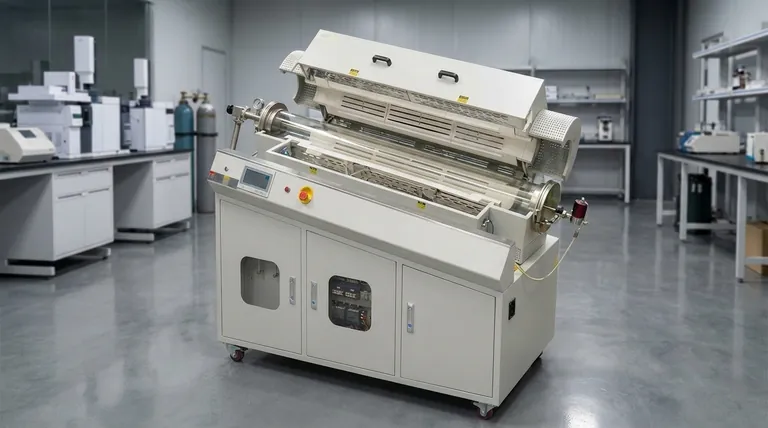
How Rotary Tilt Functionality Transforms Material Processing
The true value of this furnace lies in how its unique mechanical functions—rotation and tilting—directly address the common pitfalls of processing particulate materials in static, conventional furnaces.
Dynamic Mixing for Unmatched Homogeneity
In a static furnace, powders or granules at the center of a batch can remain under-processed, while material at the edges may be overheated. The slow rotation of a rotary furnace (typically 1-20 RPM) gently tumbles the material.
This continuous movement, often aided by internal scraper bars, breaks up agglomerates and ensures every particle is equally exposed to the heat source and processing atmosphere. The result is a highly consistent and homogenous final product.
Optimized Heat Transfer and Energy Efficiency
By constantly turning over the material, the furnace significantly improves conductive and convective heat transfer. Fresh material is always being brought to the surface, allowing it to absorb energy more quickly.
This enhanced thermal efficiency means shorter processing times and lower overall energy consumption compared to heating a stationary pile of material, where heat must slowly penetrate to the core.
Precise Control Over Residence Time
The tilt angle (typically 6-15 degrees) is a critical control parameter, especially in continuous operations. A steeper angle causes material to travel through the tube faster, reducing its residence time.
By adjusting both the rotation speed and the tilt angle, operators gain precise, repeatable control over how long the material is exposed to heat. This is essential for processes that require exact thermal treatment durations.
Simplified, Automated Material Handling
Discharging material from conventional furnaces can be a labor-intensive process. The tilt functionality of a rotary furnace automates this step completely.
Simply tilting the furnace allows the processed material to be discharged cleanly and efficiently into a collection container, minimizing labor, reducing contamination risk, and speeding up cycle times.
Understanding the Key Applications and Versatility
The combination of these features makes the Rotary Tube Tilt Furnace uniquely suited for a range of demanding industrial processes that are difficult to perform in standard furnaces.
Ideal for Powder and Granular Processing
Its primary function is the thermal treatment of powders, pellets, and other particulates. This includes applications like calcination, sintering, and drying of materials ranging from ceramics to pharmaceuticals. The constant mixing prevents caking and ensures uniform quality.
Controlled Atmosphere Reactions
These furnaces are frequently designed with sealed systems that allow for gas purging or vacuum atmospheres. This capability is critical for processes like activating catalysts, carbonization in an inert environment, or heat-treating materials that are sensitive to oxidation.
Dual Operation: Batch and Continuous Modes
A key advantage is the flexibility to operate in both batch and continuous modes. You can use it to process a single, finite batch with high precision. Alternatively, you can set it up for a continuous feed and discharge, making it scalable for high-throughput production.
Inherent Trade-offs and Considerations
While powerful, this furnace design is not a universal solution. Its specialized nature comes with specific trade-offs that must be considered.
Increased Mechanical Complexity
The mechanisms that enable rotation and tilting add a level of mechanical complexity not found in a static box or tube furnace. These moving parts, including seals and drive systems, require more rigorous maintenance schedules to ensure long-term reliability.
Not Suited for Large, Solid Objects
This furnace is purpose-built for powders, granules, and small parts that can tumble freely. It is entirely unsuitable for processing large, single-piece components or static assemblies, where a box furnace would be the correct choice.
Process Suitability
The tumbling action, while beneficial for mixing, may be too aggressive for extremely delicate or friable materials that could be damaged by the mechanical movement. Material characteristics must be carefully evaluated.
Making the Right Choice for Your Goal
To determine if a Rotary Tube Tilt Furnace is the correct investment, you must align its capabilities with your primary processing objective.
- If your primary focus is high-throughput or continuous processing of powders: The Rotary Tube Tilt Furnace is the superior choice for its automated flow and exceptional mixing uniformity.
- If your primary focus is treating small, static, high-value batches: A standard tube furnace or a precision batch furnace may offer sufficient control with less mechanical complexity and cost.
- If your primary focus is heat treating large, solid components: A box furnace is the appropriate and necessary tool for the job.
Ultimately, selecting the right furnace requires understanding that for particulate materials, the method of handling and movement is just as critical as the temperature profile itself.
Summary Table:
| Advantage | Description |
|---|---|
| Enhanced Material Mixing | Continuous rotation ensures uniform exposure and homogeneity in powders and granules. |
| Superior Thermal Efficiency | Dynamic tumbling improves heat transfer, reducing energy use and processing time. |
| Precise Residence Time Control | Adjustable tilt angle and rotation speed allow exact control over material flow and heat exposure. |
| Simplified Material Discharge | Automated tilting enables clean, efficient discharge, minimizing labor and contamination. |
| Versatile Operation | Supports both batch and continuous modes for flexible processing needs. |
Unlock the full potential of your laboratory with KINTEK's advanced high-temperature furnace solutions. Leveraging exceptional R&D and in-house manufacturing, we provide Rotary Tube Tilt Furnaces and other products like Muffle, Tube, Rotary Furnaces, Vacuum & Atmosphere Furnaces, and CVD/PECVD Systems, all with strong deep customization to meet your unique experimental requirements. Whether you're processing powders, granules, or need controlled atmosphere reactions, our solutions deliver enhanced efficiency, uniformity, and reliability. Contact us today to discuss how we can tailor a furnace to optimize your thermal processing and boost productivity!
Visual Guide

Related Products
- Laboratory Vacuum Tilt Rotary Tube Furnace Rotating Tube Furnace
- Vacuum Sealed Continuous Working Rotary Tube Furnace Rotating Tube Furnace
- Split Multi Heating Zone Rotary Tube Furnace Rotating Tube Furnace
- Inclined Rotary Plasma Enhanced Chemical Deposition PECVD Tube Furnace Machine
- Inclined Rotary Plasma Enhanced Chemical Deposition PECVD Tube Furnace Machine
People Also Ask
- What are the key advantages of using a rotary tube furnace? Achieve Dynamic, Uniform Heating for Powders
- When are rotary tube furnaces not suitable for a process? Avoid Costly Mistakes in Thermal Processing
- What other fields utilize rotary tube furnaces? Discover Versatile Heating Solutions for Multiple Industries
- What optional features enhance the processing capabilities of rotary tube furnaces? Boost Efficiency with Advanced Customizations
- What are the technical advantages of using a rotary tube furnace for hydrochar activation? Achieve Superior Porosity



















