The answer lies in the inverse power laws of mass transport.
During solid-state sintering, the dominant mechanism—whether grain boundary diffusion or lattice (volume) diffusion—is determined by a competition that hinges on particle size. Grain boundary diffusion accelerates sharply as particle size decreases, scaling with the inverse fourth power (( \propto 1/G^4 )), whereas lattice diffusion scales more gently (( \propto 1/G^3 )). Temperature selection amplifies this imbalance: the lower activation energy of grain boundary diffusion makes it even more dominant at the lower sintering temperatures made possible by fine powders.
The sintering mechanism shifts from lattice to grain boundary diffusion as particle size drops below roughly 0.5 µm. Furnace temperature controls which mechanism can be thermally activated: fine powders densify via grain boundary diffusion at temperatures 350–600°C lower than coarse powders, while coarse powders demand high-temperature holds where lattice diffusion contributes to final densification—often leaving residual porosity. Smart thermal profiling uses particle size to dictate the mechanism and temperature to unlock it.
The Scaling Laws That Govern Sintering
Why Particle Size Changes Everything
The densification rate (( \dot{\rho} )) in a ceramic compact is proportional to the inverse of grain size raised to a mechanism‑dependent exponent: ( \dot{\rho} \propto 1/G^m ).
For grain boundary diffusion, ( m = 4 ); for lattice diffusion, ( m = 3 ).
This means that as the particle size ( G ) shrinks, the advantage of grain boundary diffusion grows by an additional factor of ( 1/G ) compared with lattice transport—making ultra‑fine powders inherently biased toward grain‑boundary‑controlled sintering.
The Geometric Boost: Grain Boundary Area
As grain size decreases, the volume fraction of grain boundaries (( f_b )) increases in inverse proportion: ( f_b \propto 1/G ).
This creates a dense network of fast‑diffusion paths with a huge total cross‑section for mass flow.
In fine‑grained compacts, the combination of the ( 1/G^4 ) rate dependence and the expanding boundary area means that grain boundary transport can overwhelm lattice diffusion by orders of magnitude.
How Temperature Selection Tips the Balance
The Hierarchy of Activation Energies
The three primary diffusion pathways follow a clear energy ladder: surface diffusion has the lowest activation energy, then grain boundary, then lattice.
During furnace heat‑up, surface diffusion becomes active first but causes neck growth without densification—a trap that must be bypassed quickly.
To achieve true densification, the temperature must reach the regime where either grain boundary or lattice diffusion dominates.
Fine Powders and Low‑Temperature Sintering
Ultra‑fine powders (0.1–0.4 µm) dramatically lower the onset temperature for rapid densification.
Thermal profiles can be shifted down by 350°C to 600°C—from typical coarse‑powder conditions (~1400°C) to as low as 800–1050°C—while still reaching >99% relative density.
In this window, grain boundary diffusion handles the entire densification cycle because its lower activation energy is fully satisfied and its ( 1/G^4 ) scaling makes it kinetically superior.
Coarse Powders and the High‑Temperature Lattice Regime
Standard commercial powders with particle sizes near 1 µm lack the dense grain‑boundary network of their fine counterparts.
To drive mass transport, the furnace must hold at temperatures ≥1400°C for 10 hours or more—a region where lattice diffusion finally contributes.
Even then, final‑stage sintering often relies on lattice diffusion to close isolated pores, but the same high temperature drives uncontrolled grain growth and commonly caps density around 93% of theoretical.
Navigating the Homologous Temperature Map
The homologous temperature (( T/T_m )) provides a material‑agnostic reference point.
For most ceramics, grain boundary diffusion dominates in the 0.7–0.8 ( T/T_m ) range, while lattice‑diffusion‑controlled densification requires pushing to higher fractions of the melting point.
Deformation‑mechanism maps, such as those for alumina, allow you to pinpoint the transition temperatures for a given grain size.
The Trade‑offs You Must Manage
The Surface Diffusion Pitfall
During the early heat‑up stage, surface diffusion creates particle necks without shrinking the overall body.
This consumes a significant part of the sintering driving force and can coarsen the microstructure before densification even begins.
The solution is a controlled, rapid ramp through the low‑temperature range, minimizing time in the surface‑diffusion‑dominated zone.
Grain Growth vs. Densification
Grain boundary diffusion accelerates densification, but it also powers grain boundary migration and grain growth.
Fine powders risk rapid coarsening if the temperature soaks too long; grain‑growth inhibitors or precise thermal plateaus must be used to preserve submicron grain sizes.
Conversely, coarse‑powder sintering at high temperature inherently pushes grains to grow, often negating any mechanical property benefits from partial densification.
Residual Porosity Traps
In coarse‑powder compacts, the late stage of sintering leaves isolated pores that lack a connection to grain boundaries.
Lattice diffusion can transport vacancies only very slowly, often freezing in 5–7% porosity that becomes impossible to remove without pressure‑assisted methods.
Switching to fine powders before firing drastically reduces the final pore fraction because grain boundaries remain attached to pores until near‑full density.
Making the Right Choice for Your Goal
- If your primary focus is maximal density with submicron grain retention: Select chemically prepared powders in the 0.1–0.4 µm range and program a thermal profile with a rapid ramp to 800–1050°C, short holds, and precise cooling. This exploits grain‑boundary‑dominant sintering to reach >99% relative density while keeping grains small.
- If your primary focus is cost‑effective processing of standard commercial powders: Accept that 1 µm powders require high temperatures (~1400°C) and long holds. Pair the thermal schedule with intentional grain‑growth control agents and target a realistic final density around 93%.
- If your primary focus is mapping the exact mechanism in your material: Use the particle size and chosen heating profile to construct a binder‑burnout and sintering schedule that shifts the dominant diffusion mode—starting with grain boundary for intermediate‑stage densification and allowing a controlled transition to lattice diffusion only if necessary to close the last pores.
By mastering how particle size and temperature jointly govern the sintering mechanism, you can design thermal profiles that transform a powder compact into a fully dense, high‑performance ceramic with exactly the microstructure you need.
Summary Table:
| Parameter / Feature | Fine Powders (0.1–0.4 µm) | Coarse Powders (~1.0 µm) |
|---|---|---|
| Dominant Mechanism | Grain Boundary Diffusion | Lattice (Volume) Diffusion |
| Scaling Law | $\propto 1/G^4$ (Faster transport) | $\propto 1/G^3$ (Slower transport) |
| Sintering Temperature | Lower (800–1050°C) | Higher (≥1400°C) |
| Activation Energy | Lower | Higher |
| Typical Hold Time | Short holds | Long holds (≥10 hours) |
| Achievable Density | >99% (Retains fine grains) | ~93% (Traps residual porosity) |
Optimize Your Ceramic Thermal Profiles with KINTEK
Precise temperature control is essential to activating the right diffusion mechanism and achieving maximum theoretical density in ceramic compacts. KINTEK offers a comprehensive range of advanced high-temperature laboratory furnaces—including muffle, tube, vacuum, atmosphere, CVD, rotary, and induction melting furnaces—engineered to deliver precise thermal uniformity and exact ramp control.
Whether you need low-temperature holds for fine submicron powders or extreme, multi-stage profiles for advanced material sintering, our equipment is fully customizable to meet your specific research and production needs.
Take control of your microstructure and densification results—Contact KINTEK today for a customized furnace solution!
Related Products
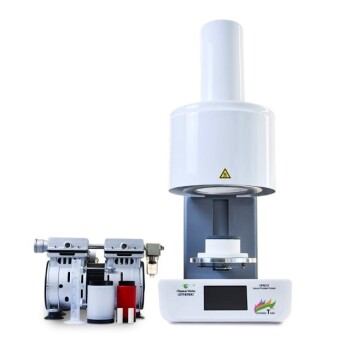
- Dental Porcelain Zirconia Sintering Ceramic Vacuum Press Furnace
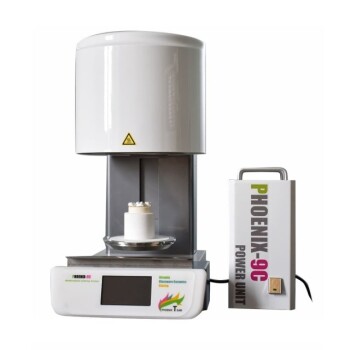
- Chairside Dental Porcelain Zirconia Sintering Furnace with Transformer for Ceramic Restorations
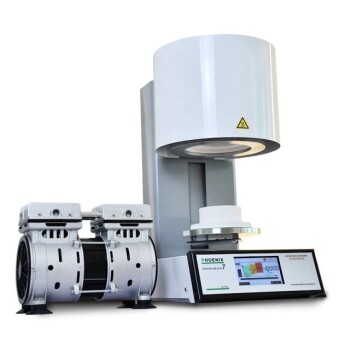
- Vacuum Dental Porcelain Sintering Furnace for Dental Laboratories
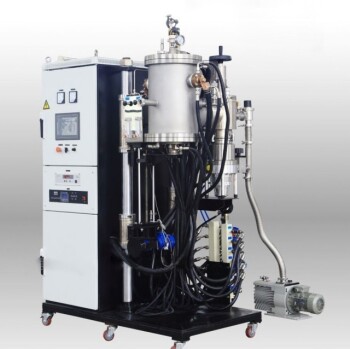
- Small Vacuum Heat Treat and Tungsten Wire Sintering Furnace
- Spark Plasma Sintering SPS Furnace
People Also Ask
- What factors determine the quality of sintered zirconia restorations? Master Material, Equipment, and Technique
- How do conventional vs rapid sintering in dental furnaces affect zirconia? Optimize Efficiency Without Sacrificing Strength
- What is the purpose of dental sintering furnaces? Transform Zirconia into Durable, High-Quality Dental Restorations
- What precautions should be taken when sintering zirconia in the Fast Slow Dental Sintering Furnace? Master Key Steps for Perfect Results
- What temperature range is used for sintering zirconia ceramics? Achieve Optimal Strength and Translucency