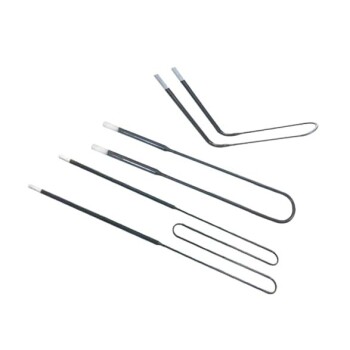
Yes, absolutely. Molybdenum disilicide (MoSi2) heating elements are specifically designed to be customized. They can be manufactured in a wide variety of shapes and sizes to fit the unique requirements of nearly any high-temperature industrial furnace, offering significant flexibility in both new designs and retrofits.
The ability to customize MoSi2 heating elements is only the surface-level benefit. Their true value lies in their unique material properties that enable continuous, high-temperature operation, but this performance is directly tied to maintaining specific operating conditions and avoiding known vulnerabilities.
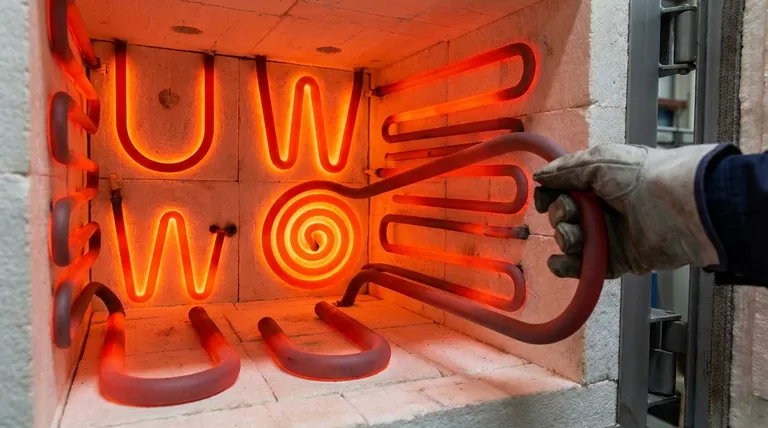
Why MoSi2 Excels in Custom High-Temperature Applications
The choice to use custom MoSi2 elements goes beyond simple dimensions. It's about leveraging a set of core material advantages that directly impact furnace performance, efficiency, and operational uptime.
Unmatched Temperature Capability in Air
MoSi2 elements are renowned for their ability to operate at extremely high temperatures. Standard models allow for furnace temperatures of 1600°C (3092°F) to 1700°C (3272°F).
This is possible due to a remarkable self-healing property. In an oxidizing atmosphere (like air), a thin, protective layer of silica glass (SiO2) forms on the element's surface, preventing further oxidation and enabling a long service life even under continuous use.
Intrinsic Design and Performance Stability
The manufacturing process allows for a high degree of design versatility. Elements can be formed into various configurations, such as U-shapes and W-shapes, with robust joint molding that provides strong impact resistance.
Once installed, they offer excellent electrical stability. Their resistance remains relatively constant over their lifespan, which means they can be easily wired in series and old elements can be replaced with new ones without disrupting the circuit's performance.
Superior Operational Efficiency
These elements feature a high power density, allowing for a rapid heating rate and excellent thermal cycling capabilities. This translates to lower overall power consumption and faster production cycles.
This combination of fast heating and stable resistance makes them an extremely efficient and reliable heat source for demanding industrial processes.
Understanding the Trade-offs and Vulnerabilities
To successfully deploy MoSi2 elements, it is critical to understand their operational limitations. Ignoring these factors is the primary cause of premature failure.
Critical Sensitivity to Contamination
The protective silica layer, while robust, is vulnerable to chemical attack. Certain compounds can act as a flux, degrading the layer and causing the underlying MoSi2 to rapidly oxidize and fail.
Technicians must be properly trained to prevent this. For example, failing to properly dry painted or colored zirconia before firing can release contaminants that destroy the elements. Strict furnace hygiene is non-negotiable.
Dependence on an Oxidizing Atmosphere
The performance and longevity of MoSi2 elements depend entirely on the formation of that protective silica layer. This process requires oxygen.
Therefore, these elements are not suitable for strongly reducing or other specific atmospheres where this protective layer cannot form or is actively stripped away.
Brittleness at Room Temperature
Like many advanced ceramics, MoSi2 elements are strong at high temperatures but can be brittle and fragile when cold. They require careful handling during installation and maintenance to avoid mechanical shock or stress that can cause them to crack.
Making the Right Choice for Your Application
Your decision should be based on a clear-eyed assessment of your specific process environment and operational priorities.
- If your primary focus is maximum temperature in an air atmosphere: MoSi2 is the superior technology, especially for continuous operation above 1500°C where it outlasts other common elements.
- If your primary focus is minimizing production downtime: The ability to replace MoSi2 elements while the furnace remains at temperature is a significant advantage for continuous manufacturing.
- If your process involves potential chemical contaminants: You must conduct a thorough material compatibility review to ensure no byproducts will attack the element's protective layer.
Ultimately, choosing MoSi2 heating elements empowers you to achieve superior thermal performance, but only when you respect their specific operational requirements.
Summary Table:
| Feature | Benefit |
|---|---|
| Custom Shapes and Sizes | Fits unique furnace designs and retrofits |
| High-Temperature Operation | Up to 1700°C with self-healing silica layer |
| Design Versatility | U-shape, W-shape configurations for impact resistance |
| Electrical Stability | Constant resistance for easy series wiring and replacement |
| Rapid Heating Rate | High power density for efficient thermal cycling |
| Operational Requirements | Requires oxidizing atmosphere and strict hygiene to avoid contamination |
Unlock the full potential of your high-temperature processes with KINTEK's advanced MoSi2 heating elements! Leveraging exceptional R&D and in-house manufacturing, we provide diverse laboratories with tailored solutions, including Muffle, Tube, Rotary Furnaces, Vacuum & Atmosphere Furnaces, and CVD/PECVD Systems. Our strong deep customization capability ensures precise alignment with your unique experimental needs, enhancing efficiency and reliability. Contact us today to discuss how we can optimize your furnace performance!
Visual Guide

Related Products
- Molybdenum Disilicide MoSi2 Thermal Heating Elements for Electric Furnace
- Silicon Carbide SiC Thermal Heating Elements for Electric Furnace
- Molybdenum Vacuum Heat Treat Furnace
- Vacuum Heat Treat Sintering Furnace Molybdenum Wire Vacuum Sintering Furnace
People Also Ask
- What are the typical application temperatures for molybdenum disilicide (MoSi2) heating elements? Master High-Temp Performance
- What is the primary use of molybdenum disilicide? Ideal for High-Temp Heating Elements
- What are the characteristics of molybdenum disilicide heating elements? Unlock High-Temp Performance
- What are the properties of molybdenum disilicide (MoSi2) that make it suitable for high-temperature applications? Discover Its High-Temp Resilience
- What are the applications of molybdenum disilicide heating elements? Achieve Extreme Heat Stability for Industrial Processes