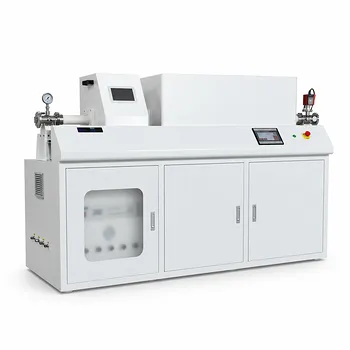
The integration of a muffle furnace and a high-pressure autoclave is essential for creating the precise hydrothermal environment required to transform the molecular structure of phosphorus. This combination allows researchers to maintain a constant, elevated temperature—typically around 165°C—which, when applied to a sealed solvent-filled vessel, generates the internal pressure necessary to facilitate the topological transition from Red Phosphorus (RP) to Black Phosphorus (BP) and form high-performance heterojunction interfaces.
Core Takeaway: The muffle furnace acts as a precision-controlled thermal reservoir that drives the hydrothermal reactions inside the autoclave, enabling the controlled molecular reorganization of phosphorus into high-mobility RP/BP heterojunctions.
The Synergy of Thermal Stability and Internal Pressure
Creating the Hydrothermal Environment
The muffle furnace provides the external thermal field required to heat the solvents contained within the sealed stainless steel autoclave. As the temperature rises to a constant set point, the solvent expands and vaporizes, creating a high-pressure state that would be impossible to achieve in an open system.
Driving Molecular Reorganization
At specific temperatures like 165°C, the combined heat and pressure trigger a wet chemical process known as a topological transition. This environment encourages the disordered atoms of Red Phosphorus to rearrange into the more ordered, crystalline structure of Black Phosphorus, allowing for the formation of seamless RP/BP interfaces.
Facilitating Charge Mobility
The primary goal of using this dual-equipment setup is to produce heterojunctions with high charge mobility. By maintaining a perfectly stable temperature, the muffle furnace ensures the transition occurs uniformly, resulting in a mixed-phase material that optimizes electronic transport properties.
Precision Control and Material Quality
Removing Surface Impurities
Beyond the structural transition, the controlled thermal environment (often reaching 200°C for purification) facilitates the dissolution of the oxidation layer on raw Red Phosphorus. This ensures that the resulting RP/BP heterojunction is formed from high-purity materials, preventing defects that would otherwise hinder performance.
Managing Temperature Gradients
Programmable muffle furnaces allow for specific heating and cooling rates, such as 120°C to 144°C per hour. Precise gradient control is vital to regulate the melting and vaporization phases, ensuring that the crystallization of Black Phosphorus occurs without the irregular morphologies or crystal defects caused by temperature fluctuations.
Assisting Gas-Phase Transport
In instances where mineralizers are used, the furnace maintains the high-temperature environment (up to 650°C) necessary for gas-phase transport. This ensures the raw phosphorus can vaporize and re-crystallize accurately into the desired high-purity bulk crystals or heterojunctions.
Understanding the Trade-offs and Risks
Thermal Lag and Pressure Limits
While the muffle furnace provides the heat, there is often a thermal lag between the furnace's internal air temperature and the core of the autoclave. If the heating rate is too aggressive, the internal pressure can exceed the safety rating of the autoclave, leading to equipment failure or hazardous leaks.
Duration vs. Crystal Quality
Maintaining a constant temperature for extended periods is necessary for high-quality crystallization, but prolonged exposure can lead to excessive grain growth. Finding the "sweet spot" between sufficient reaction time for the RP/BP transition and avoiding over-processing is a delicate balance that requires precise furnace programming.
Atmospheric Sensitivity
Although the autoclave is sealed, the environment inside the furnace still matters for safety and equipment longevity. In high-temperature applications, an atmosphere-controlled furnace using nitrogen or hydrogen may be required to prevent the external oxidation of the autoclave itself or to maintain specific reduction states in related phosphor materials.
How to Apply This to Your Process
Making the Right Choice for Your Goal
To achieve the best results in phosphorus heterojunction preparation, tailor your use of the muffle furnace based on your specific material objectives:
- If your primary focus is high-purity heterojunctions: Utilize a programmable muffle furnace to maintain a steady 165°C for the duration of the hydrothermal reaction to ensure uniform interface formation.
- If your primary focus is removing surface oxides: Set the furnace to a higher temperature range, near 200°C, during the initial wet chemical cleaning phase to fully dissolve oxidation layers.
- If your primary focus is large-scale crystal growth: Implement a strict cooling program (e.g., 120°C/hour) to control the crystallization rate and minimize structural defects in the Black Phosphorus phases.
By precisely syncing the thermal output of the muffle furnace with the pressure capabilities of the autoclave, you can master the complex phase transitions required for advanced phosphorus electronics.
Summary Table:
| Process Phase | Typical Temperature/Rate | Key Objective |
|---|---|---|
| Hydrothermal Reaction | ~165°C | Drives topological transition from RP to BP |
| Surface Purification | ~200°C | Dissolves oxidation layers on raw phosphorus |
| Crystallization Control | 120°C - 144°C / hour | Manages cooling to minimize structural defects |
| Gas-Phase Transport | Up to 650°C | Facilitates vaporization and re-crystallization |
Optimize Your Materials Research with KINTEK Precision
Achieving the perfect RP/BP heterojunction requires more than just heat; it requires absolute thermal stability and precise gradient control. KINTEK specializes in high-performance laboratory equipment and consumables tailored for advanced material science.
We offer a comprehensive range of high-temperature furnaces, including:
- Muffle & Tube Furnaces for precise hydrothermal and atmospheric control.
- Rotary, Vacuum, & CVD Furnaces for specialized material growth.
- Atmosphere, Dental, & Induction Melting Furnaces for diverse lab applications.
All our systems are fully customizable to meet your unique research parameters, ensuring uniform heating and long-term durability. Ready to enhance your lab's efficiency and material quality? Contact KINTEK today to find your custom heating solution!
References
- Cheng‐May Fung, Siang‐Piao Chai. Engineering Nanoscale Homo–Heterojunction for Robust Z‐Scheme CO<sub>2</sub> Conversion through Synchronous Amalgamation of Oxygen‐Defective Ultrathin BiVO<sub>4</sub> and Red/Black Phosphorus. DOI: 10.1002/sstr.202300083
This article is also based on technical information from Kintek Furnace Knowledge Base .
Related Products
- High Temperature Muffle Oven Furnace for Laboratory Debinding and Pre Sintering
- Laboratory Muffle Oven Furnace with Bottom Lifting
- 1200℃ Muffle Oven Furnace for Laboratory
- 1400℃ Muffle Oven Furnace for Laboratory
- 1800℃ High Temperature Muffle Oven Furnace for Laboratory
People Also Ask
- What thermal phenomena occur during polymer binder burnout in ceramic green bodies? Lab Furnace Guide
- What role does a high-temperature muffle furnace play in STFO synthesis? Achieve Pure Perovskite Results
- Why is controlled heat treatment in a muffle furnace necessary for calcined clay? Achieve Optimal Pozzolanic Activity
- How does a high-temperature muffle furnace facilitate the formation of LaNbxAl1−xO3+δ perovskite structures? Key Roles
- What role does a high-temperature muffle furnace play in the formation of biochar catalysts? Master Catalyst Synthesis