
At its core, a box furnace is a versatile tool capable of heat treating a wide range of material forms and geometries. It is well-suited for processing parts such as heavy welded fabrications, forgings, large plates, and various spun products due to its simple, accessible chamber design.
The true value of a box furnace is not defined by the specific metal it can heat, but by the fundamental thermal processes it can perform. It is a general-purpose workhorse for common heat treatments that do not require specialized atmospheric control.
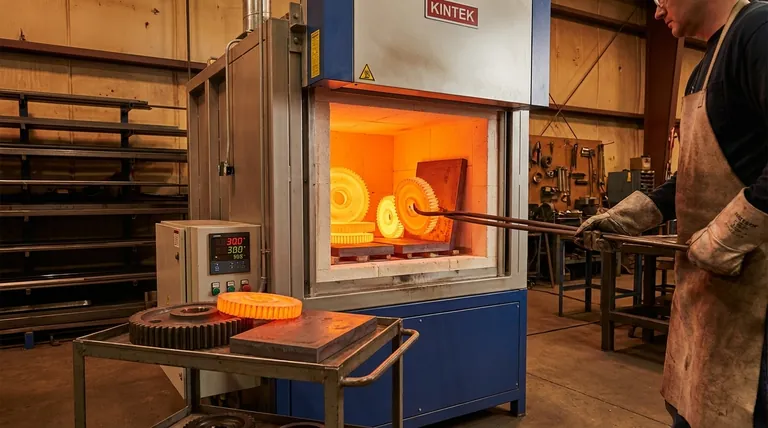
What a Box Furnace Actually Does
To determine if a box furnace is right for your needs, you must look past the material itself and focus on the required thermal process and the physical shape of the parts.
The Focus is on the Process, Not the Material
A box furnace is essentially a high-temperature oven. Its primary function is to apply heat to a part in a controlled manner over a set period in a standard air atmosphere.
The critical question is not "Can it heat my steel part?" but rather "Can it perform the annealing cycle my steel part requires?"
Core Thermal Processes Performed
Box furnaces excel at a range of common, non-atmospheric heat treatment applications.
- Annealing: Softening a metal to improve its ductility and make it easier to machine or form.
- Normalizing: Refining the grain structure of steel to improve its mechanical properties, particularly toughness.
- Hardening: Heating a metal (typically steel) to a critical temperature and then rapidly cooling it (quenching) to increase its hardness and strength. The furnace only performs the heating portion of this cycle.
- Tempering: A low-temperature heat treatment performed after hardening to reduce brittleness and increase toughness.
- Stress Relieving: Heating a part to a temperature below its transformation range to relieve internal stresses introduced during manufacturing processes like welding or machining.
- Preheating: Warming a part, often a die or a large weldment, to a specific temperature before another process begins.
Ideal Part Geometries
The "box" design makes this furnace exceptionally useful for parts that are bulky, irregularly shaped, or simply too large for other furnace types.
Common examples include individual large forgings, die blocks, custom-fabricated frames, and stacks of plate material that can be easily loaded and unloaded.
Understanding the Trade-offs
A box furnace is a powerful tool, but its utility has clear boundaries. Understanding its limitations is critical to avoiding costly mistakes.
Lack of Atmosphere Control
A standard box furnace operates in ambient air. During high-temperature heating, the oxygen in the air will cause oxidation (scaling) on the surface of most metals.
For applications where a bright, scale-free finish is required, you must use a specialized furnace with a controlled atmosphere (e.g., nitrogen, argon) or a vacuum furnace.
Batch Processing vs. Continuous Flow
By design, a box furnace is a batch processing tool. Parts are loaded, the door is closed, the cycle runs, and the parts are unloaded.
This is inefficient for high-volume, continuous production lines where a conveyor or pusher furnace would be a more appropriate choice.
Quenching is a Separate Step
For processes like hardening, the cooling rate is as important as the heating temperature. A box furnace only handles the heating.
You must have a separate, properly sized quenching system (oil, water, or polymer tank) located nearby to cool the parts rapidly and achieve the desired hardness.
Making the Right Choice for Your Goal
Select your equipment based on the process requirements and production goals, not just the part's material.
- If your primary focus is general-purpose, low-volume heat treatment: A box furnace is an excellent and highly versatile choice for annealing, stress relieving, and tempering a wide variety of parts.
- If your primary focus is high-volume, repeatable production: You should investigate continuous furnace systems like conveyor or pusher furnaces that integrate into an automated production line.
- If your primary focus is a pristine, scale-free surface finish: You must use a vacuum furnace or a furnace with a controlled inert atmosphere.
Matching the tool to the task is the foundation of efficient and effective thermal processing.
Summary Table:
| Material Type | Common Forms | Key Processes |
|---|---|---|
| Metals (e.g., Steel) | Forgings, Plates, Welded Fabrications | Annealing, Hardening, Stress Relieving |
| Various Alloys | Spun Products, Large Parts | Normalizing, Tempering, Preheating |
Optimize your heat treatment processes with KINTEK's advanced furnace solutions! Leveraging exceptional R&D and in-house manufacturing, we provide diverse laboratories with high-temperature furnaces like Box, Muffle, Tube, Rotary, Vacuum & Atmosphere, and CVD/PECVD Systems. Our strong deep customization capability ensures we precisely meet your unique experimental needs. Contact us today to discuss how our tailored solutions can enhance your lab's efficiency and results!
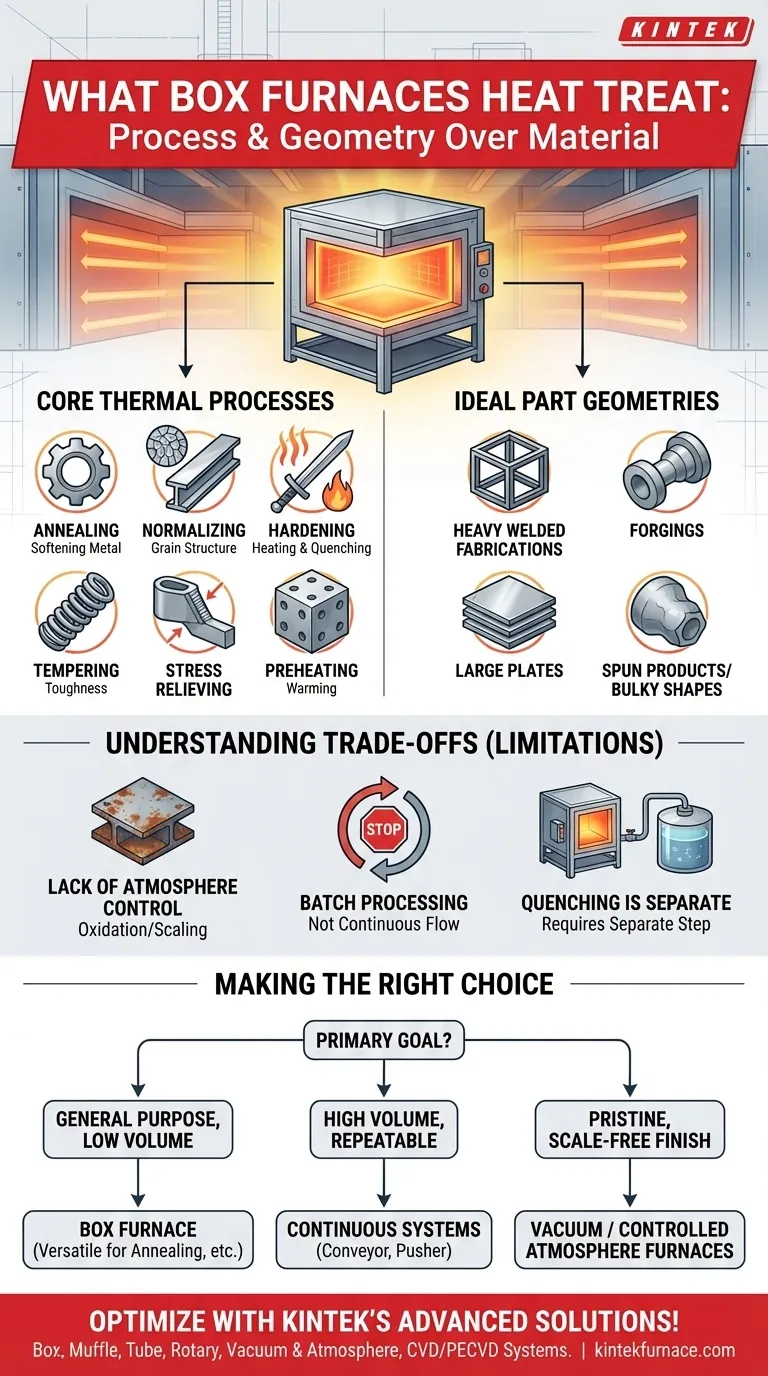
Visual Guide
Related Products
- Vacuum Hot Press Furnace Machine Heated Vacuum Press Tube Furnace
- Mesh Belt Controlled Atmosphere Furnace Inert Nitrogen Atmosphere Furnace
- Vacuum Heat Treat Sintering Furnace with Pressure for Vacuum Sintering
- 600T Vacuum Induction Hot Press Vacuum Heat Treat and Sintering Furnace
- Vacuum Hot Press Furnace Machine Heated Vacuum Press
People Also Ask
- Why use Vacuum Hot Press (VHP) for ZnS Ceramics? Achieve Superior IR Transparency and Mechanical Strength
- What are the benefits of the vacuum environment system in a vacuum hot press furnace? Unlock High-Density Sintering
- What safety features are incorporated in vacuum hot press furnaces? Ensure Operator and Equipment Protection
- How does the uniaxial pressure applied by a vacuum hot press furnace affect the microstructure of ZrC-SiC materials?
- What temperature control features do vacuum hot press furnaces have? Achieve Precision in High-Temp Material Processing



















