
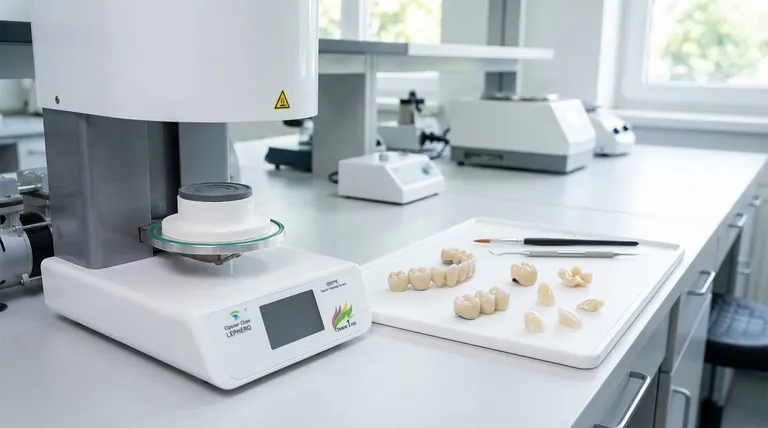
At its most fundamental level, a porcelain furnace is used to manufacture a wide range of indirect dental restorations. This includes fabricating all-ceramic and metal-ceramic crowns, bridges, veneers, inlays, and onlays, as well as applying custom stains and glazes to perfectly match a patient's natural teeth.
A porcelain furnace is more than just an oven; it is a precision instrument that transforms dental ceramics into strong, durable, and aesthetically superior restorations. Its true value lies in providing the control needed to mimic the form, function, and appearance of natural dentition.
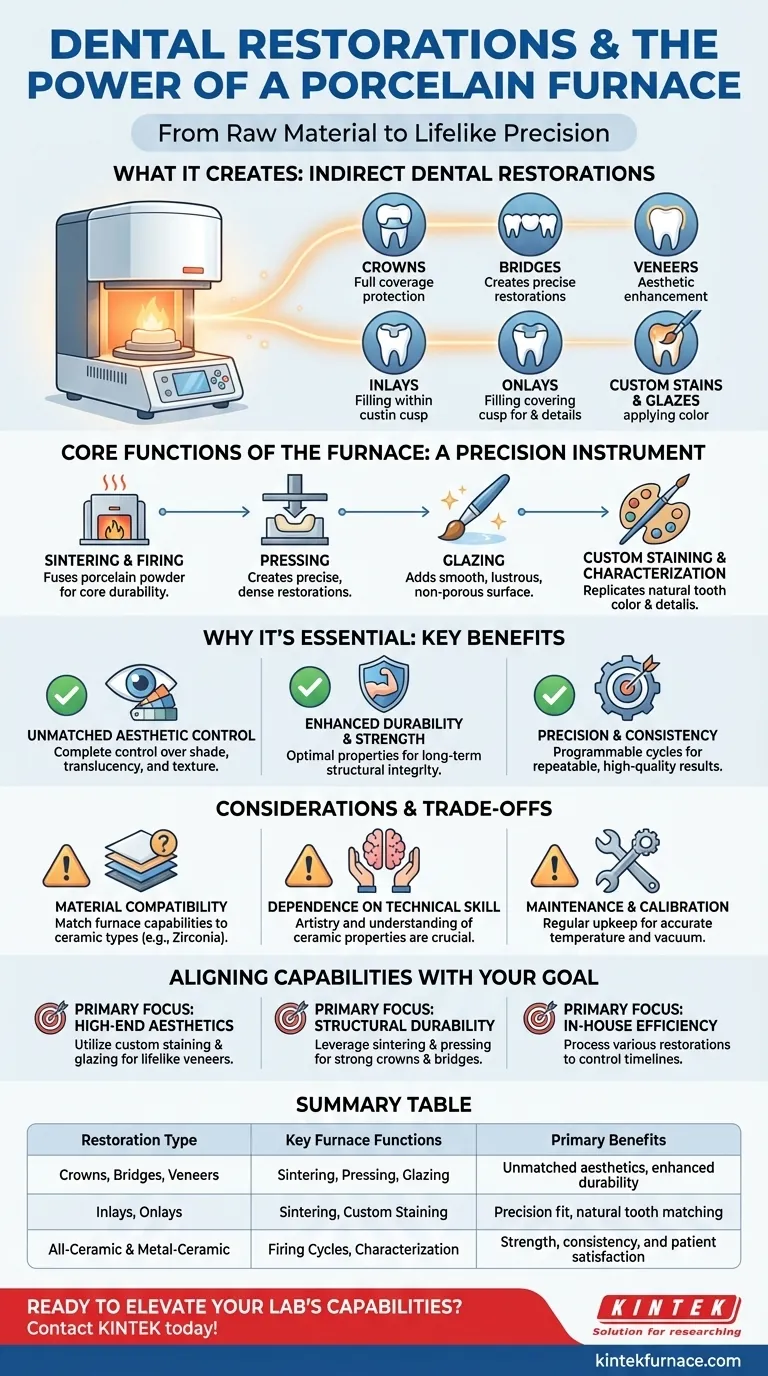
The Core Functions of a Porcelain Furnace
To understand what a furnace produces, you must first understand the key processes it performs. Each function is a critical step in achieving a final restoration that is both durable and lifelike.
Sintering and Firing
This is the primary function. Sintering heats porcelain powder to a specific temperature, causing the particles to fuse together without melting. This process is what hardens and strengthens the ceramic material, giving the final restoration its core durability.
Pressing
For certain types of ceramics, the furnace is used to press molten or softened ceramic material into a mold. This method is highly effective for creating incredibly precise and dense restorations like single crowns or veneers with an excellent fit.
Glazing
Glazing involves applying a thin layer of glass-like porcelain and firing it at a high temperature. This creates a smooth, non-porous, and lustrous surface on the restoration, which enhances its aesthetic appeal and helps prevent plaque accumulation.
Custom Staining and Characterization
A furnace allows a skilled technician to apply specific stains and fire them onto the restoration's surface. This is how the subtle color variations, translucency, and unique characteristics of a natural tooth are replicated, ensuring the restoration blends seamlessly.
Why a Furnace is Essential for Quality Restorations
The processes enabled by a porcelain furnace directly translate into tangible benefits for both the practitioner and the patient. It is the tool that bridges the gap between raw material and a high-quality clinical outcome.
Unmatched Aesthetic Control
The furnace gives the technician complete control over the final shade, translucency, and surface texture. This ability to customize is critical for anterior restorations like veneers and crowns, where a perfect match is paramount for patient satisfaction.
Enhanced Durability and Strength
Through precise sintering cycles, the furnace ensures that dental ceramics reach their optimal physical properties. This results in restorations like bridges and posterior crowns that are strong enough to withstand the forces of chewing over the long term.
Precision and Consistency
Modern porcelain furnaces offer programmable firing cycles, ensuring that every restoration is processed under ideal and repeatable conditions. This eliminates guesswork and leads to consistent, high-quality results from one case to the next.
Understanding the Trade-offs and Considerations
While indispensable, integrating a porcelain furnace requires a clear understanding of its operational realities.
Material Compatibility
Not all furnaces are designed to handle all types of dental ceramics. It is crucial to ensure the furnace's capabilities (e.g., temperature range, vacuum levels) match the specific materials you intend to use, such as feldspathic porcelain, lithium disilicate, or zirconia.
Dependence on Technical Skill
A porcelain furnace is a powerful tool, but its output is highly dependent on the skill of the operator. Achieving elite-level aesthetics requires a deep understanding of ceramic properties, firing schedules, and artistic layering techniques. It is not an automated, "push-button" solution for artistry.
Maintenance and Calibration
To ensure consistent and accurate results, a porcelain furnace requires regular maintenance and calibration. Temperature and vacuum accuracy can drift over time, which can compromise the quality and strength of the final restorations if not properly managed.
Aligning Furnace Capabilities with Your Goal
To make the right choice, consider how the furnace's capabilities align with your primary clinical or business objectives.
- If your primary focus is high-end aesthetics: The furnace's ability to handle custom staining, characterization, and glazing is your most valuable asset for creating lifelike veneers and anterior crowns.
- If your primary focus is structural durability: The furnace's precision in sintering and pressing is critical for producing strong, long-lasting crowns and multi-unit bridges that can withstand significant occlusal forces.
- If your primary focus is in-house efficiency: The versatility to process various restorations—from inlays and onlays to full crowns—allows you to control production timelines and reduce reliance on external labs.
Mastering the capabilities of a porcelain furnace is fundamental to delivering superior restorative outcomes for your patients.
Summary Table:
| Dental Restoration Type | Key Functions of Porcelain Furnace | Primary Benefits |
|---|---|---|
| Crowns, Bridges, Veneers | Sintering, Pressing, Glazing | Unmatched aesthetics, enhanced durability |
| Inlays, Onlays | Sintering, Custom Staining | Precision fit, natural tooth matching |
| All-Ceramic & Metal-Ceramic | Firing Cycles, Characterization | Strength, consistency, and patient satisfaction |
Ready to elevate your dental lab's capabilities? At KINTEK, we leverage exceptional R&D and in-house manufacturing to provide advanced high-temperature furnace solutions tailored for dental professionals. Our product line, including Muffle, Tube, Rotary Furnaces, Vacuum & Atmosphere Furnaces, and CVD/PECVD Systems, is complemented by strong deep customization capabilities to precisely meet your unique experimental and production needs. Whether you're focused on high-end aesthetics, structural durability, or in-house efficiency, our furnaces ensure superior results. Contact us today to discuss how we can enhance your restorative outcomes!
Visual Guide
Related Products
- Chairside Dental Porcelain Zirconia Sintering Furnace with Transformer for Ceramic Restorations
- Dental Porcelain Zirconia Sintering Ceramic Vacuum Press Furnace
- Vacuum Dental Porcelain Sintering Furnace for Dental Laboratories
- High Temperature Muffle Oven Furnace for Laboratory Debinding and Pre Sintering
- Spark Plasma Sintering SPS Furnace
People Also Ask
- What factors determine the quality of sintered zirconia restorations? Master Material, Equipment, and Technique
- How do conventional vs rapid sintering in dental furnaces affect zirconia? Optimize Efficiency Without Sacrificing Strength
- What industries use zirconia sintering furnaces? Beyond Dental and Jewelry Applications
- What type of heating elements are preferred for zirconia sintering and why? Choose SiC or MoSi2 for Optimal Results
- What are the key components of a zirconia sintering furnace? Unlock Precision for Superior Dental Restorations











