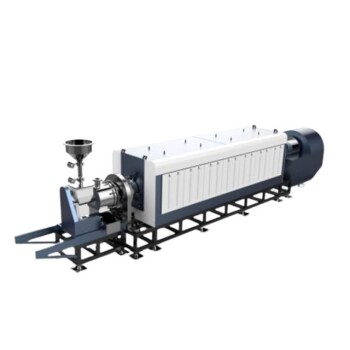
The programmable muffle furnace serves as the precision thermal reactor required to facilitate slow pyrolysis. It provides a strictly controlled, oxygen-limited environment where biomass is heated at specific rates—typically between 5°C and 30°C per minute—to target temperatures ranging from 350°C to over 700°C. This level of control ensures the complete thermochemical decomposition of raw materials into biochar with stable aromatic structures and tailored surface functional groups.
Core Takeaway: A programmable muffle furnace is essential for biochar production because it allows researchers to dictate the precise thermal kinetics and atmospheric conditions necessary to transform organic waste into a stable, porous carbon material with specific chemical properties.
Precision Control of Thermal Kinetics
Managing Heating Rates for Structural Integrity
In slow pyrolysis, the heating rate is a critical variable that determines the final quality of the biochar. Programmable furnaces allow for stable ramps, such as 15°C/min or 20°C/min, which prevent the rapid "flashing" of volatile matter that could compromise the material's structural integrity.
Target Temperature Maintenance
The ability to accurately maintain a soak temperature (e.g., 450°C or 600°C) is vital for ensuring full carbonization. This precise thermal stability allows the biomass to undergo complete conversion, resulting in a stable aromatic structure that resists biological degradation.
Programmable Step-Heating
Programmability enables complex heating profiles that can include multiple stages of temperature increases and dwell times. This flexibility is necessary to remove moisture and volatile organic compounds (VOCs) gradually before the final carbonization phase begins.
Creating the Necessary Chemical Environment
Facilitating Oxygen-Limited Conditions
The muffle furnace provides a sealed or controlled environment essential for anaerobic decomposition. By limiting oxygen, the furnace prevents the biomass from combusting into ash, instead facilitating the thermal breakdown required for biochar formation.
Integration of Inert Atmospheres
Most high-quality biochar production involves a nitrogen-protected atmosphere or a continuous flow of inert gas within the furnace. This prevents material oxidation at high temperatures and ensures that the resulting biochar retains its active functional groups and carbon content.
Removal of Volatile Components
High-temperature processing within the furnace triggers the release of syngas and bio-oils from the raw biomass. This process leaves behind a solid carbonaceous residue that serves as the physical foundation for subsequent chemical or physical modifications.
Shaping Physicochemical Properties
Developing Porosity and Surface Area
The furnace’s high-temperature environment directly influences the pore structure formation of the biochar. Specific temperatures, such as 725°C, are often used to maximize the specific surface area and porosity, which are critical for the biochar's performance as an adsorbent.
Preserving Surface Functional Groups
Programmable control allows for lower-temperature pyrolysis (e.g., 350°C) to prevent the over-destruction of acidic functional groups like phenolic and carboxylic groups. This is essential for producing biochar with a high cation exchange capacity (CEC), which is ideal for soil amendment applications.
Stabilizing Chemical Properties
The extreme heat provided by the furnace facilitates the reduction of ions and stabilizes the chemical properties of the material. This creates a biochar that is not only chemically active but also physically durable enough for long-term environmental use.
Understanding the Trade-offs
Temperature vs. Functional Group Density
Higher furnace temperatures generally increase the surface area and carbon content of the biochar but can destroy sensitive surface functional groups. Conversely, lower temperatures preserve these groups and maintain a higher yield but result in a less developed pore structure.
Heating Rate vs. Yield
Faster heating rates within the furnace can lead to higher gas yields but lower biochar yields. Precision programming is required to find the "sweet spot" where the heating rate is slow enough to maximize solid biochar production without extending the process time unnecessarily.
Atmosphere Control Challenges
While muffle furnaces provide a controlled environment, maintaining a perfectly anaerobic state requires meticulous sealing and consistent gas flow. Any oxygen leakage at high temperatures can cause partial combustion, leading to inconsistent biochar quality and high ash content.
How to Apply This to Your Project
Recommendations Based on Your Goal
- If your primary focus is heavy metal adsorption: Utilize higher temperatures (600°C - 725°C) to maximize the pore structure and specific surface area for physical trapping.
- If your primary focus is soil amendment for alkaline soils: Use a lower, precisely controlled temperature (around 350°C) and a gradual heating rate (8-9°C/min) to preserve acidic functional groups and maintain a near-neutral pH.
- If your primary focus is maximum biochar yield: Implement a slow heating rate (under 15°C/min) to allow for the gradual release of volatiles and the stabilization of the carbon skeleton.
- If your primary focus is industrial scalability: Focus on programming the furnace for repeatable "batch" cycles to ensure consistency across different runs of the same biomass material.
By leveraging the precision of a programmable muffle furnace, you can move beyond simple carbonization to the intentional engineering of biochar properties.
Summary Table:
| Parameter | Role in Pyrolysis Process | Impact on Biochar Properties |
|---|---|---|
| Heating Rate | Manages volatile release (5–30°C/min) | Preserves structural integrity and solid yield |
| Soak Temperature | Ensures complete thermochemical breakdown | Determines pore structure and surface area |
| Atmosphere | Maintains anaerobic/inert conditions | Prevents combustion and preserves carbon content |
| Programmability | Executes multi-stage heating profiles | Tailors functional groups and cation exchange capacity |
Elevate Your Biochar Research with KINTEK Precision
Unlock the full potential of your pyrolysis process with KINTEK, your specialist in high-performance laboratory equipment and consumables. We provide a comprehensive range of high-temperature furnaces designed to meet the rigorous demands of material science, including:
- Muffle & Tube Furnaces for precise atmosphere control.
- Rotary & Vacuum Furnaces for uniform processing.
- CVD & Atmosphere Furnaces for advanced chemical synthesis.
- Dental & Induction Melting Furnaces for specialized applications.
All our systems are fully customizable to match your unique research parameters, ensuring consistent thermal kinetics and repeatable results. Whether you are optimizing heavy metal adsorption or engineering soil amendments, KINTEK delivers the reliability you need.
Ready to refine your thermal processing? Contact us today to find your ideal furnace solution!
References
- Meng Lai, Ling Zhang. Biochar Applied in Places Where Its Feedstock Was Produced Mitigated More CO2 Emissions from Acidic Red Soils. DOI: 10.3390/agronomy14102193
This article is also based on technical information from Kintek Furnace Knowledge Base .
Related Products
- Laboratory Muffle Oven Furnace with Bottom Lifting
- 1400℃ Muffle Oven Furnace for Laboratory
- High Temperature Muffle Oven Furnace for Laboratory Debinding and Pre Sintering
- 1200℃ Muffle Oven Furnace for Laboratory
- Electric Rotary Kiln Continuous Working Small Rotary Furnace Kiln for Pyrolysis Plant Heating
People Also Ask
- What function does a muffle furnace perform in Ba0.75Ca0.25TiO3 calcination? Ensure Phase Purity & Synthesis
- What is the importance of the calcination process? Master High-Purity Calcium Phosphate Nanopowder Production
- Why is a high-temperature laboratory muffle furnace essential for the alkali fusion process in zeolite synthesis?
- Why is a high-temperature muffle furnace required for FeOx-MOx/TiO2? Engineering High-Performance Nanocomposites
- What are the primary functions of a high-temperature laboratory muffle furnace in the preparation of biosorbent materials?