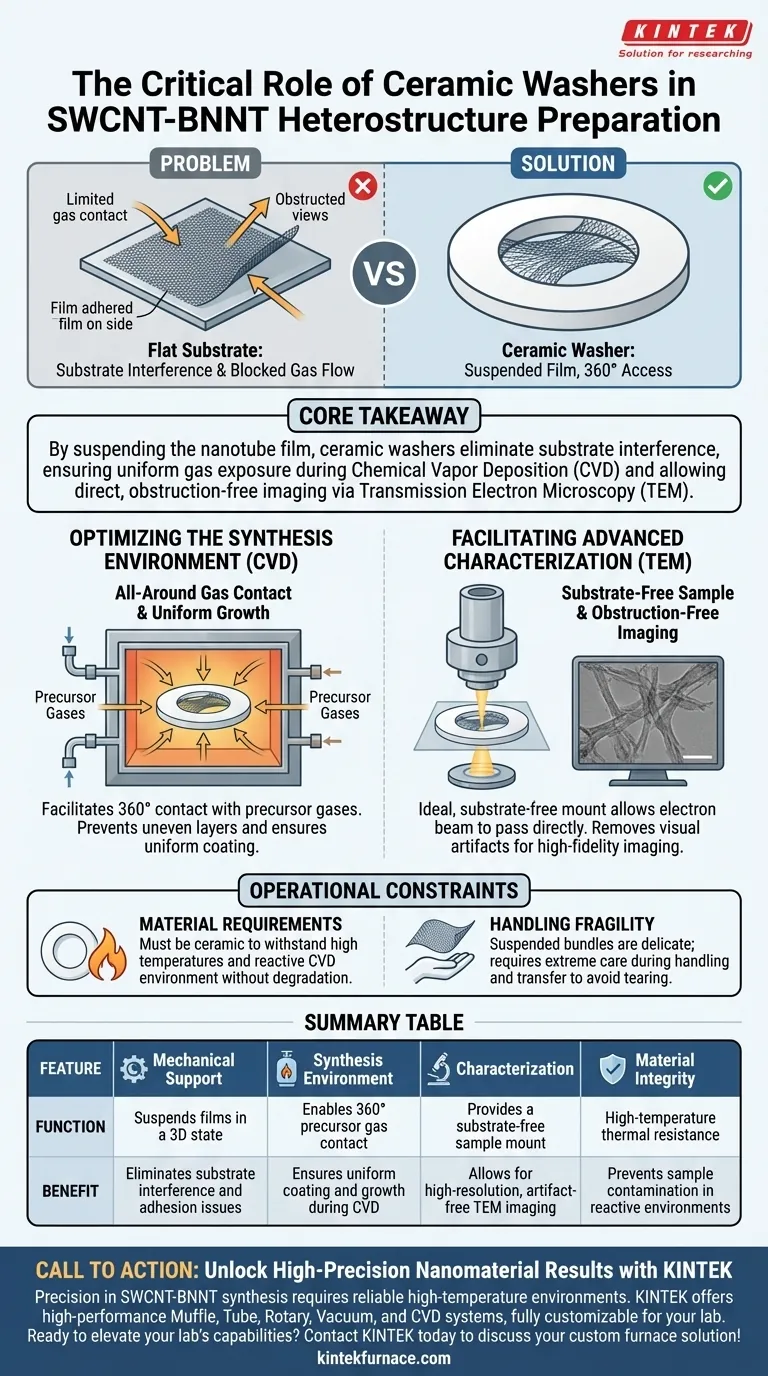
Ceramic washers serve as critical mechanical supports that hold Single-Walled Carbon Nanotube-Boron Nitride Nanotube (SWCNT-BNNT) films in a suspended state. By mounting the film on the washer, you ensure the nanotube bundles remain elevated rather than adhered to a solid backing, which fundamentally alters both the synthesis quality and the ability to characterize the material.
Core Takeaway By suspending the nanotube film, ceramic washers eliminate substrate interference during both synthesis and analysis. This configuration ensures uniform gas exposure during Chemical Vapor Deposition (CVD) and allows for direct, obstruction-free imaging via Transmission Electron Microscopy (TEM).
Optimizing the Synthesis Environment
To understand the value of the ceramic washer, you must look at how it improves the Chemical Vapor Deposition (CVD) process.
Enabling All-Around Gas Contact
When a nanotube film is placed on a solid substrate, one side is blocked from the reaction.
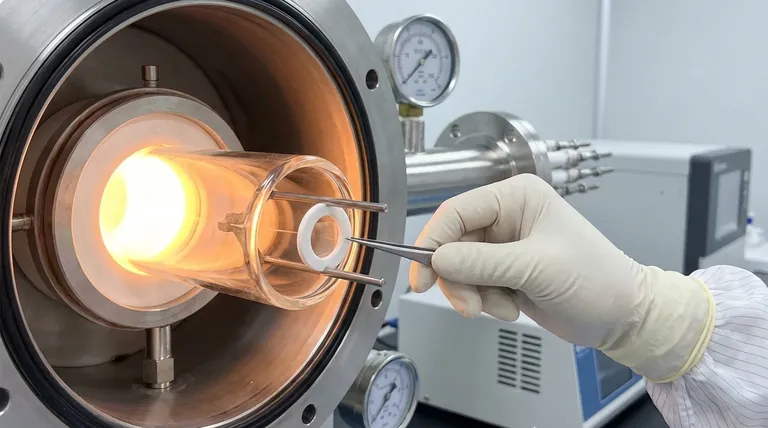
The ceramic washer suspends the SWCNT-BNNT film, exposing it fully to the environment. This facilitates all-around contact with precursor gases during the CVD process.
Ensuring Uniform Growth
Because the precursor gases can access the nanotube bundles from all directions, the coating or growth process is more uniform.
This prevents the formation of uneven layers that typically occur when a sample is shielded by a flat substrate.
Facilitating Advanced Characterization
Beyond synthesis, the ceramic washer acts as a specialized mount for high-resolution imaging.
Creating a Substrate-Free Sample
Transmission Electron Microscopy (TEM) works best when the electron beam passes through the sample without resistance.
Standard substrates can scatter the beam or create background noise. The ceramic washer provides an ideal, substrate-free sample, allowing the beam to pass directly through the suspended nanotubes.
Removing Observation Interference
Direct observation is critical for verifying the structure of heterostructures.
By using the washer to suspend the film, researchers can observe the SWCNT-BNNT bundles without the visual interference or artifacts caused by underlying support materials.
Understanding the Operational Constraints
While the ceramic washer offers significant advantages, it introduces specific operational considerations.
Material Requirements
The washer must be ceramic rather than metal or plastic.
This is because the support structure must withstand the high temperatures and reactive environment of the CVD process without degrading or contaminating the sample.
Handling Fragility
Suspending a nanotube film makes it mechanically more vulnerable than a film supported by a solid silicon wafer.
While the washer provides a frame, the suspended bundles themselves are delicate. Great care is required during handling and transfer to the microscope to avoid tearing the suspended film.
Making the Right Choice for Your Goal
The use of ceramic washers is a strategic choice depending on whether your priority is structural uniformity or imaging clarity.
- If your primary focus is Synthesis Quality: The washer is essential for ensuring precursor gases reach the entire surface area of the nanotubes for uniform coating.
- If your primary focus is Characterization: The washer is the most effective tool for generating substrate-free samples required for high-fidelity TEM imaging.
Ultimately, the ceramic washer transforms the sample from a flat, supported film into a suspended 3D structure, unlocking both uniform growth and artifact-free observation.
Summary Table:
| Feature | Function of Ceramic Washer | Benefit to Research |
|---|---|---|
| Mechanical Support | Suspends films in a 3D state | Eliminates substrate interference and adhesion issues |
| Synthesis Environment | Enables 360-degree precursor gas contact | Ensures uniform coating and growth during CVD |
| Characterization | Provides a substrate-free sample mount | Allows for high-resolution, artifact-free TEM imaging |
| Material Integrity | High-temperature thermal resistance | Prevents sample contamination in reactive environments |
Unlock High-Precision Nanomaterial Results with KINTEK
Precision in SWCNT-BNNT synthesis requires reliable high-temperature environments and specialized equipment. Backed by expert R&D and world-class manufacturing, KINTEK offers high-performance Muffle, Tube, Rotary, Vacuum, and CVD systems, all fully customizable to meet your unique laboratory needs.
Whether you are scaling up 1D heterostructure production or optimizing characterization quality, our specialized furnaces provide the thermal stability essential for sensitive ceramic-supported processes.
Ready to elevate your lab’s capabilities? Contact KINTEK today to discuss your custom furnace solution!
Visual Guide
References
- Chunxia Yang, Rong Xiang. Janus MoSSe Nanotubes on 1D SWCNT‐BNNT van der Waals Heterostructure. DOI: 10.1002/smll.202412454
This article is also based on technical information from Kintek Furnace Knowledge Base .
Related Products
- Custom Made Versatile CVD Tube Furnace Chemical Vapor Deposition CVD Equipment Machine
- Split Chamber CVD Tube Furnace with Vacuum Station CVD Machine
- Multi Heating Zones CVD Tube Furnace Machine for Chemical Vapor Deposition Equipment
- Slide PECVD Tube Furnace with Liquid Gasifier PECVD Machine
- Inclined Rotary Plasma Enhanced Chemical Deposition PECVD Tube Furnace Machine
People Also Ask
- Why are CVD tube furnace sintering systems indispensable for 2D material research and production? Unlock Atomic-Scale Precision
- What is a CVD tube furnace and what is its primary function? Discover Precision Thin-Film Deposition
- Which industries and research fields benefit from CVD tube furnace sintering systems for 2D materials? Unlock Next-Gen Tech Innovations
- How does CVD tube furnace sintering enhance graphene growth? Achieve Superior Crystallinity and High Electron Mobility
- What customization options are available for CVD tube furnaces? Tailor Your System for Superior Material Synthesis