The answer lies in a single, mathematically elegant relationship between porosity and strength. Green's yield condition is a theoretical criterion that predicts when a porous metal will begin to plastically deform. It defines the yield strength of the porous compact ($\sigma_{po}$) as a function of the solid metal's yield strength ($\sigma^{po}$) and the pore volume fraction ($\eta$), typically expressed as $\sigma{po} = \frac{3(1-\eta^{1/3})}{3-2\eta^{1/4}} \sigma^_{po}$. In the context of atmosphere or vacuum furnace sintering, this model becomes a practical map—it allows you to correlate thermal cycles, dwell times, and applied pressures with the evolving porosity, and thus predict the structural integrity of the final sintered part.
Green's yield condition bridges the gap between theoretical powder metallurgy and industrial sintering. It provides the fundamental stress-porosity envelope that governs densification. By using it to model how pores collapse under thermal and mechanical driving forces, engineers can reverse-engineer the exact furnace parameters needed to achieve target density and load-bearing capacity, while clearly understanding the idealized assumptions that limit its absolute accuracy.
The Mechanics of Green’s Yield Criterion
The Core Equation and Its Variables
Green’s model starts with a rigid-plastic, isotropic matrix that follows the von Mises yield criterion.
The key variable is porosity ($\eta$)—the volume fraction of uniformly distributed spherical pores.
The equation directly links the yield strength of the porous body to that of the fully dense metal. As porosity increases, the available load-bearing cross-section shrinks, so $\sigma_{po}$ drops sharply.
From Pores to Stress Invariants
The model is not limited to uniaxial loading. It defines an elliptical yield surface in stress-invariant space.
For spherical shells under hydrostatic compression or shear, the condition connects the mean stress and deviatoric stress to the void volume fraction.
This is critical: it predicts that even pure hydrostatic pressure can cause yielding. That is the exact mechanism exploited in hot isostatic pressing (HIP) and atmosphere furnaces to close internal pores without shape distortion.
How Green’s Condition Assists in Furnace Sintering Analysis
Linking Porosity Evolution to Thermal Cycles
Sintering is a time-temperature-dependent pore-closure process. Green’s yield condition provides the termination point for that closure—the stress level at which the porous skeleton becomes plastic.
In a vacuum or hydrogen-atmosphere furnace, the sintering driving force (capillary stress) acts like a hydrostatic tension on the pores.
By inputting the current porosity into the model, you can calculate the strength of the porous body at any stage. This tells you whether the thermal energy available is sufficient to exceed the local yield point and continue densification.
Predicting Final Load-Bearing Capacity
The equation is a direct predictor of the sintered part’s structural integrity. Once you know the final porosity achieved from a furnace run, you can immediately calculate $\sigma_{po}$.
For example, reducing $\eta$ from 10% to 2% yields a disproportionately large strength gain because the stress-bearing fraction of the matrix increases non-linearly.
Engineers use this to set acceptance criteria: if a part requires a minimum service strength, Green’s condition tells you the maximum permissible porosity after sintering.
Accounting for Atmosphere and Pressure Effects
Atmosphere furnaces apply a gas pressure, and vacuum furnaces apply a negative pressure relative to the pore interior. Both impose a net hydrostatic compressive load on the compact.
Using the spherical-shell formulation of Green’s model, you can calculate the exact pressure needed to plastically collapse pores of a given size and volume fraction.
This turns the furnace pressure setting from a guess into a calculated parameter. For a target final density, the model specifies the minimum pressure and temperature combination that will trigger yield and accelerate densification.
Understanding the Trade-offs
Idealized Assumptions vs. Real Powder Compacts
Green assumes perfectly spherical, isolated pores in a homogeneous matrix. Real metal compacts have irregular, interconnected porosity with angular particles.
The model treats the matrix as rigid-plastic, ignoring work-hardening and creep. Yet furnace sintering often relies on diffusion and creep mechanisms, especially at high temperatures.
No initial coordination number effects are included. As your supplementary reference highlights, the initial green density—determined by the number of particle contact points—dominates the final achievable density, a factor that Green’s model does not explicitly capture.
Where Green’s Model Deviates from Experiment
Experimental data often show a slower strength decline at low porosities than Green predicts. The pore shape and neck geometry create a more efficient load transfer than the spherical-void assumption allows.
The modified energy condition (Kuhn-Downey model) frequently aligns better with measured yield strength ratios. Green’s condition still serves as a valuable upper-bound estimate, but for precision process control, experimental calibration against a specific powder is essential.
Making the Right Choice for Your Sintering Process
Use Green’s yield condition as a strategic lens, not a blind prescription. Your specific goal determines how to apply it.
- If your primary focus is designing a robust furnace thermal cycle: Use Green’s model to calculate the decreasing yield strength as porosity drops, then set dwell temperatures and times that ensure the sintering stress consistently exceeds that threshold.
- If your primary focus is predicting the final mechanical strength of a sintered compact: Input your target porosity into the Green equation to estimate the maximum load your component can bear, then cross-validate with physical samples to account for pore morphology effects.
- If your primary focus is optimizing initial green compact density: Recognize that Green’s condition only applies after pores are present; combine it with the understanding that higher initial density (fewer initial pores) means your furnace cycle has less work to do, and the final strength will land at a higher point on the Green curve.
- If your primary focus is setting atmosphere or vacuum pressure for pore closure: Use the hydrostatic yield prediction from Green’s spherical-shell analysis to compute the minimum furnace pressure required to collapse pores of a given fraction, and add a safety margin for irregular pore geometries.
A predictive model in hand turns sintering from a black art into a repeatable science. Let Green’s yield condition guide your furnace parameters, but always temper theory with a sample run—because real powder particles rarely read the textbook.
Summary Table:
| Aspect | Core Concept | Impact on Atmosphere & Vacuum Sintering |
|---|---|---|
| Mathematical Basis | Yield strength ($\sigma_{po}$) depends on matrix strength ($\sigma^*_{po}$) & porosity ($\eta$) | Calculates theoretical load capacity at any stage of densification |
| Hydrostatic Yielding | Spherical-shell deformation under plastic hydrostatic compression | Determines exact gas or vacuum pressure needed for plastic pore collapse |
| Thermal Cycle Control | Links pore reduction driving forces to matrix plasticity thresholds | Optimizes furnace dwell time and temperature to reach target density |
| Practical Constraints | Assumes ideal spherical pores & rigid-plastic matrix without creep | Requires physical sample validation to adjust for irregular powder shapes |
Master Precision Powder Metallurgy with KINTEK Sintering Solutions
Translating theoretical models like Green's yield condition into predictable real-world results requires absolute control over furnace temperature, pressure, and atmosphere. At KINTEK, we supply high-performance laboratory equipment and consumables tailored for powder metallurgy researchers and material scientists.
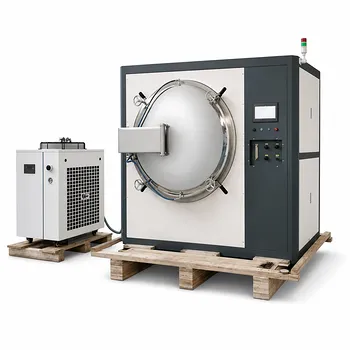
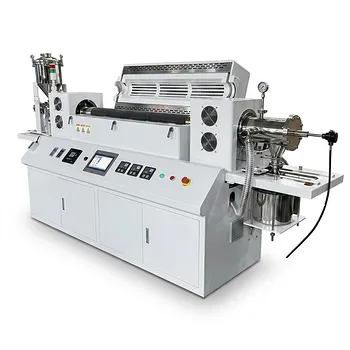
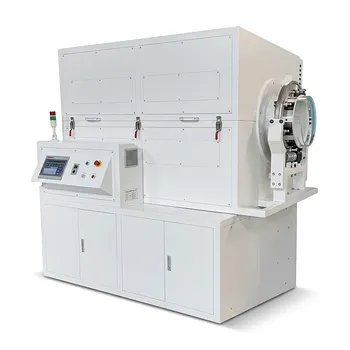
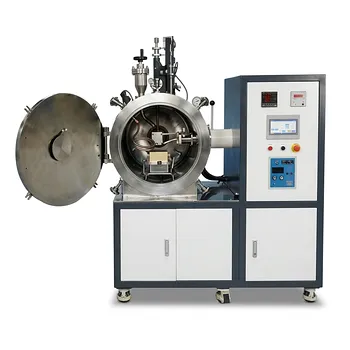
From high-vacuum and controlled atmosphere furnaces to specialized tube, muffle, rotary, CVD, dental, and induction melting furnaces, all our systems are fully customizable to meet your exact heating profiles and sintering demands.
Ready to eliminate process guesswork and achieve target compact densities? Contact KINTEK today to discover how our advanced high-temperature equipment can elevate your lab's capabilities!
Related Products
- 1400℃ Controlled Inert Nitrogen Atmosphere Furnace
- 9MPa Air Pressure Vacuum Heat Treat and Sintering Furnace
- 2200 ℃ Tungsten Vacuum Heat Treat and Sintering Furnace
- 1200℃ Controlled Inert Nitrogen Atmosphere Furnace
- Mesh Belt Controlled Atmosphere Furnace Inert Nitrogen Atmosphere Furnace
People Also Ask
- How does nitrogen atmosphere control in high-temperature furnaces prevent the decomposition of silicon nitride during sintering?
- How does oxygen partial pressure control affect ceramic sintering? Master Defect Chemistry
- Why is thorough binder burnout necessary before sintering advanced ceramics? Ensure Peak Density & Zero Defects
- Why is controlled-atmosphere heating required for functional ceramics and sensors? Master Defect Engineering
- How do controlled-atmosphere furnaces support polymer pyrolysis? Master SiC & Si3N4 Ceramic Conversion