
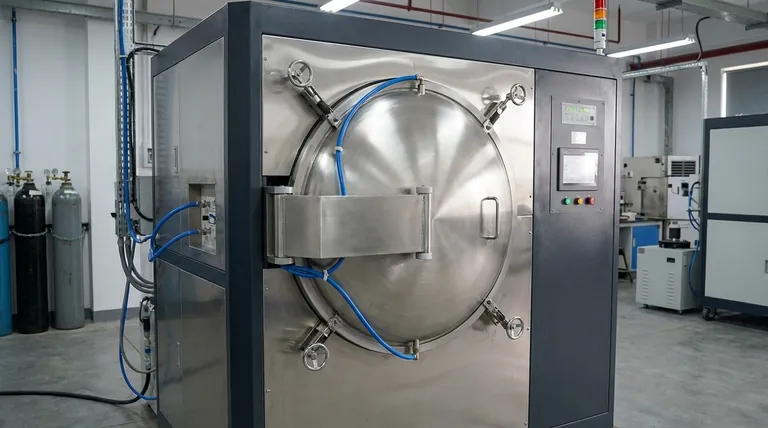
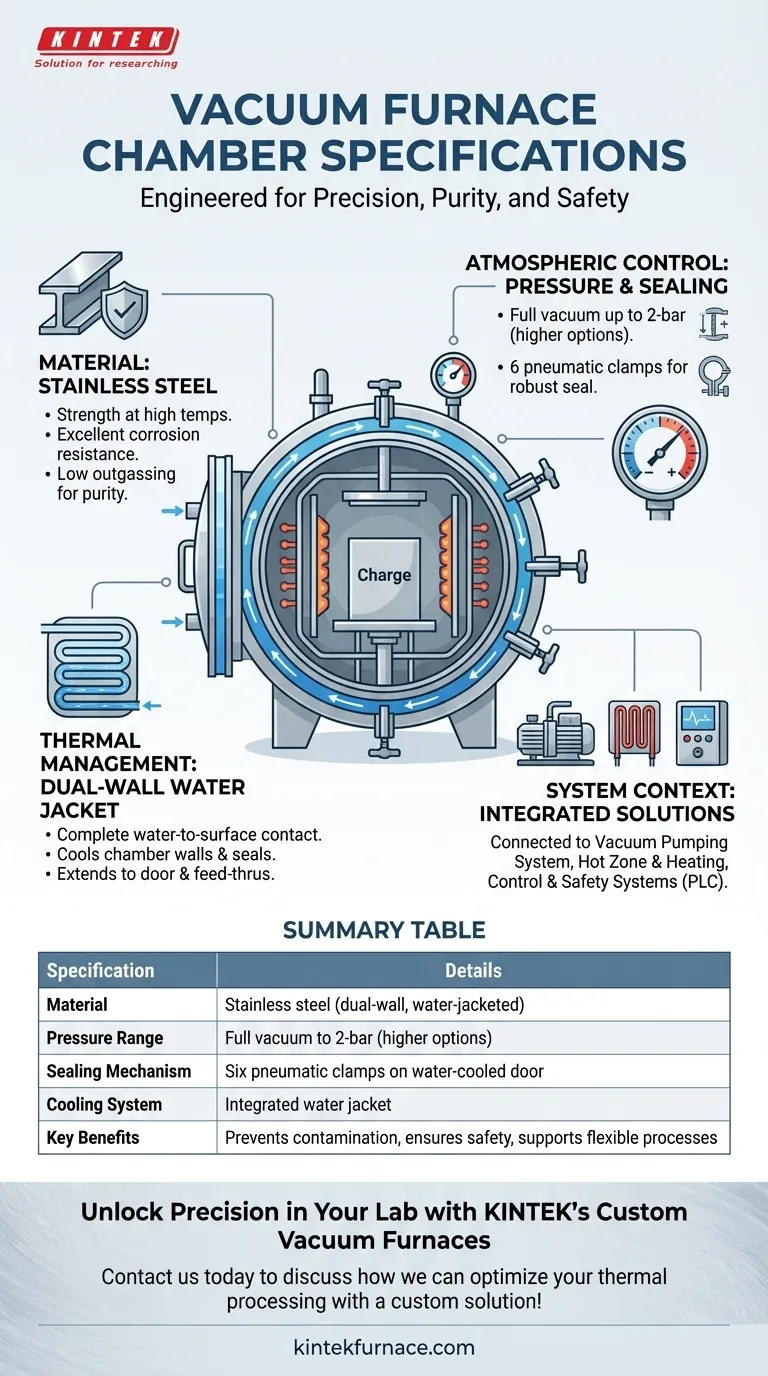
In summary, the vacuum furnace chamber is a dual-wall, water-jacketed vessel constructed entirely of stainless steel. It features a water-cooled door secured by six pneumatic clamps and is engineered to operate at pressures ranging from a full vacuum up to 2-bar, with options for higher pressures. The design prioritizes thermal management and atmospheric integrity to prevent contamination and ensure process safety.
The design of a vacuum furnace chamber is a deliberate exercise in control. Every feature, from the material choice to the cooling system, is engineered to isolate a high-temperature process from the outside world, ensuring the purity and integrity of the materials being treated.
Deconstructing the Chamber's Design
The chamber is the heart of the vacuum furnace, acting as a controlled environment. Its specifications are not arbitrary; they are directly tied to its function of withstanding extreme temperatures and pressure differentials while preventing contamination.
Material Selection: The Role of Stainless Steel
The entire chamber, including the door and water-jacketing, is built from stainless steel. This material is chosen for its strength at high temperatures and its excellent corrosion resistance.
More importantly, stainless steel is a preferred material for high-vacuum applications because it does not readily release trapped gases (outgassing), which would otherwise contaminate the vacuum environment and compromise the process.
Thermal Management: The Dual-Wall Water Jacket
The chamber features a dual-wall construction designed for complete water-to-surface contact. This water jacket is the furnace's primary cooling system.
While the interior "hot zone" reaches extreme temperatures, the circulating water keeps the chamber's structural walls cool. This prevents the steel from weakening, protects vacuum seals from failing, and ensures the safety of the operators and surrounding equipment.
This integrated cooling extends to the door and power feed-thrus, preventing any potential water leaks from entering the pristine vacuum environment.
Atmospheric Control: Pressure and Sealing
The chamber is designed to operate from a full vacuum up to a 2-bar positive pressure. This dual capability is critical for modern metallurgical processes.
A robust seal is essential. The system uses six clamp-over-center pneumatic clamps to lock the door. This mechanism provides the immense, evenly distributed force needed to maintain an airtight seal against both internal pressure and the powerful force of an external atmosphere during vacuum operation.
The Chamber's Core Function
Ultimately, the chamber is the vessel that houses the critical process components. Inside, you will find the heating elements (like graphite tubes), the thermal insulation (carbon felt), and the charge, which is the material being heat-treated. The chamber's job is to protect this entire process from the outside atmosphere.
Understanding the System Context
The chamber, while central, does not operate in isolation. It is one component in a larger, integrated system, and its design is dependent on the function of these other parts.
The Vacuum Pumping System
A dedicated vacuum system, composed of various pumps and valves, is responsible for evacuating the air from the chamber. The chamber's robust construction and tight seals are what allow this system to achieve and maintain the required low pressures.
The Hot Zone and Heating System
The heating elements and insulation located inside the chamber create the high-temperature environment. The chamber's cooling system works to contain this intense heat, protecting the vessel itself from the process it encloses.
The Control and Safety Systems
A programmable logic controller (PLC) and touch-panel interface manage every aspect of the furnace's operation. This includes controlling temperature ramps, vacuum set points, and gas backfills. The chamber's physical integrity is the foundation upon which these precise digital controls can reliably execute a process.
Key Takeaways for Evaluation
When assessing this or any vacuum furnace, understanding the chamber specifications allows you to match the equipment to your specific goals.
- If your primary focus is process purity: The all-stainless steel construction and high-vacuum design are engineered specifically to prevent atmospheric contamination of your materials.
- If your primary focus is operational safety: The comprehensive dual-wall water cooling for the chamber, door, and feed-thrus is the most critical feature for preventing structural failure and ensuring system reliability.
- If your primary focus is process flexibility: The ability to operate from a full vacuum to 2-bar positive pressure allows for a wide range of processes, from simple degassing to complex gas quenching and carburizing.
Ultimately, the chamber's specifications define its capacity to create and sustain a precisely controlled environment for high-value thermal processing.
Summary Table:
| Specification | Details |
|---|---|
| Material | Stainless steel (dual-wall, water-jacketed) |
| Pressure Range | Full vacuum up to 2-bar (higher options available) |
| Sealing Mechanism | Six pneumatic clamps on water-cooled door |
| Cooling System | Integrated water jacket for thermal management |
| Key Benefits | Prevents contamination, ensures safety, supports flexible processes |
Unlock Precision in Your Lab with KINTEK's Custom Vacuum Furnaces
Leveraging exceptional R&D and in-house manufacturing, KINTEK provides diverse laboratories with advanced high-temperature furnace solutions. Our product line, including Muffle, Tube, Rotary Furnaces, Vacuum & Atmosphere Furnaces, and CVD/PECVD Systems, is complemented by our strong deep customization capability to precisely meet unique experimental requirements. Whether you need enhanced purity, safety, or process flexibility, our vacuum furnace chambers deliver reliable performance tailored to your goals.
Contact us today to discuss how we can optimize your thermal processing with a custom solution!
Visual Guide
Related Products
- Split Chamber CVD Tube Furnace with Vacuum Station CVD Machine
- Vacuum Hot Press Furnace Machine Heated Vacuum Press Tube Furnace
- High Pressure Laboratory Vacuum Tube Furnace
- Small Vacuum Heat Treat and Tungsten Wire Sintering Furnace
- Vacuum Hot Press Furnace Machine Heated Vacuum Press
People Also Ask
- What role does a Tube Furnace play in the CVD growth of carbon nanotubes? Achieve High-Purity CNT Synthesis
- What are the operational and maintenance requirements for a CVD tube furnace? Ensure Precision for Thin Film Deposition
- What are the advantages of using a CVD tube furnace for preparing gate dielectrics? Achieve High-Quality Thin Films for Transistors
- How does a CVD tube furnace achieve high purity in gate media preparation? Master Precision Control for Flawless Films
- What improvements can be made to the bonding force of gate dielectric films using a CVD tube furnace? Enhance Adhesion for Reliable Devices



















