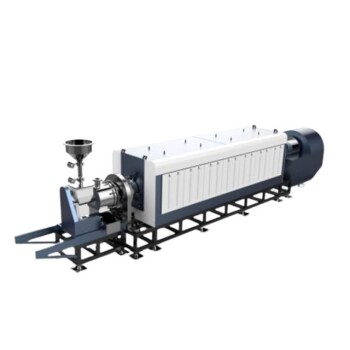
The universal SHS reactor functions as a precision-controlled pressure vessel that enables the rapid, self-sustaining synthesis of complex composite powders. By utilizing a high-pressure argon atmosphere and specialized ignition systems, the reactor facilitates the magnesiothermic reduction required to produce ZrSi2–MoSi2–ZrB2. It manages the extreme thermal energy of the reaction while preventing the loss of volatile components, ensuring a high-purity final product.
The universal SHS reactor's primary value lies in its ability to maintain a stable combustion wave under high pressure, which prevents material volatilization and ensures the uniform formation of the ZrSi2–MoSi2–ZrB2 composite through controlled, self-propagating energy.
The Role of Controlled Atmospheric Pressure
Suppressing Component Volatilization
The 8-liter reaction chamber is pressurized with high-purity argon at 3 MPa. This high-pressure environment is critical because it effectively suppresses the evaporation of volatile components during the intense heat of the synthesis process.
Stabilization of the Combustion Wave
A consistent pressure environment ensures that the combustion wave moves uniformly through the material layer. This stability is vital for achieving a homogenous phase distribution and preventing structural defects in the resulting composite powders.
Safety through Real-Time Monitoring
The reactor is equipped with a pressure monitoring system that records real-time changes throughout the synthesis. This system ensures safety during the rapid energy release and provides the data necessary to guarantee repeatability across different production batches.
Ignition and Propagation Mechanisms
Localized Initiation via Tungsten Coils
Tungsten wire coils serve as the primary ignition source, generating the instantaneous heat required to trigger the local exothermic reaction. By applying electricity to these coils, the reactor initiates the synthesis at a specific point within the material layer.
Self-Sustaining Combustion Propagation
Once ignited, the reaction becomes self-propagating, meaning the heat generated by the initial exothermic reaction is sufficient to drive the process through the remaining material. This allows the synthesis of ZrSi2–MoSi2–ZrB2 to be completed in a matter of seconds without continuous external heating.
Material Containment and Process Integrity
Use of High-Purity Graphite Carriers
The reactor utilizes high-purity graphite containers to hold the precursors during the reaction. These containers are specifically chosen for their ability to withstand extreme, instantaneous temperatures without reacting with the materials being synthesized.
Magnesiothermic Reduction Environment
The reactor is designed to facilitate the magnesiothermic reduction process, which is the chemical driver for forming these specific composites. The combination of chemical reduction and high-pressure containment allows for the efficient production of complex multi-phase powders.
Understanding the Trade-offs
Energy Intensity vs. Reaction Speed
While the SHS process is incredibly fast and efficient once started, the initial energy pulse required for ignition is substantial. This requires robust electrical infrastructure and reactor components capable of handling sudden thermal shocks.
Pressure Constraints and Scalability
Maintaining a constant 3 MPa pressure in an 8-liter chamber is manageable, but scaling this process to larger volumes introduces significant engineering challenges. As the reactor size increases, the mechanical stress on seals and chamber walls requires increasingly expensive and heavy-duty materials.
Optimizing SHS for Composite Synthesis
To achieve the best results with a universal SHS reactor, your approach should depend on your specific production requirements:
- If your primary focus is phase purity: Prioritize the use of high-purity graphite containers and inert argon gas to eliminate contamination and minimize the volatilization of reactants.
- If your primary focus is process repeatability: Ensure the real-time pressure monitoring system is meticulously calibrated to capture and analyze the dynamics of the combustion wave.
- If your primary focus is energy efficiency: Optimize the precursor mixture to maximize the exothermic heat release, ensuring the reaction sustains itself with the minimum possible ignition energy.
By mastering the balance of pressure, ignition, and containment, the universal SHS reactor provides a definitive path toward high-quality composite powder production.
Summary Table:
| Feature | Function | Benefit |
|---|---|---|
| 3 MPa Argon Atmosphere | Prevents component evaporation | Ensures high-purity final product |
| Tungsten Ignition Coils | Triggers exothermic reaction | Rapid, seconds-long synthesis |
| Graphite Containers | Withstands extreme heat | Prevents material contamination |
| Pressure Monitoring | Real-time data tracking | Guaranteed batch repeatability |
Optimize Your High-Temperature Synthesis with KINTEK
Achieving precision in composite synthesis requires more than just a reaction—it requires the right environment. KINTEK specializes in high-performance laboratory equipment and consumables designed for the most demanding thermal processes. From muffle, tube, and rotary furnaces to advanced vacuum, CVD, and atmosphere systems, our high-temperature solutions are fully customizable to your research needs.
Whether you are working on induction melting or dental applications, our experts are ready to help you enhance your lab's efficiency and product quality. Contact us today to explore our full range of solutions.
References
- A. N. Astapov, M. V. Prokofiev. HEAT-RESISTANT COATINGS FORMED FROM SHS POWDER OF THE ZrSi2–MoSi2–ZrB2 SYSTEM FOR CARBON COMPOSITES. DOI: 10.24411/9999-014a-2019-10014
This article is also based on technical information from Kintek Furnace Knowledge Base .
Related Products
- Controlled Inert Nitrogen Hydrogen Atmosphere Furnace
- Laboratory Quartz Tube Furnace RTP Heating Tubular Furnace
- High Pressure Laboratory Vacuum Tube Furnace
- Electric Rotary Kiln Small Rotary Furnace Biomass Pyrolysis Plant Rotating Furnace
- 915MHz MPCVD Diamond Machine Microwave Plasma Chemical Vapor Deposition System Reactor
People Also Ask
- How does hydrogen furnace annealing assist in preparing mechanically alloyed powders for compaction?
- How does atmospheric annealing in a controlled hydrogen furnace affect the cold compaction behavior of metal powders?
- What are the characteristics and uses of hydrogen atmospheres in furnaces? Unlock Clean Metal Processing
- What are the characteristics and uses of hydrogen atmosphere in furnaces? Achieve Superior Surface Purity and Bonding
- What controlled-atmosphere furnace conditions are required for sintering powder metallurgy copper alloy compacts? Ideal Setup