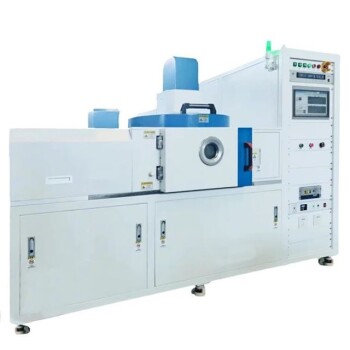
Spark Plasma Sintering (SPS) promotes the decomposition of zirconium dioxide ($ZrO_2$) by combining pulsed direct current with synchronized mechanical pressure in a vacuum. This synergy generates intense localized Joule heating at the contact interfaces between the titanium matrix and the oxide particles. These conditions lower the thermal energy barrier, allowing zirconium and oxygen atoms to detach from the oxide structure and diffuse directly into the titanium lattice at temperatures significantly lower than those required by conventional sintering.
Core Takeaway: The SPS system utilizes rapid energy discharge and axial pressure to bypass traditional thermodynamic constraints, enabling the thermochemical breakdown of stable oxides like $ZrO_2$ while preserving the fine microstructure of the titanium matrix.
The Synergistic Mechanism of Decomposition
Pulsed Current and Joule Heating
The SPS system passes a pulsed high current directly through the conductive titanium powder and the mold. This generates Joule heat precisely at the points of contact between particles, leading to extremely high heating rates. These rapid heating rates ensure that the energy required for thermochemical decomposition is reached quickly, minimizing the time available for unwanted grain growth.
Pressure-Induced Interface Reactions
Simultaneous axial pressure (often reaching 60 MPa or higher) forces the titanium matrix into intimate contact with the $ZrO_2$ particles. This mechanical stress breaks down surface contaminants and increases the contact area, which acts as a catalyst for the interface reactions. The pressure essentially "squeezes" the reactants together, facilitating the chemical breakdown of the oxide bond.
Controlled Vacuum Environment
Operating within a controlled vacuum is critical for the decomposition process. The vacuum prevents the titanium matrix from reacting with atmospheric nitrogen or oxygen, which would otherwise form a passivating layer. This clean environment ensures that once the $ZrO_2$ decomposes, the released atoms have a clear path to enter the titanium lattice.
Atomic Diffusion and Lattice Integration
Solid-State Diffusion at Low Temperatures
Once the SPS system triggers the decomposition of $ZrO_2$, the released zirconium and oxygen atoms migrate via solid-state diffusion. Because the SPS process is so efficient at concentrating energy, this diffusion occurs at relatively low temperatures (e.g., 753 K to 1200°C) compared to traditional methods. This allows for the creation of a solid solution or fine precipitates without melting the matrix.
Inhibition of Grain Growth
The speed of the SPS process—often completing densification within 5 minutes—is its primary advantage. By rapidly reaching the decomposition temperature and then cooling quickly, the system inhibits grain growth. This allows the final material to retain high-density dislocations and fine nano-precipitate phases that improve mechanical strength.
Enhancement of Material Properties
The efficient decomposition and subsequent diffusion of $ZrO_2$ elements into the titanium lattice alter the material's microstructural features. These features maintain high electrical conductivity while significantly enhancing phonon scattering. The result is a material with reduced thermal conductivity and improved structural integrity.
Understanding the Trade-offs
Kinetics vs. Microstructure
While high temperatures and pressures accelerate the decomposition of $ZrO_2$, they also increase the risk of excessive grain coarsening. If the pulsed current is too intense, the localized heating may cause the titanium matrix to lose its desired nanostructure. Finding the "sweet spot" between reaction completion and grain preservation is the primary challenge in SPS processing.
Chemical Homogeneity Limits
The rapid nature of SPS can sometimes lead to chemical inhomogeneities if the heating rate is too high for the diffusion coefficients of zirconium and oxygen. While the oxide may decompose, the released atoms might not have sufficient time to distribute evenly throughout the titanium matrix. This can result in localized zones of high solute concentration, which may embrittle the material.
How to Apply This to Your Project
When utilizing SPS to integrate zirconium dioxide into a titanium matrix, your parameters must align with your specific material requirements.
- If your primary focus is Maximum Hardness: Prioritize higher axial pressure and shorter holding times to ensure full $ZrO_2$ decomposition while maintaining a fine, nanocrystalline titanium grain structure.
- If your primary focus is Chemical Homogeneity: Use a slightly longer holding time at a moderate temperature (e.g., 1200°C) to allow the released zirconium and oxygen atoms sufficient time to diffuse evenly through the lattice.
- If your primary focus is Thermal Insulation: Optimize the pulsed current to maximize the formation of nano-precipitates, which serve as effective phonon scattering centers to reduce thermal conductivity.
By precisely controlling the interplay of current, pressure, and time, the SPS system transforms zirconium dioxide from a stable additive into a functional alloying element within the titanium matrix.
Summary Table:
| SPS Mechanism | Function in Decomposition | Key Benefit |
|---|---|---|
| Pulsed Current | Generates localized Joule heating at contact points | Lowers thermal barrier for rapid decomposition |
| Axial Pressure | Enhances contact area and breaks contaminants | Catalyzes interface reactions at lower temps |
| Controlled Vacuum | Prevents formation of passivating layers | Facilitates clean diffusion into the Ti lattice |
| Rapid Processing | Completes densification in minutes | Inhibits grain growth and preserves nanostructure |
Elevate Your Material Research with KINTEK
Precision is non-negotiable in advanced sintering and thermochemical reactions. At KINTEK, we specialize in providing state-of-the-art laboratory equipment and consumables, offering a comprehensive range of high-temperature furnaces—including muffle, tube, rotary, vacuum, CVD, and induction melting systems.
Whether you are studying the decomposition of stable oxides or developing complex titanium alloys, our furnaces are fully customizable to meet your unique research needs.
Ready to enhance your lab's efficiency and material performance? Contact KINTEK today to discover the ideal high-temperature solution for your project.
References
- Mizuki Fukuo, Masato Yoshiya. Strengthening Mechanisms of Powder Metallurgy Extruded CP Titanium Materials with Zirconium and Oxygen Solid Solution via Decomposition of ZrO<sub>2</sub> Additives in Sintering. DOI: 10.2320/matertrans.y-m2019833
This article is also based on technical information from Kintek Furnace Knowledge Base .
Related Products
- Spark Plasma Sintering SPS Furnace
- Chairside Dental Porcelain Zirconia Sintering Furnace with Transformer for Ceramic Restorations
- 600T Vacuum Induction Hot Press Vacuum Heat Treat and Sintering Furnace
- 9MPa Air Pressure Vacuum Heat Treat and Sintering Furnace
- Dental Porcelain Zirconia Sintering Ceramic Vacuum Press Furnace
People Also Ask
- Why is it necessary to maintain a high vacuum environment during the SPS of SiC? Key to High-Density Ceramics
- How does the heating mechanism of Spark Plasma Sintering (SPS) function? Enhance TiC/SiC Composite Fabrication
- What are the technical advantages of using an SPS sintering furnace? Elevate Al2O3-TiC Material Performance
- What are the steps in the discharge plasma sintering process? Master Fast, High-Density Material Consolidation
- What are the advantages of spark plasma sintering (SPS) over traditional forging? Precision Microstructural Control