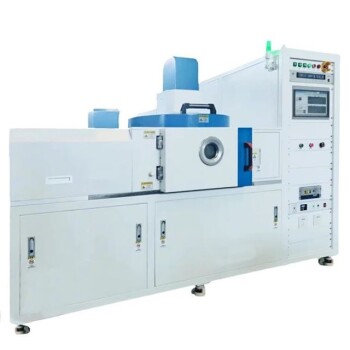
The fundamental difference lies in where the heat is born. In a traditional hot press, the sample is a passive recipient of external heat, leading to slow, indirect warming. In stark contrast, a Spark Plasma Sintering (SPS) system makes the sample and its tooling an active part of the electrical circuit, generating precise, instantaneous internal heat through pulsed direct current. This core distinction shortens the entire consolidation process from several hours to just a few minutes.
The central takeaway is this: By using the powder compact itself as a heating element through pulsed DC, SPS achieves a consolidation speed and microstructural control that indirect radiant heating can never match. This direct, internal Joule heating mechanism is the singular reason why you can achieve near-theoretical density in ceramics within minutes, not hours, and at significantly lower temperatures.
Deconstructing the Heating Mechanism
The contrasting heating mechanisms are the root cause of the massive performance difference between these two technologies. Understanding this principle is key to selecting the right tool for advanced ceramic processing.
Traditional Hot Press: External and Slow
Traditional hot pressing relies entirely on external heating elements, typically made of graphite or molybdenum, that surround the die assembly inside a vacuum or inert atmosphere chamber. The process is thermally indirect.
Heat is transferred from these elements to the outer surface of the die primarily through thermal radiation. From there, it must conduct through the die wall and into the ceramic powder compact itself.
This series of thermal resistances creates a significant lag. A large volume of the furnace chamber is heated, resulting in substantial thermal energy loss and slow, often uneven, heating rates. The entire cycle, including ramp-up and soak time, typically lasts for several hours.
SPS: Direct and Internal
A Spark Plasma Sintering system completely reimagines the energy flow. It applies a high-current, low-voltage pulsed direct current (DC) through the water-cooled rams that press on the die and punches.
Because the graphite die and punches are electrically conductive, the current flows directly through them. The intense electrical resistance generates instantaneous Joule heating from within the assembly itself.
Crucially, if the ceramic powder itself has any electrical conductivity, the current can also flow through the particle network. This means heat is generated simultaneously and precisely where it is needed—from the inside out, and the outside in—at microscopic contact points between particles.
The Result: Unmatched Consolidation Speed
The direct heating mechanism of SPS creates a cascade of effects that dramatically accelerate the densification process, making it fundamentally different from slow thermal diffusion.
Dramatically Faster Heating Rates
Because heat is generated internally rather than being radiated from a distance, thermal inertia is virtually eliminated. An SPS can achieve heating rates of 200°C to 1000°C per minute, or even higher.
This allows the system to bypass entire low-temperature regimes where non-densifying, coarsening mechanisms are active. A temperature that takes an hour to reach in a hot press can be attained in seconds with SPS, getting straight to the sintering-active temperature window.
From Hours to Single-Digit Minutes
The combination of rapid heating and enhanced sintering kinetics collapses the total process time. A hot press cycle that consumes three to six hours is replaced by an SPS cycle completed in only 5 to 20 minutes.
This speed provides a practical benefit beyond just throughput. The extremely short dwell time at peak temperature directly inhibits grain growth, preserving ultra-fine microstructures that would be lost during a prolonged conventional cycle.
Lower Sintering Temperatures
The highly efficient energy transfer and proposed field-assisted effects mean SPS can achieve full densification at temperatures 200°C to 500°C lower than a traditional hot press for the same material.
This is critical for processing nano-crystalline ceramics and refractory materials. By hitting maximum density at a lower thermal budget, the system locks in a sub-100 nm or sub-micron grain structure, resulting in superior mechanical and optical properties.
Understanding the Trade-offs
An objective assessment requires acknowledging the limitations that come with this advanced technology. SPS is not a universal solution.
The most critical limitation is the geometry of the final part. Like traditional uniaxial hot pressing, SPS must apply uniform pressure through rigid graphite rams. This inherently confines the process to simple, cylindrical or near-net disc shapes. Complex, final-shape sintering is not possible with this uniaxial pressure configuration.
While temperature uniformity is excellent across small samples, scaling to larger parts introduces the potential for thermal gradients. The current path and thermal profile in a large die must be carefully modeled and managed to ensure homogeneous properties.
The initial capital equipment cost and the specialized, high-quality graphite tooling required for SPS represent a significant investment compared to simpler hot-press chambers, though this is often offset by energy savings and cycle-time reduction over the long term.
Making the Right Choice for Your Goal
The decision between SPS and traditional hot pressing should be driven entirely by your primary material objective and application constraints.
- If your primary focus is preserving a nanoscale grain structure: SPS is the definitive choice. Its rapid heating and short, low-temperature cycle are specifically designed to bypass grain growth mechanisms, making it the essential tool for achieving fully dense, nano-crystalline ceramics.
- If your primary focus is producing ceramics with complex near-net shapes: SPS and uniaxial hot pressing are equally unsuitable. Your process must shift to a pressureless sintering or hot isostatic pressing (HIP) route that can apply force uniformly over complex surfaces.
- If your primary focus is maximizing productivity and energy efficiency for simple shapes: SPS offers a transformational advantage. Replacing multi-hour cycles with a 15-minute consolidation step fundamentally changes throughput and slashes energy consumption per part, making it the superior choice for manufacturing simple-form components.
By replacing the sluggish, indirect heating of a hot press with the instantaneous, internal Joule heating of a pulsed electric current, SPS doesn't just speed up sintering—it fundamentally changes the physics of how a powder compact becomes a dense, high-performance ceramic.
Summary Table:
| Feature / Parameter | Traditional Hot Pressing | Spark Plasma Sintering (SPS) |
|---|---|---|
| Heating Mechanism | External radiant heating | Internal direct Joule heating (Pulsed DC) |
| Heating Rate | Slow (typically 10–20°C/min) | Ultra-fast (200–1000°C/min) |
| Process Cycle Time | 3 to 6 hours | 5 to 20 minutes |
| Sintering Temperature | Standard high baseline | 200°C to 500°C lower |
| Grain Growth Control | Poor (prolonged thermal budget) | Excellent (retains nano/sub-micron grains) |
Accelerate Your Advanced Material Research with KINTEK
Looking to achieve near-theoretical ceramic density in minutes while maintaining precise microstructural control? KINTEK specializes in high-performance laboratory equipment and high-temperature furnaces—including Spark Plasma Sintering (SPS) systems, hot pressing furnaces, vacuum, tube, and atmosphere furnaces, all fully customizable to meet your unique sintering requirements.
Maximize your lab's throughput, energy efficiency, and material quality. Contact KINTEK experts today for tailored furnace solutions!
Related Products
- Spark Plasma Sintering SPS Furnace
- Chairside Dental Porcelain Zirconia Sintering Furnace with Transformer for Ceramic Restorations
- 600T Vacuum Induction Hot Press Vacuum Heat Treat and Sintering Furnace
- 9MPa Air Pressure Vacuum Heat Treat and Sintering Furnace
- Dental Porcelain Zirconia Sintering Ceramic Vacuum Press Furnace
People Also Ask
- How does the heating mechanism of Spark Plasma Sintering (SPS) function? Enhance TiC/SiC Composite Fabrication
- Why is it necessary to maintain a high vacuum environment during the SPS of SiC? Key to High-Density Ceramics
- What are the technical advantages of using an SPS sintering furnace? Elevate Al2O3-TiC Material Performance
- What are the steps in the discharge plasma sintering process? Master Fast, High-Density Material Consolidation
- What are the advantages of spark plasma sintering (SPS) over traditional forging? Precision Microstructural Control