
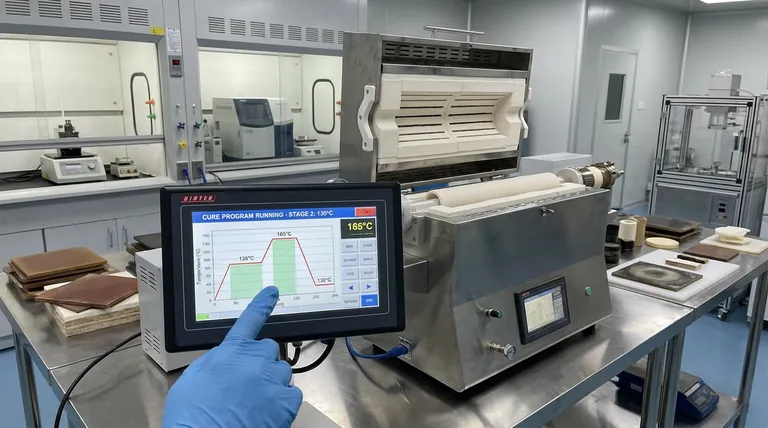
A digital temperature controller acts as the central nervous system for the segmented curing of phenolic thermal protection materials. It executes a precise, multi-stage heating and insulation program designed to synchronize the resin's physical viscosity changes with its chemical reaction rate, ensuring a defect-free final structure.
By enforcing strict temperature plateaus at critical points like 130°C and 165°C, the controller allows sufficient time for resin flow before final hardening occurs. This precise regulation prevents structural defects caused by thermal lag, such as incomplete impregnation or uneven curing.
Coordinating Viscosity and Chemical Reaction
Managing Multi-Stage Profiles
The controller does not simply maintain a single set point. Instead, it manages a dynamic multi-stage heating program.
This involves ramping temperatures up and holding them steady at specific intervals (insulation stages). This "segmented" approach is essential for complex chemical processing.
Synchronizing Flow and Cure
The primary function of the controller is to align viscosity evolution with the chemical reaction rate.
If the temperature rises too fast, the resin reacts and hardens before it can flow properly. The controller regulates the heat to keep the resin fluid long enough to penetrate the material fully.
Critical Control Stages in Phenolic Curing
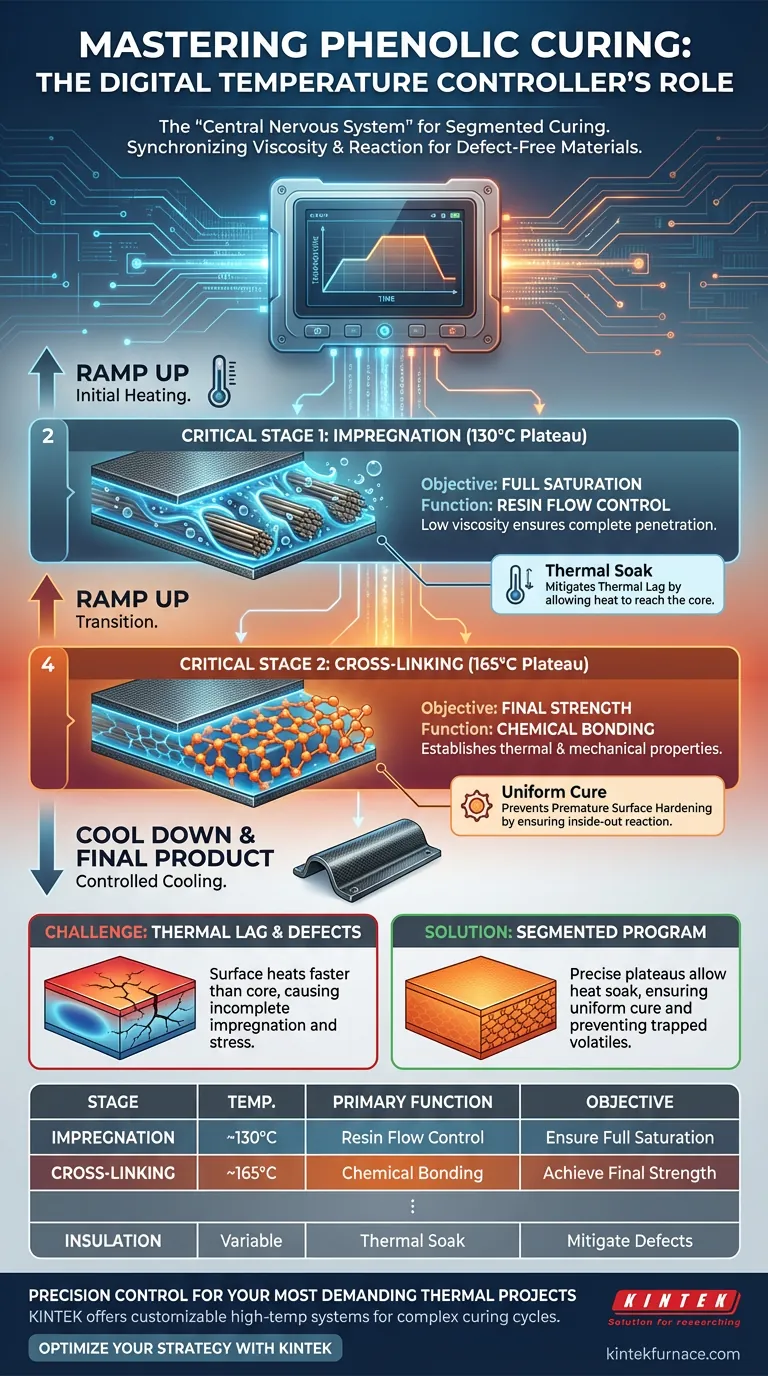
The Impregnation Stage (130°C)
According to standard processing protocols, the controller must strictly regulate the temperature around 130°C.
At this stage, the priority is resin flow and impregnation. The controller maintains this plateau to ensure the resin viscosity is low enough to saturate the reinforcement materials completely.
The Cross-Linking Stage (165°C)
Once impregnation is achieved, the controller ramps the system to a higher threshold, typically around 165°C.
This stage is dedicated to thorough cross-linking. Holding this temperature ensures the chemical bonds form completely, establishing the material's final thermal and mechanical strength.
Mitigating Thermal Lag and Defects
Combating Thermal Lag
In thick or complex thermal protection materials, the core temperature often lags behind the surface temperature.
The controller mitigates this thermal lag by holding temperatures steady. This allows the heat to soak through to the center of the material before the program advances to the next stage.
Preventing Premature Surface Hardening
If the controller fails to manage these stages, the surface of the material may cure and harden while the inside is still reacting.
This premature surface hardening creates a seal that can trap volatiles or prevent internal resin flow. The controller’s segmented program ensures the material cures uniformly from the inside out.
Optimizing Your Curing Strategy
To ensure high-performance results, you must configure your controller based on the specific phase of the cure:
- If your primary focus is achieving full saturation: Ensure the controller holds the 130°C stage long enough to accommodate the resin's specific viscosity profile.
- If your primary focus is maximizing mechanical strength: Verify that the 165°C stage is maintained until thorough cross-linking is confirmed throughout the material thickness.
Precise digital control transforms a volatile chemical reaction into a predictable, high-quality manufacturing process.
Summary Table:
| Curing Stage | Temperature Plateau | Primary Function | Objective |
|---|---|---|---|
| Impregnation | ~130°C | Resin Flow Control | Ensure full saturation & low viscosity |
| Cross-Linking | ~165°C | Chemical Bonding | Achieve final thermal & mechanical strength |
| Insulation | Variable | Thermal Soak | Mitigate thermal lag & prevent internal defects |
Precision Control for Your Most Demanding Thermal Projects
Don’t let thermal lag or premature hardening compromise your materials. KINTEK provides the cutting-edge R&D and manufacturing expertise needed to master complex curing cycles.
Backed by industry-leading technology, our Muffle, Tube, Rotary, Vacuum, and CVD systems are fully customizable to meet your specific phenolic processing requirements. Whether you need to synchronize viscosity flow or ensure thorough cross-linking, KINTEK high-temp lab furnaces deliver the precise, segmented control your lab demands.
Ready to optimize your curing strategy? Contact KINTEK today for a custom solution!
Visual Guide
References
- Xiaodong He, Hualian Li. A Study on the Compaction Behavior and Parameter Sensitivity of Curing Phenolic Thermal Protection Material Strips. DOI: 10.3390/polym17081045
This article is also based on technical information from Kintek Furnace Knowledge Base .
Related Products
- Multi Heating Zones CVD Tube Furnace Machine for Chemical Vapor Deposition Equipment
- High Temperature Muffle Oven Furnace for Laboratory Debinding and Pre Sintering
- 1400℃ Muffle Oven Furnace for Laboratory
- 1700℃ High Temperature Muffle Oven Furnace for Laboratory
- Multi Zone Laboratory Quartz Tube Furnace Tubular Furnace
People Also Ask
- What is the function of a multi-zone tube furnace in CVD synthesis? Master 2D In2Se3 Nanosheet Precision
- What role do multi zone tube furnaces play in new energy research? Unlock Precise Thermal Control for Innovation
- Why are multi zone tube furnaces particularly useful for nanomaterial research? Unlock Precise Thermal Control for Advanced Synthesis
- What environmental protection applications utilize multi zone tube furnaces? Unlock Precision in Waste Treatment and Green Tech
- What temperature-related capabilities make multi zone tube furnaces valuable for research? Unlock Precision Thermal Control



















