The Invisible Vanishing Act in Your Lab
You’ve meticulously calculated the stoichiometric ratios for your ZrSi2–MoSi2–ZrB2 composite. You’ve prepared the magnesium reductant and loaded the precursor into the furnace. But when the reaction is over, the resulting powder is inconsistent, the purity is off, or worse—the yield is significantly lower than expected.
If you are working with advanced ultra-high-temperature ceramics (UHTCs), you are likely facing a frustrating reality: at the extreme temperatures required for synthesis, your materials don't just react; they try to escape.
The Traditional Sintering Trap
When researchers attempt to synthesize complex composites like ZrSi2–MoSi2–ZrB2 using conventional methods, they often encounter two major bottlenecks.
First is the energy-time deficit. Traditional sintering requires hours, if not days, of sustained high heat, leading to massive energy consumption and grain growth that degrades the final product’s properties.
Second is the "volatilization leak." To bypass the time deficit, many turn to Self-propagating High-temperature Synthesis (SHS). It’s faster, but in a standard, low-pressure environment, the intense heat causes magnesium and other critical components to vaporize and drift away before the reaction is complete. You’re left with a "hit or miss" process where repeatability is non-existent and the "combustion wave" is erratic and dangerous.
The Science of the "Combustion Wave"
The secret to successful composite synthesis lies in mastering the magnesiothermic reduction process. In an SHS reaction, once a local point is ignited, the chemical energy of the material itself fuels a "combustion wave" that sweeps through the entire sample.
However, this wave is a double-edged sword. The instantaneous temperatures are high enough to melt almost anything, which causes the volatile components to reach their boiling points rapidly. If the surrounding pressure isn't high enough to "push back," these components volatilize. This shifts the chemical balance mid-reaction, leading to an incomplete or heterogeneous composite.
To solve this, you don't just need heat; you need atmospheric suppression. You need to create an environment where the pressure is high enough to keep every atom in its place while the combustion wave passes through.
Mastering the Pressure: The Universal SHS Reactor
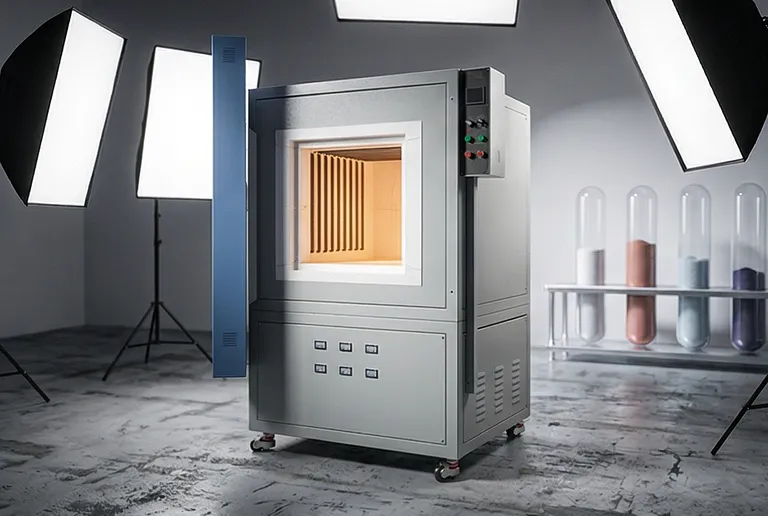
This is where the engineering of the KINTEK Universal SHS Reactor changes the game. It is not merely a furnace; it is a precision-controlled pressure vessel designed to tame the violence of SHS.
- The 3 MPa Argon Shield: By filling the 8-liter reaction chamber with high-purity argon at 3 MPa, the reactor creates a high-pressure "blanket." This pressure is specifically tuned to suppress the volatilization of components during the magnesiothermic reduction. It ensures that the magnesium stays in the reaction zone long enough to do its job.
- Precision Tungsten Ignition: Instead of relying on unreliable external heating, the system uses high-purity graphite containers and tungsten wire coils. These coils provide the instantaneous electrical spark needed to trigger the local exothermic reaction, initiating a stable, self-sustaining combustion wave.
- Real-Time Safety and Repeatability: With integrated pressure monitoring systems, the reactor records every fluctuations in real-time. This isn't just for safety; it’s for science. It allows you to verify that every batch experienced the exact same pressure profile, ensuring that your ZrSi2–MoSi2–ZrB2 powders are identical every time.
Beyond the Powder: Unlocking Ultra-High-Temp Potential
When you stop fighting the physics of volatilization and start controlling it, the possibilities for your research expand. By stabilizing the synthesis of ZrSi2–MoSi2–ZrB2 composite powders, you are no longer limited by material loss or inconsistent batches.
With reliable, high-purity composite powders, you can move faster toward developing the next generation of aerospace heat shields, high-efficiency turbine components, and cutting-edge dental materials. The transition from "experimental struggle" to "repeatable production" means your lab can focus on innovation rather than troubleshooting failed reactions.
At KINTEK, we understand that advanced material science requires more than just high temperatures—it requires a controlled environment where every variable is under your command. Whether you are scaling up synthesis or exploring new UHTC compositions, our team is ready to help you configure a high-pressure SHS solution tailored to your specific chemical challenges. Contact Our Experts to discuss how we can bring stability and precision to your next project.
Related Products
- High Pressure Laboratory Vacuum Tube Furnace
- 9MPa Air Pressure Vacuum Heat Treat and Sintering Furnace
- Controlled Inert Nitrogen Hydrogen Atmosphere Furnace
- Custom Made Versatile CVD Tube Furnace Chemical Vapor Deposition CVD Equipment Machine
- MPCVD Machine System Reactor Bell-jar Resonator for Lab and Diamond Growth
Related Articles
- Mastering the Micro-Environment: The Art and Science of the Laboratory Tube Furnace
- Beyond Heat: Mastering the Controlled Universe Inside a Tube Furnace
- Why Your Crystal Growth Experiments Are Failing: The Hidden Culprit in Your Tube Furnace
- Mastering the Void: How Tube Furnaces Forge the Atoms of Innovation
- Is Your Material Data Real? Why Temperature Gradients Are Sabotaging Your Cu2Se Resistivity Measurements









