
At its core, a Chemical Vapor Deposition (CVD) tube furnace provides two fundamental types of atmosphere control. It can create a high-purity vacuum by removing atmospheric gases, or it can introduce precisely managed gases, such as inert atmospheres, to create a specific chemical environment for your process.
The true value of a CVD tube furnace is its ability to create a chemically pristine and highly controlled environment. Whether by removing unwanted molecules through vacuum or introducing specific ones through gas flow, this control is the key to achieving successful, repeatable results in advanced material synthesis.
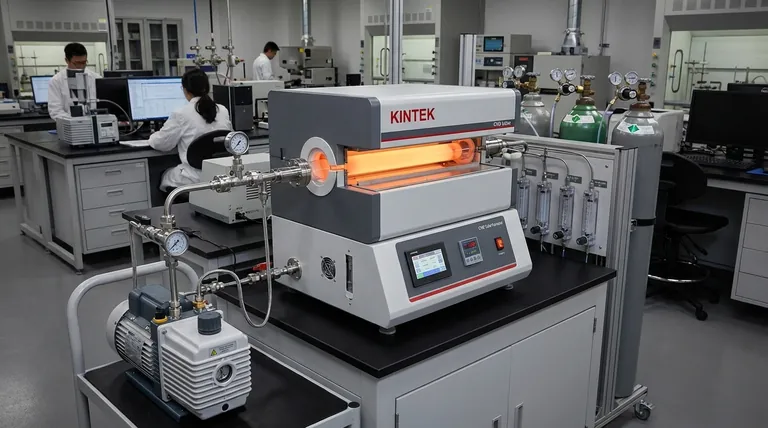
The Two Pillars of Atmosphere Control
To master a CVD furnace, you must first understand its two primary modes of environmental management: creating a vacuum and introducing a controlled gas atmosphere. These are not mutually exclusive; they are often used in sequence.
Achieving Vacuum Conditions
A vacuum is essential for processes that require extreme purity. By pumping out the air and any other contaminants from the furnace tube, you eliminate the risk of unwanted chemical reactions, such as oxidation, at high temperatures.
This is accomplished using vacuum pumps connected to the furnace tube via specialized, airtight seals known as SS KF flanges. The quality of your vacuum—and thus the purity of your process—is directly tied to the capability of your pumping system and the integrity of these seals.
Introducing Controlled Gas Atmospheres
Once a vacuum is established, or as an alternative, a specific gas or gas mixture can be flowed through the tube. This allows for precise environmental engineering.
The most common application is creating an inert atmosphere using gases like argon or nitrogen. This protects the material from reacting with oxygen or moisture while at high temperature, which is critical for processes like annealing and sintering. The furnace can also support reactive atmospheres for processes like CVD or atmosphere reduction.
Key Components Enabling Precise Control
The furnace's ability to manage its atmosphere is not magic; it is the result of several critical, interacting components.
The Furnace Tube (Quartz vs. Alumina)
The tube itself is the sealed reactor where your process occurs. The material of this tube is a primary limiting factor.
Quartz tubes are common and suitable for temperatures up to approximately 1200°C. For higher temperatures, up to 1700°C, more robust alumina tubes are required. The choice depends entirely on your process's temperature demands and chemical compatibility.
Vacuum Flanges and Sealing
Airtight sealing is non-negotiable for atmosphere control. CVD tube furnaces use standardized KF or CF flanges, which create a reliable, leak-proof connection between the furnace tube and the vacuum pumps or gas lines. This ensures no contaminants leak in and no process gases leak out.
Gas Inlet and Purging System
To introduce a controlled atmosphere, the system includes ports for gas inlets. This allows for gas purging, where a flow of gas is used to flush out any residual air before the heating process begins, and for maintaining a specific gas environment during the operation.
Understanding the Trade-offs
While powerful, a CVD tube furnace requires you to balance several competing factors to achieve your desired outcome.
Temperature vs. Tube Material
The most fundamental trade-off is performance versus cost, dictated by the tube material. While an alumina tube allows for much higher process temperatures, it is typically more expensive and can be more brittle than a quartz tube. You must select the material that meets your temperature requirements without over-specifying.
Process Purity vs. Pumping System
Simply having a "vacuum" is not enough. The ultimate level of vacuum, and therefore the purity of your starting environment, is determined by the power and type of your vacuum pump (e.g., a simple mechanical pump vs. a turbomolecular pump). A higher-purity process demands a more advanced and costly pumping system.
Simplicity vs. Process Capability
Running a simple annealing process in an inert gas flow is relatively straightforward. However, running a multi-step CVD process involving a vacuum purge, followed by flowing multiple reactive precursor gases at precise rates, dramatically increases operational complexity and the need for sophisticated gas handling and safety protocols.
Making the Right Choice for Your Goal
Your application dictates the required atmospheric conditions. Use this as a guide to determine your furnace setup.
- If your primary focus is drying, purification, or outgassing: A vacuum is your most effective tool to remove volatile compounds and moisture.
- If your primary focus is preventing oxidation (e.g., annealing or sintering): A continuous flow of an inert gas like argon or nitrogen is required.
- If your primary focus is material deposition (CVD) or growth (nanowires): You will need a precise mixture of carrier gases and reactive precursor gases.
- If your primary focus is chemical reduction of a material: You will need a vacuum purge followed by a specific reducing atmosphere.
Understanding how to manipulate the environment inside the furnace is the single most important skill for successful high-temperature material processing.
Summary Table:
| Control Type | Key Features | Common Applications |
|---|---|---|
| Vacuum | Removes contaminants, prevents oxidation | Drying, purification, outgassing |
| Controlled Gas Atmospheres | Inert (argon, nitrogen) or reactive gases | Annealing, sintering, CVD, material growth |
Unlock Precision in Your Lab with KINTEK's Custom CVD Furnace Solutions
Leveraging exceptional R&D and in-house manufacturing, KINTEK provides diverse laboratories with advanced high-temperature furnace solutions. Our product line, including Muffle, Tube, Rotary Furnaces, Vacuum & Atmosphere Furnaces, and CVD/PECVD Systems, is complemented by our strong deep customization capability to precisely meet unique experimental requirements. Whether you need vacuum control for purity or gas atmospheres for synthesis, we deliver reliable, tailored systems to enhance your material processing outcomes.
Contact us today to discuss how our expertise can optimize your laboratory's efficiency and results!
Visual Guide

Related Products
- Custom Made Versatile CVD Tube Furnace Chemical Vapor Deposition CVD Equipment Machine
- Split Chamber CVD Tube Furnace with Vacuum Station CVD Machine
- Multi Heating Zones CVD Tube Furnace Machine for Chemical Vapor Deposition Equipment
- Slide PECVD Tube Furnace with Liquid Gasifier PECVD Machine
- Inclined Rotary Plasma Enhanced Chemical Deposition PECVD Tube Furnace Machine
People Also Ask
- Why are CVD tube furnace sintering systems indispensable for 2D material research and production? Unlock Atomic-Scale Precision
- What is a CVD tube furnace and what is its primary function? Discover Precision Thin-Film Deposition
- Which industries and research fields benefit from CVD tube furnace sintering systems for 2D materials? Unlock Next-Gen Tech Innovations
- How does CVD tube furnace sintering enhance graphene growth? Achieve Superior Crystallinity and High Electron Mobility
- What are the benefits of developing new precursor materials for CVD tube furnaces? Unlock Advanced Thin-Film Synthesis



















