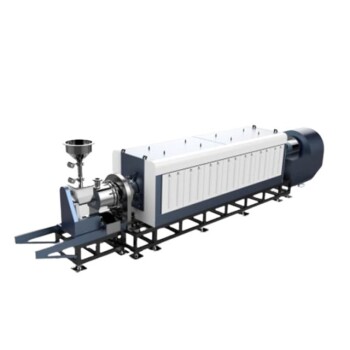
A high-precision muffle furnace acts as the primary thermal reactor for the controlled oxidation and purification of raw wood biomass into active ash. By maintaining a stable, high-temperature environment—specifically 800°C ± 25°C for hardwood residues—the furnace facilitates the complete removal of organic matter and volatile components. This transformation results in an inorganic residue with extremely low carbon content and highly concentrated mineral phases, ready for specialized industrial uses.
The muffle furnace is the critical instrument for converting organic biomass into chemically active inorganic ash. Through precise temperature control and uniform heat distribution, it ensures the complete incineration of carbonaceous material, leaving behind a mineral-rich residue with the specific reactivity required for downstream carbon mineralization or industrial extraction.
The Role of Controlled Incineration in Ash Synthesis
Eliminating the Organic Carbon Matrix
The primary function of the muffle furnace is to provide a continuous oxidative environment that breaks down plant matter. By applying high-temperature radiation, the furnace forces the release of carbon, hydrogen, and oxygen as gases. This process leaves only the inorganic mineral residues, which are essential for assessing purity and residue disposal burdens.
Concentrating Active Mineral Phases
In hardwood processing, maintaining a constant temperature for approximately four hours ensures that the ash reaches a state of chemical activity. This stage is vital for concentrating metal oxides, such as potassium oxide (K2O) or calcium-rich phases. These concentrated minerals serve as the core raw materials for CO2 mineralization reactions and the production of specialized fertilizers.
Achieving Constant Weight and Purity
For analytical and industrial purposes, the furnace allows the sample to reach a constant weight. This indicates that all volatile components have been fully expelled, leaving a stable material. This stability is critical when the ash is intended for use as a metal source to enhance catalysts or for evaluating the quality of biomass energy.
The Necessity of High-Precision Instrumentation
Maintaining Thermal Stability and Accuracy
High-precision furnaces are required because even minor temperature fluctuations can alter the chemical profile of the resulting ash. For example, a target of 800°C ± 25°C is often the "sweet spot" for maintaining mineral reactivity while ensuring complete carbon removal. If the temperature is poorly regulated, the ash may retain unwanted carbon or suffer from premature melting.
Ensuring Thermal Uniformity
Precision isn't just about the temperature reading; it is about heat distribution throughout the chamber. Uniform radiation ensures that every gram of biomass powder undergoes the same degree of calcination. This uniformity is what makes the resulting ash a reliable metric for analytical chemistry and industrial scaling.
Understanding the Trade-offs and Constraints
Temperature Selection vs. Mineral Volatilization
There is a critical trade-off between combustion efficiency and mineral retention. While 800°C is excellent for removing carbon, some volatile minerals like potassium may begin to vaporize at higher temperatures (e.g., 1200°C+). Selecting the wrong temperature can result in an ash that is pure but lacks the specific alkali metals required for your end goal.
Processing Time vs. Energy Consumption
Achieving a "constant weight" often requires a long dwell time, sometimes up to 5 hours. This high energy demand must be balanced against the need for total oxidation. Shortening the process may save power but risks leaving residual carbon, which can deactivate catalysts or inhibit CO2 mineralization.
How to Apply This to Your Project
When utilizing a muffle furnace for biomass preparation, your choice of temperature and duration should be dictated by your specific technical objective.
- If your primary focus is CO2 mineralization: Use a high-precision setting of 800°C for 4 hours to ensure low carbon content and high mineral reactivity.
- If your primary focus is analytical ash content determination: Operate at 550°C to 650°C to ensure complete oxidation while minimizing the loss of volatile inorganic species.
- If your primary focus is industrial potassium extraction: Maintain a stable thermal environment at 500°C to 600°C to concentrate potassium in the form of oxides without causing significant volatilization.
- If your primary focus is briquette or catalyst support formation: Utilize higher temperatures (up to 1250°C) to create a stable, stony ash material that can withstand mechanical binding.
By mastering the thermal precision of the muffle furnace, you transform agricultural and wood waste into a high-value chemical asset.
Summary Table:
| Function | Key Objective | Recommended Temperature/Time |
|---|---|---|
| Organic Removal | Complete oxidation and elimination of carbon | 800°C ± 25°C |
| Mineral Concentration | Maximize alkali metals (K2O) and mineral phases | 500°C - 800°C |
| Analytical Purity | Achieving constant weight and stable residue | 4 - 5 Hour Dwell Time |
| Ash Determination | Minimize loss of volatile inorganic species | 550°C - 650°C |
| Sintering/Binding | Creating stable, stony ash for catalyst support | Up to 1250°C |
Elevate Your Biomass Research with KINTEK Precision
Achieving the perfect chemical profile for wood biomass ash requires uncompromising thermal accuracy. KINTEK specializes in high-performance laboratory equipment, offering a comprehensive range of high-temperature furnaces, including muffle, tube, rotary, vacuum, CVD, and atmosphere furnaces.
Whether you are focusing on CO2 mineralization, industrial potassium extraction, or analytical ash determination, our furnaces are fully customizable to meet your unique temperature uniformity and atmosphere control needs.
Ready to transform your organic waste into high-value chemical assets?
Contact KINTEK Today to Find Your Ideal Furnace Solution
References
- Nimisha Tripathi, Andrew P. Hurt. Mineralisation of CO2 in wood biomass ash for cement substitution in construction products. DOI: 10.3389/frsus.2024.1287543
This article is also based on technical information from Kintek Furnace Knowledge Base .
Related Products
- High Temperature Muffle Oven Furnace for Laboratory Debinding and Pre Sintering
- 1200℃ Muffle Oven Furnace for Laboratory
- 1400℃ Muffle Oven Furnace for Laboratory
- 1700℃ High Temperature Muffle Oven Furnace for Laboratory
- 1800℃ High Temperature Muffle Oven Furnace for Laboratory
People Also Ask
- What thermal phenomena occur during polymer binder burnout in ceramic green bodies? Lab Furnace Guide
- What role does a high-temperature muffle furnace play in STFO synthesis? Achieve Pure Perovskite Results
- Why is controlled heat treatment in a muffle furnace necessary for calcined clay? Achieve Optimal Pozzolanic Activity
- How does a high-temperature muffle furnace facilitate the formation of LaNbxAl1−xO3+δ perovskite structures? Key Roles
- What role does a high-temperature muffle furnace play in the formation of biochar catalysts? Master Catalyst Synthesis