
At a high level, vacuum furnace chillers are critical components in advanced manufacturing sectors where material properties must be controlled with extreme precision. Industries such as aerospace, machinery, semiconductor manufacturing, solar panel production, and specialized glassmaking all rely on this technology for heat treatment and material processing in a controlled, oxygen-free environment.
The core function of a vacuum furnace chiller is not just cooling; it is the precise and rapid removal of heat to lock in specific material characteristics. Industries use them to create components that are harder, stronger, or have unique electronic and optical properties that are impossible to achieve with conventional atmospheric heating and cooling.
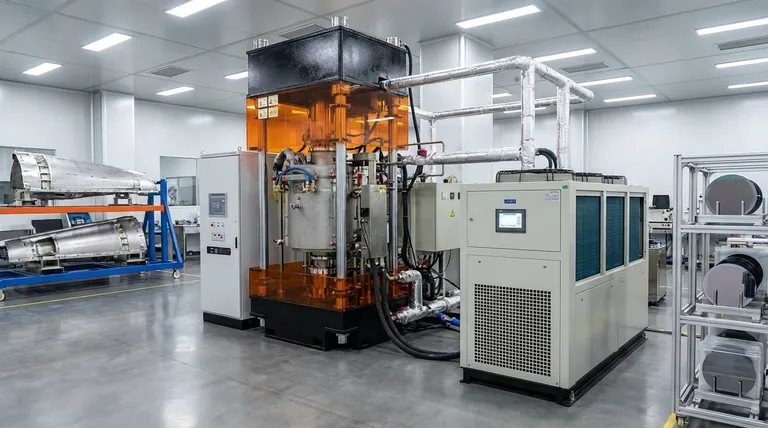
The Role of Precise Cooling in Vacuum Furnaces
A vacuum furnace heats materials to very high temperatures in a vacuum to prevent oxidation and contamination. However, the cooling phase, known as quenching, is equally important.
A dedicated chiller circulates a cooling medium—typically water or a water-glycol mix—through the furnace's heat exchanger or cooling jackets. This enables highly controlled and rapid temperature reduction.
Why Controlled Cooling is Essential
Controlling the cooling rate directly influences the final microstructure of the material. For metals, rapid quenching can increase hardness and strength. For other materials, like glass or silicon, it prevents the formation of internal stresses or defects.
Without a powerful and responsive chiller, the furnace cannot achieve the rapid cooling rates required for modern high-performance materials, leading to inconsistent quality and component failure.
Key Industries and Their Applications
The need for precise, contamination-free heat treatment drives chiller adoption in several high-stakes industries.
Aerospace and Machinery
In the aerospace and heavy machinery sectors, components like turbine blades, gears, and engine parts must withstand extreme stress and wear.
Vacuum furnaces are used for processes like vacuum carburizing and hardening. The chiller enables a rapid quench that freezes the desired crystalline structure in place, resulting in parts with exceptional surface hardness and fatigue resistance.
Semiconductor and Solar Panel Manufacturing
Producing semiconductors and solar cells involves depositing and treating thin films on silicon wafers. These processes are highly sensitive to thermal fluctuations and contamination.
A vacuum furnace chiller ensures thermal stability during these delicate operations. It provides precise, repeatable cooling cycles that are essential for creating the flawless crystalline structures required for optimal electronic performance.
Glassmaking and Optics
Specialty glass, lenses, and fiber optics require an annealing process to remove internal stresses created during manufacturing. Uncontrolled cooling can cause these products to become brittle or optically distorted.
Vacuum furnace chillers allow for a precisely programmed cooling ramp-down. This controlled process ensures the final product is structurally stable and meets exacting optical clarity standards.
Understanding the Operational Trade-offs
While essential, integrating a vacuum furnace chiller involves important considerations that impact efficiency and cost. Choosing the wrong system can create significant production bottlenecks.
Precision vs. Cost
Chillers capable of tighter temperature control and faster response times are more technologically complex and carry a higher initial investment. The key is to match the chiller's capability to the specific tolerance requirements of your process.
Energy Consumption
Chillers are energy-intensive systems. An oversized chiller will waste electricity, while an undersized one will fail to meet the required cooling rates, compromising product quality. Sizing the chiller correctly for the furnace's heat load is critical for operational efficiency.
Maintenance and Reliability
In continuous manufacturing environments, chiller downtime means furnace downtime, which can be catastrophic for production schedules. Investing in a reliable chiller with a robust maintenance plan is not an option—it is a requirement to avoid costly interruptions.
Making the Right Choice for Your Process
Your selection of a cooling strategy should be dictated by the desired properties of your final product.
- If your primary focus is mechanical strength and hardness (aerospace, tooling): Prioritize a chiller that can deliver the highest possible cooling rate for rapid quenching.
- If your primary focus is electronic integrity and purity (semiconductors): Select a high-precision, closed-loop chiller that guarantees temperature stability and prevents contamination.
- If your primary focus is structural stability and stress reduction (glass, optics): Choose a chiller with programmable controls that allow for precise, repeatable cooling profiles.
Ultimately, the chiller is not an accessory but a core component of the vacuum furnace system, directly responsible for the quality and performance of the final product.
Summary Table:
| Industry | Key Applications | Benefits of Vacuum Furnace Chillers |
|---|---|---|
| Aerospace & Machinery | Turbine blades, gears, engine parts | Rapid quenching for hardness, fatigue resistance |
| Semiconductor & Solar Panel | Thin film deposition, wafer processing | Thermal stability, contamination-free cooling |
| Glassmaking & Optics | Specialty glass, lenses, fiber optics | Controlled cooling for structural stability, optical clarity |
Ready to enhance your material processing with precise cooling solutions? Leveraging exceptional R&D and in-house manufacturing, KINTEK provides diverse laboratories with advanced high-temperature furnace systems, including Muffle, Tube, Rotary Furnaces, Vacuum & Atmosphere Furnaces, and CVD/PECVD Systems. Our strong deep customization capability ensures we precisely meet your unique experimental requirements. Contact us today to discuss how our vacuum furnace chillers can optimize your processes for superior results in aerospace, semiconductor, or glass applications!
Visual Guide
Related Products
- Vacuum Hot Press Furnace Machine Heated Vacuum Press Tube Furnace
- Vacuum Hot Press Furnace Machine Heated Vacuum Press
- 600T Vacuum Induction Hot Press Vacuum Heat Treat and Sintering Furnace
- 2200 ℃ Tungsten Vacuum Heat Treat and Sintering Furnace
- Vacuum Heat Treat Sintering Furnace with Pressure for Vacuum Sintering
People Also Ask
- Why use Vacuum Hot Press (VHP) for ZnS Ceramics? Achieve Superior IR Transparency and Mechanical Strength
- What safety features are incorporated in vacuum hot press furnaces? Ensure Operator and Equipment Protection
- What are the benefits of the vacuum environment system in a vacuum hot press furnace? Unlock High-Density Sintering
- What is a vacuum hot press furnace? Unlock Superior Material Performance
- Which process parameters must be optimized for specific materials in a vacuum hot press furnace? Achieve Optimal Density and Microstructure



















