
The integration of a programmable temperature controller with a B-type thermocouple directly enhances zinc recovery efficiency by enabling precise thermal regulation. By strictly maintaining optimal set points, such as 460°C, the system manipulates the physical properties of the molten metal. This precise control maximizes the volume of recovered zinc while significantly reducing iron contamination in the final product.
Core Takeaway: Temperature is the governing variable in zinc dross recovery that dictates the delicate balance between fluidity and purity. A programmable control system ensures the process stays in the narrow thermal window where zinc flows freely, but iron impurities remain precipitated and separable.
The Physics of Separation
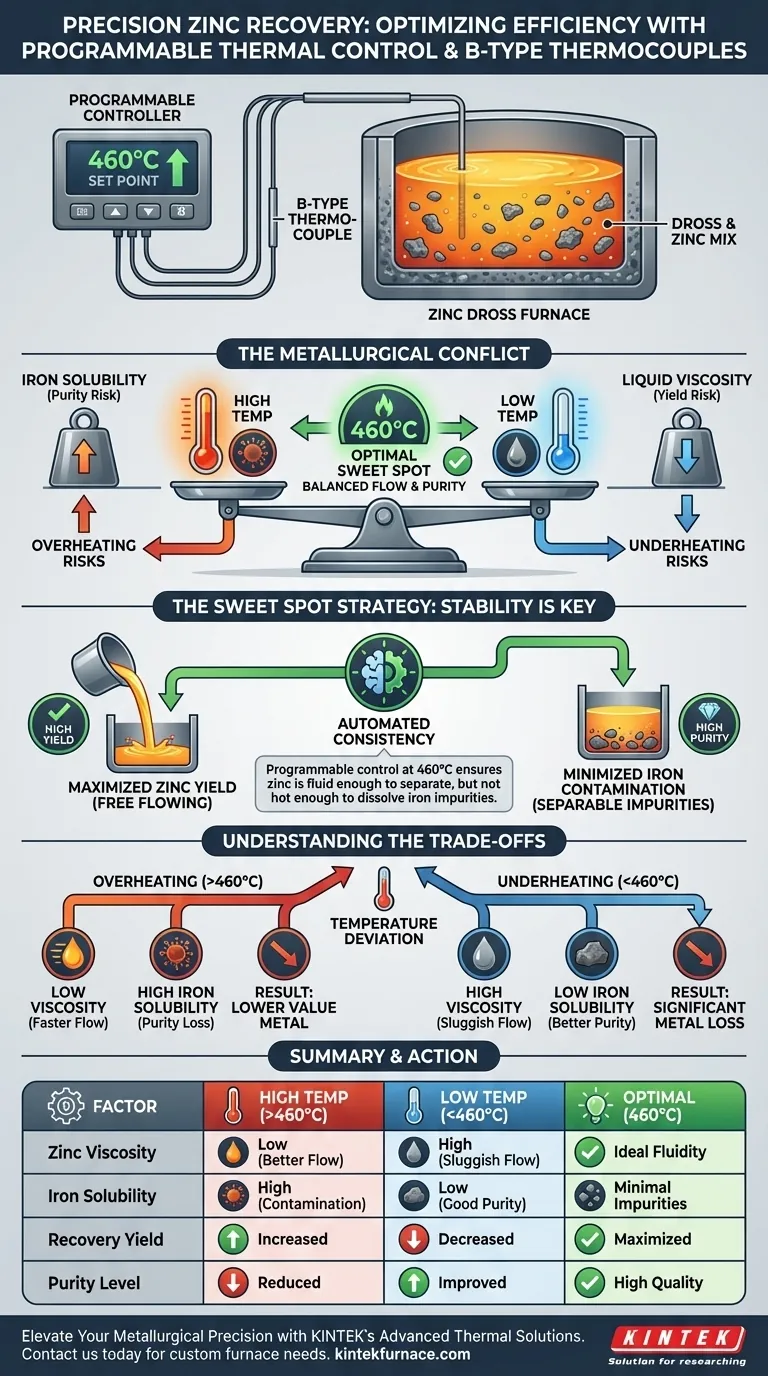
To understand why this equipment configuration is effective, one must understand the metallurgical conflict at play during recovery. You are managing two opposing forces: iron solubility and liquid viscosity.
Controlling Iron Solubility
The primary reference highlights that temperature determines the saturated solubility of iron within liquid zinc.
As temperatures rise, the capacity for molten zinc to absorb iron increases. If the process runs too hot, iron impurities that should remain solid (and removable) dissolve back into the liquid.
Managing Viscosity and Fluidity
Conversely, the molten metal requires sufficient heat to maintain low viscosity.
If the temperature drops too low, the zinc becomes sluggish. This prevents it from flowing away from the dross (the waste material), trapping usable metal and reducing your overall yield.
The Role of Precision Instrumentation
The combination of a programmable controller and a B-type thermocouple solves the solubility-vs-viscosity conflict by enforcing stability.
The "Sweet Spot" Strategy
The system allows operators to target a specific "sweet spot," noted in the primary reference as 460°C.
At this exact temperature, the zinc is fluid enough to separate efficiently from the solid dross. However, it is not so hot that it forces the iron impurities into solution.
Automated Consistency
A programmable controller removes human error from the heating profile.
It constantly adjusts the energy input to maintain the set point, regardless of external fluctuations. This ensures that the recovery conditions remain constant throughout the entire batch processing time.
Understanding the Trade-offs
While precise control is essential, it is important to understand the risks of deviation in either direction.
The Risk of Overheating
If the controller is set incrementally too high, the viscosity improves, making the zinc flow faster.
However, the trade-off is purity. The resulting zinc liquid will contain higher levels of dissolved iron, lowering the market value of the recovered metal.
The Risk of Underheating
If the controller allows the temperature to dip below the optimal window, iron precipitation is maximized (good for purity).
However, the trade-off is yield. The zinc becomes too viscous to filter through the dross effectively, leading to significant metal loss in the waste stream.
Making the Right Choice for Your Goal
To apply this effectively, you must configure your programmable controller based on your specific quality targets.
- If your primary focus is Maximum Purity: Set the temperature at the lower end of the operational window (e.g., strictly 460°C or slightly below) to minimize iron solubility, accepting a slight reduction in flow speed.
- If your primary focus is Maximum Yield: Ensure the temperature never drops below the critical flow threshold, prioritizing viscosity to extract every drop of liquid zinc from the dross.
Success in zinc recovery relies not just on melting the metal, but on stabilizing the thermal environment where separation physics work in your favor.
Summary Table:
| Factor | Effect of High Temp (>460°C) | Effect of Low Temp (<460°C) | Optimal Control (460°C) |
|---|---|---|---|
| Zinc Viscosity | Low (Better Flow) | High (Sluggish Flow) | Ideal Fluidity |
| Iron Solubility | High (High Contamination) | Low (Good Purity) | Minimal Impurities |
| Recovery Yield | Increased | Decreased | Maximized |
| Purity Level | Reduced | Improved | High Quality |
Elevate Your Metallurgical Precision with KINTEK
Maximize your recovery yields and ensure peak material purity with KINTEK’s advanced thermal solutions. Backed by expert R&D and manufacturing, KINTEK offers state-of-the-art Muffle, Tube, Rotary, Vacuum, and CVD systems, all customizable to meet your unique lab and industrial requirements. Our high-temperature furnaces, equipped with precision programmable controllers, provide the stability needed for critical processes like zinc dross recovery.
Ready to optimize your thermal processing? Contact us today to discuss your custom furnace needs!
Visual Guide
References
- S. J. Zhang, Zhancheng Guo. Purification and Recovery of Hot-Dip Galvanizing Slag via Supergravity-Induced Cake-Mode Filtration. DOI: 10.3390/met14010100
This article is also based on technical information from Kintek Furnace Knowledge Base .
Related Products
People Also Ask
- What are the advantages of using a condensing tube furnace for magnesium extraction? Achieve High Purity and Efficient Metal Recovery
- Why is 800 °C Required for Ln-MoP@C Phosphorization? Unlock Superior Catalyst Engineering
- How does a tube furnace facilitate the activation and shaping of NiCoO2 nanowires? Optimize Your Catalyst Performance
- Why is a tube furnace considered essential for metal-zeolite catalysts? Unlock Porosity and Active Sites
- How does thermal treatment in a tube furnace improve biomass films? Enhance Heat Management via Graphitization
