
In short, vacuum heat treatment is essential for mirror copper tubes because it is the only process that can simultaneously create the required mechanical strength while guaranteeing the perfectly clean, oxide-free surface critical for high-performance applications. It removes environmental contaminants that would otherwise compromise the material's integrity during the heating process.
The core issue is not simply heating the copper, but controlling the environment in which it is heated. Standard atmospheric heating introduces surface-degrading impurities, while a vacuum provides a pristine environment to achieve the unique combination of strength and surface perfection that defines a mirror copper tube.
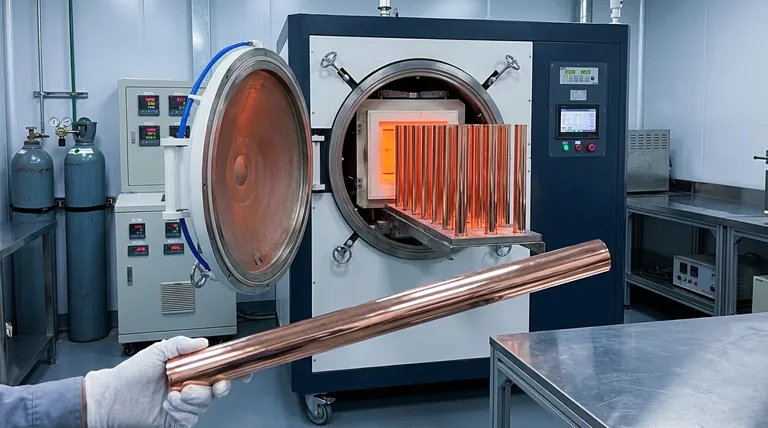
The Challenge: Why Standard Heat Treatment Fails
Heat treatment is necessary to relieve internal stresses and refine the grain structure of the copper, making it strong and ductile. However, performing this in a standard air-filled furnace creates more problems than it solves for high-specification components.
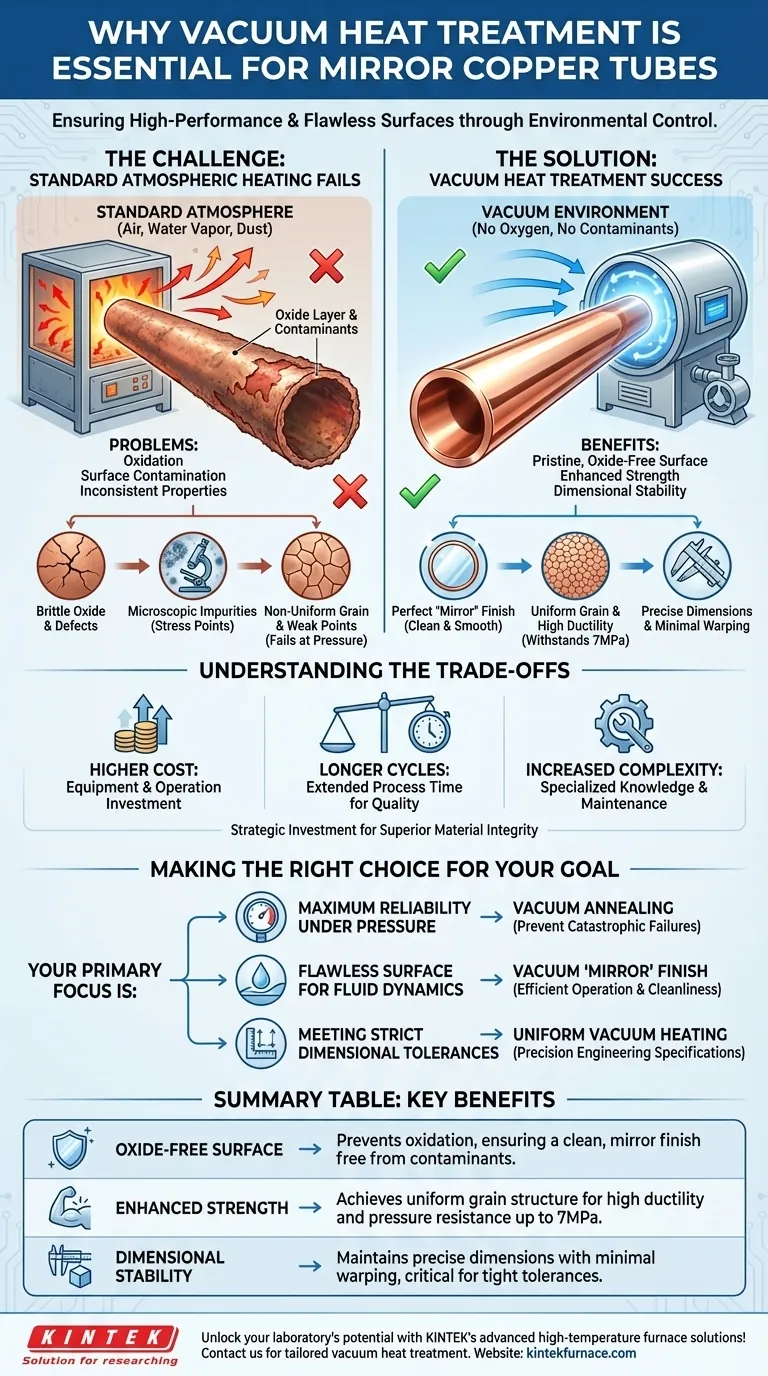
The Problem of Oxidation
Copper reacts readily with oxygen at high temperatures. This reaction forms a brittle, flaky layer of copper oxide on the surface.
This oxide layer ruins the "mirror" finish, can flake off to contaminate systems like air conditioners, and creates a weak point on the tube's surface.
Surface Contamination and Impurities
Standard atmosphere is filled with water vapor, dust, and other gases. During heating, these contaminants can embed into the copper's surface.
These embedded impurities create microscopic defects that act as stress concentration points, significantly increasing the risk of cracks and leaks, especially under high pressure.
Inconsistent Mechanical Properties
Heating in a furnace with circulating air can lead to uneven temperature distribution across the tube.
This results in a non-uniform grain structure and inconsistent mechanical properties, making it impossible to reliably meet strict performance standards like withstanding 7MPa of pressure without failure.
How Vacuum Heat Treatment Solves the Core Problems
By performing the heat treatment process inside a vacuum, we fundamentally change the outcome. The vacuum removes the reactive elements—primarily oxygen and water vapor—that cause degradation.
Achieving a Pristine, Oxide-Free Surface
The primary benefit of a vacuum is the near-total removal of oxygen. With no oxygen to react with, the copper surface remains bright, smooth, and clean throughout the heating and cooling cycle.
This is what produces the "mirror" finish and ensures the inner surface of the tube is free of particulates that could disrupt system performance.
Enhancing Mechanical Strength and Ductility
In the clean environment of a vacuum, the annealing process can proceed perfectly. This creates a highly uniform and refined grain structure throughout the material.
This structural uniformity is what gives the tube its stable performance and high ductility, allowing it to withstand extreme pressure (7MPa) and vibration without breakage.
Ensuring Dimensional Stability
Vacuum furnaces provide exceptionally uniform and controlled heating and cooling. This controlled thermal cycle minimizes warping and distortion.
As a result, the tubes maintain their precise dimensions, including critical specifications like wall thickness deviation of less than 20%, which is essential for consistent performance and proper fitting.
Understanding the Trade-offs
While vacuum heat treatment is the superior method, it's important to recognize the associated trade-offs, which are primarily related to cost and complexity.
Higher Equipment and Operational Costs
Vacuum furnaces and their associated pumping systems are significantly more expensive to purchase and operate than conventional atmospheric furnaces. This is an investment in quality.
Longer Process Cycle Times
Achieving a deep vacuum and executing a precisely controlled cooling curve takes more time than a simple atmospheric process. This reduces overall throughput but is necessary for the final quality.
Increased Process Complexity
Operating and maintaining a vacuum system requires specialized knowledge. Ensuring the integrity of vacuum seals and monitoring the process is more demanding than with simpler furnace types.
Making the Right Choice for Your Goal
The decision to use vacuum heat treatment is driven entirely by the non-negotiable demands of the final application.
- If your primary focus is maximum reliability under pressure: Vacuum annealing is the only way to create the uniform microstructure needed to prevent catastrophic failures in high-pressure HVAC/R systems.
- If your primary focus is a flawless surface for fluid dynamics: The "mirror" finish achieved in a vacuum is essential for efficient system operation and preventing particulate contamination over the product's lifespan.
- If your primary focus is meeting strict dimensional tolerances: The uniform heating of a vacuum process is critical for minimizing distortion and ensuring components meet precise engineering specifications.
Ultimately, choosing vacuum heat treatment is a strategic decision to guarantee the material integrity required for demanding, high-performance applications.
Summary Table:
| Key Benefit | Description |
|---|---|
| Oxide-Free Surface | Prevents oxidation, ensuring a clean, mirror finish free from contaminants. |
| Enhanced Strength | Achieves uniform grain structure for high ductility and pressure resistance up to 7MPa. |
| Dimensional Stability | Maintains precise dimensions with minimal warping, critical for tight tolerances. |
Unlock the full potential of your laboratory with KINTEK's advanced high-temperature furnace solutions! Leveraging exceptional R&D and in-house manufacturing, we provide diverse laboratories with tailored products like Muffle, Tube, Rotary Furnaces, Vacuum & Atmosphere Furnaces, and CVD/PECVD Systems. Our strong deep customization capability ensures we precisely meet your unique experimental needs, such as achieving flawless mirror copper tubes with vacuum heat treatment. Don't compromise on quality—contact us today to discuss how we can enhance your processes and deliver reliable, high-performance results!
Visual Guide
Related Products
- Vacuum Heat Treat Furnace with Ceramic Fiber Liner
- 2200 ℃ Graphite Vacuum Heat Treat Furnace
- Molybdenum Vacuum Heat Treat Furnace
- 2200 ℃ Tungsten Vacuum Heat Treat and Sintering Furnace
- Vacuum Heat Treat Sintering and Brazing Furnace
People Also Ask
- How does vacuum heat treating affect the grain structure of metal alloys? Achieve Precise Microstructure Control
- What are the benefits of using vacuum heat treating furnaces for metal alloys? Achieve Superior Metal Properties and Performance
- What is one of the most important uses of vacuum heat treating furnaces in aerospace? Achieve Superior Strength in Aircraft Alloys
- How does a vacuum heat treat furnace work? Achieve Pristine, High-Performance Results
- What is the difference between heat treat and vacuum heat treat? Achieve Superior Metal Properties with Pristine Finishes



















