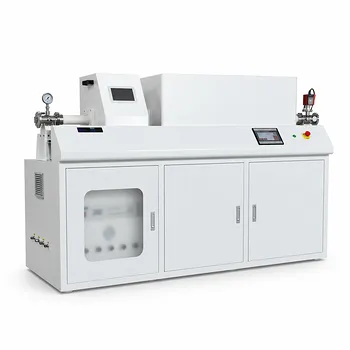
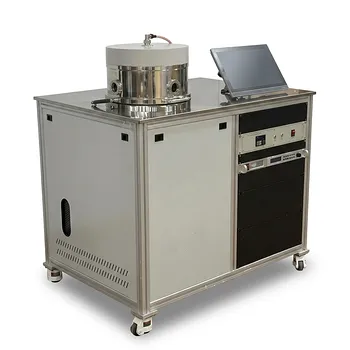
A precision annealing furnace is the foundational tool for stabilizing glass structure. It is essential because it eliminates the internal thermal stresses that accumulate during the rapid cooling of molten glass. Without this controlled heat treatment, gradient refractive index (GRIN) glass films would be prone to spontaneous cracking, optical distortion, and failure during subsequent processing.
Precision annealing transforms unstable, stressed glass into a reliable optical material by regulating temperature and cooling rates. This process is the only way to ensure the structural integrity and optical uniformity required for high-performance glass applications.
The Mechanics of Stress Elimination
Neutralizing Internal Thermal Gradients
When glass is formed or quenched, the exterior cools faster than the interior, creating massive internal tension. Precision annealing furnaces hold the glass at a specific temperature—often near its transition point—to allow the atomic structure to relax and redistribute these stresses.
The Role of Controlled Slow Cooling
After the stress is released, the furnace must cool the glass at a highly regulated, slow rate (such as 30°C per hour). This prevents new stresses from forming, which is critical for maintaining the specific density and refractive index profiles required in gradient films.
Maintaining Material Homogeneity
In GRIN glass, the refractive index varies by design; any unplanned stress-induced density changes would ruin the optical gradient. A precision furnace ensures that the only variations in the glass are the intentional ones, preserving the optical uniformity of the film.
Ensuring Mechanical and Structural Integrity
Preventing Spontaneous Fractures
Glass that has not been properly annealed contains "frozen-in" strain that can cause the material to shatter without warning. A precision furnace provides the mechanical stability necessary to keep the film intact from the moment it is formed until it reaches the end user.
Enabling Secondary Processing
Gradient glass films often require cutting, grinding, or polishing to reach their final dimensions. Eliminating residual stress is vital because it ensures the glass can withstand the mechanical vibrations and pressures of these processes without cracking.
Stability for Powder Conversion
If the glass is intended to be processed into fine powders, it must first be structurally sound. Annealing ensures the bulk glass is stable enough to be crushed or milled into uniform fine powders without unpredictable fracturing.
Common Pitfalls and Trade-offs
The Risk of Improper Temperature Selection
Setting the annealing temperature too high can lead to unwanted crystallization or deformation of the glass film. Conversely, if the temperature is too low, the internal stresses will not be fully eliminated, leading to long-term structural instability.
Time vs. Stability Trade-offs
Precision annealing is a time-consuming process that can act as a bottleneck in production. While shortening the annealing cycle may increase throughput, it significantly increases the risk of optical aberrations and mechanical failure in the final product.
How to Apply This to Your Project
Making the Right Choice for Your Goal
To achieve the best results with your gradient refractive index glass, your annealing strategy must align with your final application.
- If your primary focus is optical precision: Prioritize a very slow cooling rate (e.g., <20°C/hr) to ensure maximum refractive index uniformity across the gradient.
- If your primary focus is mechanical durability: Focus on the precise hold time at the annealing point to ensure all internal tension is fully neutralized before cooling begins.
- If your primary focus is high-volume production: Invest in multi-zone furnaces that can maintain tighter tolerances while processing larger batches of film simultaneously.
By mastering the annealing phase, you ensure that your gradient refractive index glass films meet the rigorous standards of modern optical systems.
Summary Table:
| Key Feature | Role in GRIN Glass Preparation | Primary Benefit |
|---|---|---|
| Stress Elimination | Neutralizes internal tension from rapid cooling | Prevents spontaneous cracking & shattering |
| Slow Cooling Rates | Prevents new thermal gradients from forming | Maintains precise density & refractive index |
| Material Homogeneity | Preserves intentional optical gradients | Ensures high-performance optical uniformity |
| Mechanical Stability | Toughens the glass structure | Enables safe cutting, grinding, and polishing |
| Thermal Precision | Regulates temperature near transition points | Prevents unwanted crystallization or deformation |
Optimize Your Optical Materials with KINTEK Precision Furnaces
Don't let internal stress compromise the quality of your gradient refractive index glass. KINTEK specializes in advanced laboratory high-temperature furnaces engineered for the precise cooling and thermal stability your research demands.
From muffle and tube furnaces to vacuum, CVD, and atmosphere-controlled systems, our equipment is fully customizable to meet your unique processing needs. Whether you are aiming for maximum optical precision or high-volume production durability, KINTEK provides the reliability and expertise you need to succeed.
Ready to elevate your lab's capabilities? Contact our thermal processing experts today to find the perfect furnace solution for your project!
References
- Shihong Liang, Xiaohong Yan. Preparation and Optical Property of Far-Red LED Encapsulated with the Graded-Index Fluorescent Glass Film. DOI: 10.3390/electronics12163448
This article is also based on technical information from Kintek Furnace Knowledge Base .
Related Products
- Custom Made Versatile CVD Tube Furnace Chemical Vapor Deposition CVD Equipment Machine
- Multi Heating Zones CVD Tube Furnace Machine for Chemical Vapor Deposition Equipment
- Controlled Inert Nitrogen Hydrogen Atmosphere Furnace
- Slide PECVD Tube Furnace with Liquid Gasifier PECVD Machine
- Inclined Rotary Plasma Enhanced Chemical Deposition PECVD Tube Furnace Machine
People Also Ask
- Why are CVD tube furnace sintering systems indispensable for 2D material research and production? Unlock Atomic-Scale Precision
- What is a CVD tube furnace and what is its primary function? Discover Precision Thin-Film Deposition
- How does CVD tube furnace sintering enhance graphene growth? Achieve Superior Crystallinity and High Electron Mobility
- Which industries and research fields benefit from CVD tube furnace sintering systems for 2D materials? Unlock Next-Gen Tech Innovations
- What are the practical applications of gate media prepared by CVD tube furnaces? Unlock Advanced Electronics and More