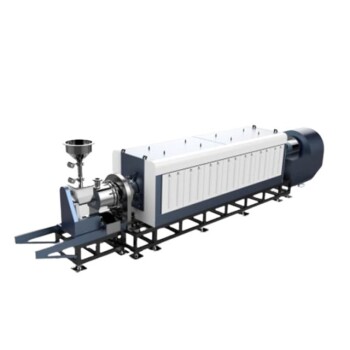
The electric muffle furnace acts as the primary thermal reactor for converting camel manure into biochar. It maintains a constant high temperature—typically 500 °C for four hours—within a sealed, oxygen-deficient environment to facilitate the thermochemical decomposition (pyrolysis) of the biomass without allowing it to catch fire.
The electric muffle furnace provides the precise anaerobic conditions necessary to prevent complete oxidative combustion, allowing camel manure to carbonize into a stable, porous material while preserving critical surface functional groups.
The Role of Controlled Thermal Decomposition
Maintaining an Anaerobic Environment
The furnace creates a sealed or oxygen-limited atmosphere that is critical for the carbonization process. By inhibiting combustion, the equipment ensures that the organic material is thermally decomposed rather than destroyed by fire.
This oxygen-deficient state is often achieved by sealing the material in crucibles or introducing an inert gas flow, such as nitrogen. This environment allows the raw biomass to transform into a stable carbon skeleton.
Precise Temperature and Residence Time
The furnace allows operators to set specific heating rates and residence times, which directly influence the biochar’s final quality. For camel manure, maintaining a steady 500 °C ensures a complete transition from raw organic matter to carbon-rich biochar.
Precise control over these parameters prevents "over-cooking," which could lead to excessive ash content or the loss of structural integrity. Stable temperatures are essential for achieving consistent physicochemical properties across different batches.
Impact on Chemical and Physical Structure
Retention of Surface Functional Groups
The specific environment inside the muffle furnace allows for the retention of vital surface functional groups, such as carboxyl, hydroxyl, and phenolic groups. These chemical markers are essential for the biochar's performance in environmental applications.
Because the furnace prevents complete oxidation, these groups remain bonded to the carbon surface. This makes the resulting biochar highly effective for adsorption and chemical interaction with pollutants.
Development of Porous Architecture
The heat provided by the furnace drives off volatile components in the camel manure, leaving behind a preliminary pore structure. This increased surface area is what gives biochar its ability to hold water and nutrients.
The uniformity of the furnace's heat distribution ensures that the pore development is consistent throughout the sample. This structural foundation is necessary for any subsequent chemical modifications or industrial uses.
Understanding the Trade-offs
Temperature vs. Surface Area
While higher temperatures (above 600 °C) generally increase the specific surface area and porosity of the biochar, they can also cause the degradation of important oxygen-containing functional groups.
Conversely, lower temperatures may result in incomplete carbonization, leaving behind a higher percentage of volatile matter. The furnace must be calibrated to the specific goal of the project to balance structural surface area against chemical reactivity.
Concentration of Contaminants
Thermal treatment in a muffle furnace naturally leads to the enrichment of heavy metals and the potential generation of polycyclic aromatic hydrocarbons (PAHs). As the organic mass decreases, non-volatile elements become more concentrated in the final product.
The choice of temperature and residence time directly influences the concentration and stability of these compounds. Careful monitoring of the furnace settings is required to ensure the biochar remains environmentally safe for soil or water treatment.
Making the Right Choice for Your Goal
Applying These Principles to Production
When using a muffle furnace for camel manure pyrolysis, your settings should be dictated by the intended application of the biochar.
- If your primary focus is Adsorption Capacity: Utilize higher temperatures (500 °C to 600 °C) to maximize the development of pore structures and surface area.
- If your primary focus is Chemical Reactivity: Maintain moderate temperatures (around 400 °C to 500 °C) to preserve the carboxyl and hydroxyl functional groups.
- If your primary focus is Carbon Sequestration: Ensure longer residence times at stable temperatures to create the most chemically stable carbon substrate possible.
By mastering the furnace's environmental controls, you can precisely tune the properties of camel manure biochar to meet specific technical requirements.
Summary Table:
| Parameter | Role in Pyrolysis | Impact on Final Biochar |
|---|---|---|
| Atmosphere | Anaerobic/Oxygen-limited | Prevents combustion; preserves carbon skeleton |
| Temperature | Stable 500°C (Standard) | Balances specific surface area & chemical reactivity |
| Residence Time | Controlled duration (e.g., 4h) | Ensures complete transition and structural integrity |
| Thermal Uniformity | Consistent heat distribution | Guarantees uniform pore development across batches |
Elevate Your Biochar Research with KINTEK Precision
Precision is the difference between simple ash and high-performance biochar. At KINTEK, we specialize in advanced laboratory equipment designed to meet the rigorous demands of biomass pyrolysis. Our comprehensive range of high-temperature furnaces—including muffle, tube, rotary, vacuum, CVD, and atmosphere furnaces—provides the stable anaerobic conditions and exacting temperature control necessary to optimize your carbonization yields.
Whether you are a researcher refining camel manure biochar or an industrial developer seeking customizable thermal solutions, KINTEK offers the reliability and technical expertise you need to succeed. Contact us today to discuss your unique project requirements and discover how our customizable high-temp furnaces can enhance your laboratory’s efficiency and output!
References
- Kenesha Wilson, Yousef Nazzal. Camel Dung-Derived Biochar for the Removal of Copper(II) and Chromium(III) Ions from Aqueous Solutions: Adsorption and Kinetics Studies. DOI: 10.1021/acsomega.3c08230
This article is also based on technical information from Kintek Furnace Knowledge Base .
Related Products
- Electric Rotary Kiln Small Rotary Furnace Biomass Pyrolysis Plant Rotating Furnace
- Electric Rotary Kiln Continuous Working Small Rotary Furnace Kiln for Pyrolysis Plant Heating
- Electric Rotary Kiln Pyrolysis Furnace Plant Machine Small Rotary Kiln Calciner
- 1200℃ Muffle Oven Furnace for Laboratory
- High Temperature Muffle Oven Furnace for Laboratory Debinding and Pre Sintering
People Also Ask
- What are the key components of a rotary kiln electric furnace? Unlock Efficient Thermal Processing
- What is the significance of the refractory lining in a rotary kiln electric furnace? Unlock Efficiency and Longevity
- What are the main applications of a rotary kiln electric furnace? Achieve Uniform Heat Treatment for Powders
- What are the key components of a rotary kiln's construction? Discover the Essential Parts for Efficient Industrial Processing
- What are the differences between direct-heat and indirect-heat rotary kilns? Choose the Right Kiln for Your Process