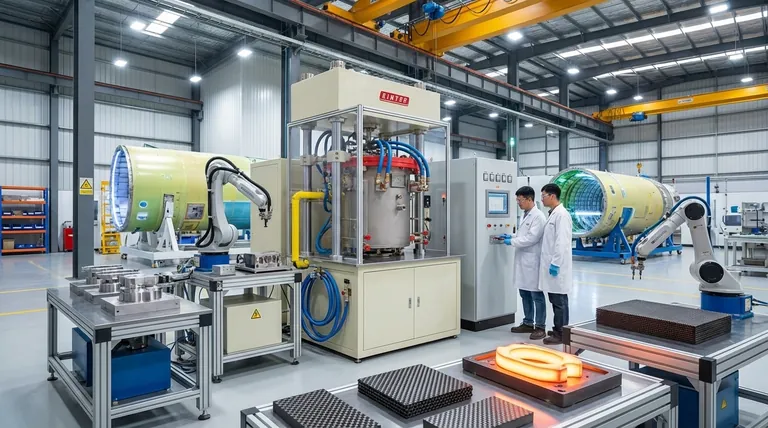
In the aerospace industry, Vacuum Hot Press (VHP) equipment is a critical manufacturing tool used to create high-performance components from advanced materials. It is essential for producing parts that must withstand extreme temperatures and mechanical stress, such as ceramic matrix composite (CMC) turbine blades, lightweight metal matrix composite (MMC) structural elements, and heat shields for hypersonic vehicles. The process simultaneously applies high heat and pressure in a vacuum to forge materials with properties unattainable through conventional methods.
At its core, the use of Vacuum Hot Press technology in aerospace is driven by a non-negotiable need: achieving near-perfect material integrity. The process is not just about shaping a part; it is about fundamentally creating a material with maximum density, strength, and purity, which is essential for components where failure is not an option.
The Principle: Why Heat, Pressure, and Vacuum Are Essential
A Vacuum Hot Press combines three environmental forces to produce superior materials. Understanding how each contributes is key to grasping its importance in aerospace.
Eliminating Porosity with High Pressure
The immense, uniform pressure applied by the press physically compacts powdered or layered materials. This force squeezes out voids and porosity, which are microscopic weak points where cracks can form under stress.
The result is a fully dense or near-fully dense component, a critical requirement for parts subjected to the intense vibrations and loads of flight.
Enabling Bonding with High Heat
Simultaneously, the system heats the material to extremely high temperatures, often just below its melting point. This thermal energy activates a process called diffusion bonding or sintering.
Atoms migrate across the boundaries of individual material grains or layers, fusing them into a single, solid, monolithic structure with exceptional mechanical strength.
Ensuring Purity with a Vacuum
The entire process occurs inside a vacuum chamber. Removing the atmosphere prevents high-temperature oxidation and contamination, which is especially critical for reactive materials like titanium and nickel-based superalloys used in jet engines.
This vacuum environment ensures the final material is chemically pure and free from impurities that could compromise its performance at extreme temperatures.
Key Applications in Aerospace Manufacturing
The unique capabilities of VHP make it the preferred, and sometimes only, method for manufacturing certain classes of aerospace components.
Crafting Ceramic Matrix Composites (CMCs)
CMCs are used for the hottest sections of jet engines and on thermal protection systems. VHP is used to infiltrate and consolidate ceramic fibers with a ceramic matrix.
The process achieves full densification without damaging the delicate reinforcing fibers, creating a lightweight material that is incredibly tough and resistant to extreme heat. Key examples include turbine shrouds, combustor liners, and exhaust nozzles.
Forging Metal Matrix Composites (MMCs)
MMCs combine a metal (like aluminum or titanium) with a reinforcing material (like silicon carbide) to create a material that is both light and exceptionally strong and stiff.
VHP is used to bond the metal matrix to the reinforcement, ensuring there are no voids or weak points at the interface. This is vital for producing lightweight structural components and actuator arms.
Processing High-Performance Superalloys
For engine components like turbine disks and blades, VHP is used to process powdered superalloys or to diffusion-bond multiple wrought alloy sections together.
This creates a "near-net-shape" part that requires minimal final machining, saving expensive material and ensuring a uniform, fine-grained microstructure for superior fatigue life and creep resistance.
Understanding the Trade-offs
While powerful, VHP technology is not a universal solution. Its application involves clear trade-offs that engineers must consider.
High Equipment and Operational Costs
Vacuum Hot Press systems are complex and expensive to procure, install, and maintain. The high energy consumption and specialized tooling contribute to a higher cost per part.
Slower Cycle Times
Compared to conventional manufacturing like forging or casting, the VHP process is significantly slower. Heating, pressing, and cooling cycles can take many hours, making it unsuitable for high-volume production.
Constraints on Component Geometry
The need to apply uniform pressure generally limits VHP to parts with relatively simple geometries. Complex, three-dimensional shapes are often more difficult to produce than with methods like casting or additive manufacturing.
Making the Right Choice for Your Goal
The decision to use Vacuum Hot Pressing depends entirely on the performance requirements of the final component.
- If your primary focus is producing flight-critical components with maximum strength and heat resistance: VHP is the indispensable standard for processing CMCs, MMCs, and powdered superalloys.
- If your primary focus is materials research and development: VHP is a vital laboratory tool for rapidly prototyping new material formulations and investigating the fundamental principles of densification.
- If your primary focus is cost-effective, high-volume production: You must carefully evaluate if the unparalleled performance benefits of VHP justify its higher cost and slower speed compared to conventional manufacturing methods.
Ultimately, Vacuum Hot Pressing is the technology that empowers engineers to create the next generation of materials that make aircraft and spacecraft lighter, faster, and safer.
Summary Table:
| Aspect | Details |
|---|---|
| Key Applications | CMC turbine blades, MMC structural elements, superalloy engine parts |
| Process Benefits | Maximum density, strength, purity via heat, pressure, and vacuum |
| Material Types | Ceramic matrix composites, metal matrix composites, nickel/titanium superalloys |
| Trade-offs | High cost, slow cycle times, geometry limitations |
Elevate Your Aerospace Manufacturing with KINTEK Solutions
Leveraging exceptional R&D and in-house manufacturing, KINTEK provides diverse laboratories with advanced high-temperature furnace solutions. Our product line, including Muffle, Tube, Rotary Furnaces, Vacuum & Atmosphere Furnaces, and CVD/PECVD Systems, is complemented by our strong deep customization capability to precisely meet unique experimental requirements. Whether you're developing CMCs, MMCs, or superalloys for aerospace, we deliver tailored equipment that ensures maximum performance and reliability.
Contact us today to discuss how our Vacuum Hot Press and other furnace technologies can drive your innovations forward!
Visual Guide

Related Products
- Vacuum Hot Press Furnace Machine for Lamination and Heating
- Vacuum Hot Press Furnace Machine Heated Vacuum Press
- Vacuum Hot Press Furnace Machine Heated Vacuum Press Tube Furnace
- 600T Vacuum Induction Hot Press Vacuum Heat Treat and Sintering Furnace
- Vacuum Heat Treat Sintering Furnace with Pressure for Vacuum Sintering
People Also Ask
- What are the primary components of a vacuum hot press furnace? Master the Core Systems for Precise Material Processing
- What safety features are incorporated in vacuum hot press furnaces? Ensure Operator and Equipment Protection
- What are the benefits of the vacuum environment system in a vacuum hot press furnace? Unlock High-Density Sintering
- What industries benefit from the use of vacuum hot press furnaces? Unlock High-Performance Materials for Your Industry
- Why is a high vacuum environment crucial when preparing copper-carbon nanotube composites in a vacuum hot press furnace? Achieve Superior Composite Integrity