
Industrial thermal analysis simulation software serves as a virtual laboratory for the intricate directional solidification process. By utilizing advanced physical models of heat conduction, thermal radiation, and phase-change latent heat, the software accurately predicts dynamic temperature fields within complex mold configurations. This capability allows engineers to visualize invisible phenomena—specifically liquidus isotherm curvatures and melt convection patterns—enabling the refinement of designs and processes before a single blade is cast.
The core value of this software lies in its ability to reveal the "hidden physics" of casting. By modeling the thermal environment with precision, it transforms the optimization of heat baffles and withdrawal rates from a trial-and-error experiment into a predictable science, ensuring structural consistency and reducing manufacturing costs.
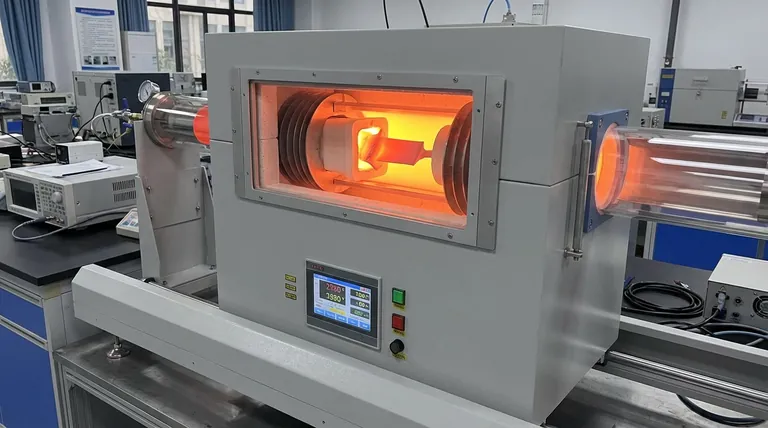
Unveiling the Invisible Physics of Solidification
Modeling Complex Heat Transfer
The software functions by integrating three fundamental physical models: heat conduction, thermal radiation, and phase-change latent heat.
These models work in unison to calculate how thermal energy moves through the casting assembly. This is critical for predicting temperature changes within mold shapes that are geometrically complex.
Visualizing Liquidus Isotherm Curvatures
A primary contribution of this technology is the visualization of the liquidus isotherm—the boundary between liquid and solid metal.
The curvature of this isotherm is critical for single-crystal growth but is invisible to the naked eye. Simulation exposes this geometry, allowing engineers to verify if the solidification front is planar or convex as required.
Revealing Melt Convection Patterns
Beyond simple temperature mapping, these simulations identify melt convection patterns within the liquid metal.
Understanding these fluid dynamics is essential. It helps engineers predict how molten metal flows and interacts with the solidifying front, which can influence defect formation.
Optimizing Process Parameters and Design
Refining Heat Baffle Designs
The software provides the data necessary to optimize the design of heat baffles used in the furnace.
By simulating the thermal environment, engineers can adjust baffle configurations to control heat radiation precisely. This ensures the correct thermal gradient is maintained throughout the solidification process.
Tuning the Withdrawal Process
The speed at which the mold is withdrawn from the hot zone determines the quality of the crystal structure.
Simulation allows for the "virtual withdrawal" of the mold at various rates. This helps identify the optimal speed that maintains the desired solidification front without inducing defects.
Reducing Manufacturing Costs
By performing these optimizations digitally, manufacturers significantly reduce the need for physical trial runs.
This minimizes the scrap rate of expensive superalloys and ceramic molds. It streamlines the development cycle, leading to direct cost savings.
Improving Structural Consistency
The ultimate goal of using these simulations is to ensure the reliability of the final product.
By controlling the thermal variables, the software helps produce blades with uniform structural properties. This consistency is vital for components subjected to the extreme environments of gas turbines.
Understanding the Limitations
Dependence on Input Accuracy
The simulation is only as reliable as the physical models it employs.
If the input data regarding material properties or boundary conditions is imprecise, the predicted temperature fields will be inaccurate.
Complexity vs. Speed
Modeling phase-change latent heat and radiation in complex 3D shapes is computationally intensive.
High-fidelity simulations require significant processing power and time. Engineers must balance the need for extreme detail with the practical constraints of production timelines.
Making the Right Choice for Your Goal
To maximize the benefits of industrial thermal analysis, align your simulation strategy with your specific manufacturing objectives:
- If your primary focus is cost reduction: Concentrate on virtually iterating heat baffle designs to eliminate the waste associated with failed physical prototypes.
- If your primary focus is product quality: Prioritize the detailed analysis of liquidus isotherm curvatures to ensure a defect-free, single-crystal structure.
By leveraging these digital insights, you move beyond intuition and ground your manufacturing process in verifiable, physical data.
Summary Table:
| Optimization Factor | Simulation Contribution | Manufacturing Impact |
|---|---|---|
| Isotherm Curvature | Visualizes liquid/solid boundary | Ensures defect-free crystal growth |
| Heat Transfer | Models conduction & radiation | Predicts dynamic temperature fields |
| Baffle Design | Digital iteration of thermal shields | Precise control of thermal gradients |
| Withdrawal Rate | Virtual testing of mold movement | Prevents structural inconsistency |
| Production Cost | Reduces physical trial-and-error | Minimizes scrap and material waste |
Precision Engineering for High-Temperature Applications
Take your thermal processing to the next level with KINTEK. Backed by expert R&D and world-class manufacturing, we provide high-performance Muffle, Tube, Rotary, Vacuum, and CVD systems tailored for the most demanding lab and industrial needs. Whether you are refining directional solidification or developing advanced superalloys, our customizable high-temperature furnaces deliver the consistency and control you require.
Ready to optimize your thermal workflow? Contact us today to discuss your unique project requirements with our technical specialists.
References
- Effect of Temperature Profile Curvature on the Formation of Atypical Inhomogeneity of Dendritic Microstructure Across the Width of a Single Crystal Blade. DOI: 10.1007/s11661-025-07909-y
This article is also based on technical information from Kintek Furnace Knowledge Base .
Related Products
- Multi Heating Zones CVD Tube Furnace Machine for Chemical Vapor Deposition Equipment
- Multi Zone Laboratory Quartz Tube Furnace Tubular Furnace
- High Temperature Muffle Oven Furnace for Laboratory Debinding and Pre Sintering
- 1700℃ High Temperature Muffle Oven Furnace for Laboratory
- Vertical Laboratory Quartz Tube Furnace Tubular Furnace
People Also Ask
- What is the function of a multi-zone tube furnace in CVD synthesis? Master 2D In2Se3 Nanosheet Precision
- Why are multi zone tube furnaces particularly useful for nanomaterial research? Unlock Precise Thermal Control for Advanced Synthesis
- What temperature-related capabilities make multi zone tube furnaces valuable for research? Unlock Precision Thermal Control
- What environmental protection applications utilize multi zone tube furnaces? Unlock Precision in Waste Treatment and Green Tech
- What role do multi zone tube furnaces play in new energy research? Unlock Precise Thermal Control for Innovation



















