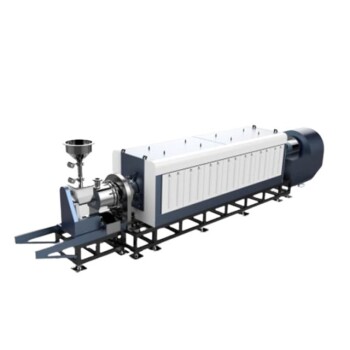
High-precision muffle furnaces are essential for wine by-product analysis because they provide the exact thermal control required to release complex volatiles without oxidation. By maintaining a strict temperature of 950°C and employing multi-stage heating increments, these furnaces ensure that organic components are fully gasified in a controlled, anaerobic environment. This level of precision is the only way to accurately evaluate the flammability and chemical energy potential of the biomass.
A high-precision muffle furnace ensures accurate biomass assessment by managing the incremental release of volatiles in an oxygen-free environment. This prevents premature combustion and ensures that complex organic molecules are fully decomposed for precise flammability and yield calculations.
The Necessity of a Controlled Anaerobic Environment
Preventing Oxidative Combustion
To determine volatile matter, the biomass must undergo pyrolysis rather than simple burning. The furnace, combined with sealed crucibles, creates an oxygen-deficient environment that allows gases like methane and carbon monoxide to escape without catching fire.
Preserving Chemical Integrity
A high-precision furnace prevents external air from interfering with the thermal decomposition process. This isolation is critical for distinguishing between the proportion of condensable vapors and non-condensable gases within the wine by-product.
Ensuring Accurate Mass Loss Measurements
The determination of volatile matter relies entirely on measuring mass loss after heating. If the environment is not strictly controlled, unintended oxidation of fixed carbon will occur, leading to inflated and inaccurate volatile matter readings.
Why Multi-Stage Heating Matters for Biomass
Managing Complex Organic Structures
Wine by-products contain diverse and complex organic components that release at different thermal thresholds. Multi-stage heating allows for the gradual evolution of these volatiles, ensuring that the sample does not undergo violent "thermal shock" that could eject material from the crucible.
Facilitating Complete Pyrolysis
Certain volatile components require specific heating increments to be fully released from the biomass matrix. A high-precision furnace can follow a programmed heating curve to ensure that every combustible gas is driven out within the standardized timeframe.
Evaluating Flammability and Ignition
The rate at which volatiles are released directly impacts the assessment of a fuel's ignition ease. By controlling the heating stages, technicians can better understand the combustion intensity and flame length characteristics of the resulting biomass fuel.
The Role of High-Temperature Stability
Maintaining the 950°C Threshold
Standard protocols for wine by-products often demand temperatures as high as 950°C to ensure the complete breakdown of resilient organic structures. High-precision furnaces provide the stability needed to hold these extreme temperatures without fluctuations that would compromise the data.
Rapid Temperature Recovery
When a sample is introduced, the furnace must be able to recover its set temperature rapidly. This "rapid rise" capability is vital for ensuring that the pyrolysis occurs within the 7 to 10-minute window required by most testing standards.
Mineralization and Ash Consistency
Beyond volatiles, the stable high-temperature environment is necessary for thermal mineralization. This ensures that the remaining organic matter is completely carbonized, leaving behind only the inorganic ash for an accurate proximate analysis.
Common Pitfalls and Trade-offs
The Risk of Incomplete Sealing
Even the highest-quality furnace cannot compensate for a poorly fitted crucible lid. If the seal is not airtight, oxygen will enter, causing the sample to oxidize and rendering the "volatile matter" calculation useless.
Equipment Wear vs. Precision
Operating consistently at 950°C places significant stress on the furnace's heating elements and refractory lining. While high-precision models are built for this, they require more frequent calibration and maintenance than lower-temperature ovens used for simple drying.
Sample Preparation Sensitivity
The moisture content and particle size of the wine by-product can affect how it responds to multi-stage heating. Inconsistent sample preparation can lead to "popping" or uneven gas release, even if the furnace's thermal program is perfectly executed.
Applying This to Your Biomass Analysis
Making the Right Choice for Your Goal
- If your primary focus is evaluating fuel flammability: Use a furnace with a programmable multi-stage controller to observe how volatiles release at specific temperature increments.
- If your primary focus is calculating pyrolysis yields: Ensure the furnace can maintain a strict anaerobic environment at 950°C to accurately separate condensable vapors from fixed carbon.
- If your primary focus is assessing mineralization for compost: A furnace capable of stable operation at 550°C is sufficient to oxidize organic structures into ash.
Precision in thermal management is the foundation of turning raw biomass into reliable energy data.
Summary Table:
| Feature | Purpose in Biomass Analysis | Key Benefit |
|---|---|---|
| 950°C Stability | Complete breakdown of resilient organic structures | Accurate proximate analysis & data integrity |
| Multi-Stage Heating | Controlled, gradual evolution of complex volatiles | Prevents thermal shock and sample ejection |
| Anaerobic Environment | Facilitates pyrolysis rather than simple burning | Prevents oxidative loss of fixed carbon |
| Rapid Thermal Recovery | Re-establishes set-point quickly after sample entry | Ensures pyrolysis within strict 7-10 min windows |
Elevate Your Research with KINTEK Precision
Accurate biomass assessment requires more than just heat—it requires absolute thermal control. KINTEK specializes in premium laboratory equipment and consumables, offering a comprehensive range of high-temperature furnaces, including muffle, tube, rotary, vacuum, CVD, atmosphere, dental, and induction melting furnaces.
Whether you are analyzing wine by-products or developing new biofuels, our furnaces are fully customizable to meet your unique multi-stage heating and anaerobic requirements. Don't compromise your yield data with inconsistent temperatures.
Ready to optimize your lab’s efficiency? Contact our technical experts today to find the perfect, high-precision heating solution tailored to your specific application!
References
- Miguel Oliveira, Amadeu Borges. Transforming Wine By-Products into Energy: Evaluating Grape Pomace and Distillation Stillage for Biomass Pellet Production. DOI: 10.3390/app14167313
This article is also based on technical information from Kintek Furnace Knowledge Base .
Related Products
- High Temperature Muffle Oven Furnace for Laboratory Debinding and Pre Sintering
- 1400℃ Muffle Oven Furnace for Laboratory
- 1700℃ High Temperature Muffle Oven Furnace for Laboratory
- 1800℃ High Temperature Muffle Oven Furnace for Laboratory
- 1200℃ Muffle Oven Furnace for Laboratory
People Also Ask
- What thermal phenomena occur during polymer binder burnout in ceramic green bodies? Lab Furnace Guide
- Why is controlled heat treatment in a muffle furnace necessary for calcined clay? Achieve Optimal Pozzolanic Activity
- What role does a high-temperature muffle furnace play in STFO synthesis? Achieve Pure Perovskite Results
- How does a high-temperature muffle furnace facilitate the formation of LaNbxAl1−xO3+δ perovskite structures? Key Roles
- What role does a high-temperature muffle furnace play in the multi-stage synthesis of Li0.5MnFe1.5O4? Key to Pure Spinel