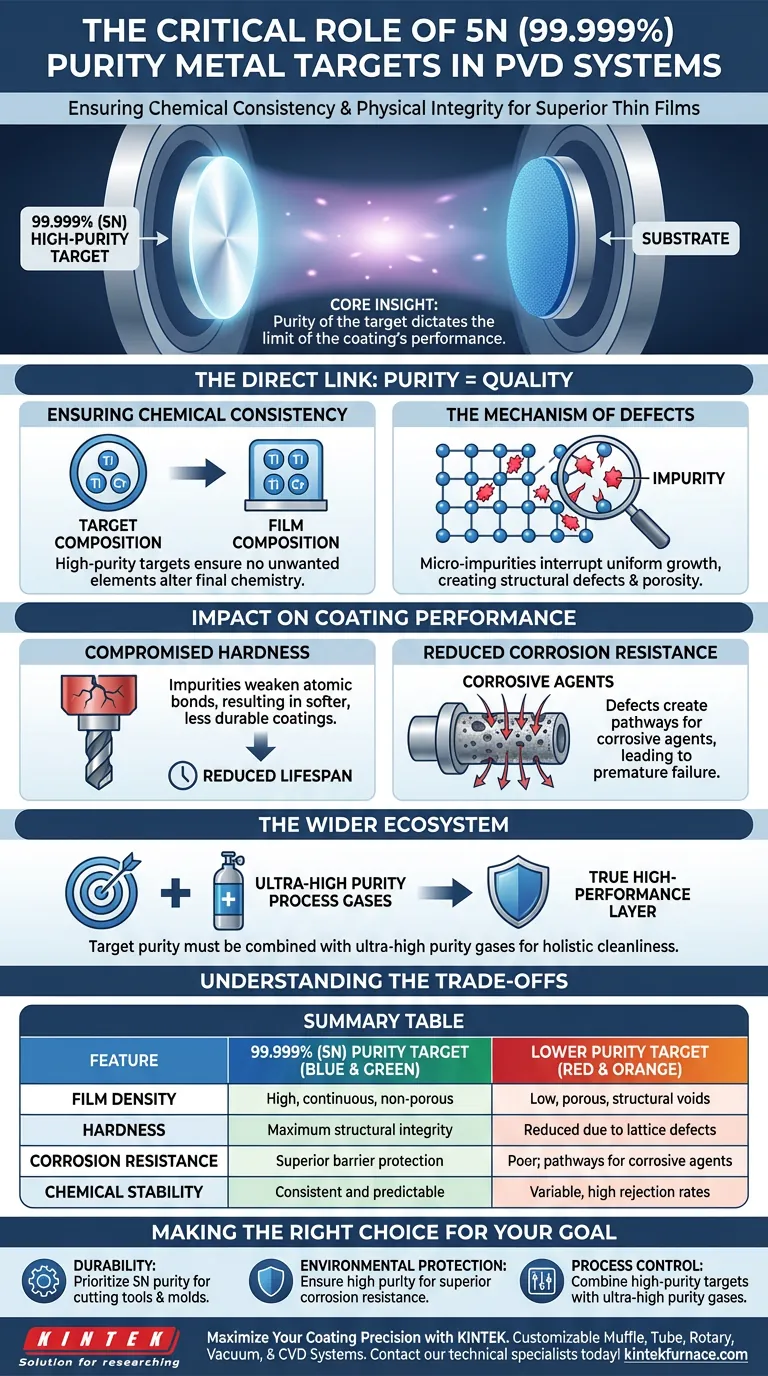
PVD systems require high-purity (99.999%) metal targets primarily to guarantee the chemical consistency and physical integrity of the deposited thin film. This "5N-grade" standard is essential because even microscopic impurities in the source material act as contaminants that introduce structural defects, compromising the coating's density and protective qualities.
Core Insight: The purity of the target material dictates the limit of the coating's performance. Using 99.999% purity targets eliminates micro-impurities that otherwise cause reduced hardness, poor corrosion resistance, and structural defects in high-performance applications.
The Direct Link Between Purity and Quality
Ensuring Chemical Consistency
In Physical Vapor Deposition, the material from the target is transferred directly to the substrate. Consequently, the chemical composition of the target defines the composition of the film.
To maintain consistent physical properties across the entire coated surface, the source material—often metals like titanium or chromium—must be chemically uniform. High-purity targets ensure that no unwanted elements alter the intended chemistry of the final layer.
The Mechanism of Defects
When a target contains micro-impurities, these contaminants do not simply disappear during the vacuum process. Instead, they are incorporated into the growing film.
These impurities interrupt the uniform growth of the crystal lattice. This disruption introduces defects that compromise the density of the coating, creating a layer that is structurally porous rather than solid and continuous.
Impact on Coating Performance
Compromised Hardness
For applications such as cutting tools and molds, surface hardness is the primary performance metric.
Defects caused by target impurities weaken the atomic bonds within the film. This results in a coating that is softer and less durable, significantly reducing the lifespan of the tool it is meant to protect.
Reduced Corrosion Resistance
A primary function of PVD coatings is to act as a barrier against environmental damage.
Micro-impurities create weak points and microscopic voids within the film's density. These defects act as pathways for corrosive agents to penetrate the coating and attack the substrate, leading to premature failure.
The Role of the Wider Ecosystem
Pairing with Process Gases
Target purity does not operate in isolation. The industry standard requires a holistic approach to cleanliness.
To achieve a true high-performance protective layer, 5N-grade targets must be combined with ultra-high purity process gases. If the gas introduces contaminants, the benefits of the high-purity target are negated.
Understanding the Trade-offs
The Cost of Inconsistency
While high-purity targets represent a strict standard, deviations from this 99.999% requirement introduce immediate risks.
The trade-off for using lower-grade materials is a loss of predictability. Lower purity introduces variables that result in fluctuating film density and adhesion issues. In industrial settings, this inconsistency leads to a higher rate of part rejection and tool failure.
Making the Right Choice for Your Goal
Selecting the correct target purity is about matching material quality to performance requirements.
- If your primary focus is Durability: Prioritize 5N (99.999%) purity targets to maximize hardness and wear resistance for cutting tools and molds.
- If your primary focus is Environmental Protection: Ensure high target purity to achieve the high film density required for superior corrosion resistance.
- If your primary focus is Process Control: Combine high-purity targets with ultra-high purity gases to eliminate defect variables from the deposition environment.
Ultimately, the integrity of your protective coating is strictly limited by the purity of your source material.
Summary Table:
| Feature | 99.999% (5N) Purity Target | Lower Purity Target |
|---|---|---|
| Film Density | High, continuous, and non-porous | Low, porous with structural voids |
| Hardness | Maximum structural integrity | Reduced due to lattice defects |
| Corrosion Resistance | Superior barrier protection | Poor; pathways for corrosive agents |
| Chemical Stability | Consistent and predictable | Variable with high rejection rates |
Maximize Your Coating Precision with KINTEK
Don't let impurities compromise your research or industrial output. Backed by expert R&D and manufacturing, KINTEK offers a comprehensive range of high-purity materials and advanced thermal solutions, including Muffle, Tube, Rotary, Vacuum, and CVD systems. All our laboratory high-temp furnaces are fully customizable to meet your unique thin-film deposition and material processing needs.
Ready to elevate your film quality? Contact us today to consult with our technical specialists!
Visual Guide
References
- André Paulo Tschiptschin. PROCESSOS SOB VÁCUO USADOS PARA TRATAMENTOS TÉRMICOS E DE SUPERFÍCIE DE AÇOS E LIGAS ESPECIAIS. DOI: 10.17563/rbav.v43i1.1262
This article is also based on technical information from Kintek Furnace Knowledge Base .
Related Products
- Vacuum Dental Porcelain Sintering Furnace for Dental Laboratories
- Ultra Vacuum Electrode Feedthrough Connector Flange Power Lead for High Precision Applications
- Multi Heating Zones CVD Tube Furnace Machine for Chemical Vapor Deposition Equipment
People Also Ask
- What is the purpose of dental sintering furnaces? Transform Zirconia into Durable, High-Quality Dental Restorations
- How does a dental vacuum porcelain furnace maintain restoration quality? Precision Sintering for Superior Esthetics
- What are the main advantages of a dental sintering furnace? Boost Quality, Efficiency, and Profits
- What is the role of dental sintering furnaces in dental restorations? Transform Zirconia into Durable, Aesthetic Teeth
- What are the cooling requirements for ceramics in the Fast Slow Dental Sintering Furnace? Ensure Crack-Free Restorations