In the modified Physical Vapor Transport (PVT) process, the high-purity graphite crucible and lid serve distinct, critical functions that enable the growth of Aluminum Nitride (AlN) crystals. The crucible acts as a thermally conductive vessel for the molten source material, while the lid serves as the primary substrate where the crystals physically nucleate and grow.
Success in the modified PVT process relies on the dual nature of high-purity graphite: it provides the thermal uniformity required for the melt source below and the chemical stability needed for the crystal nucleation surface above.
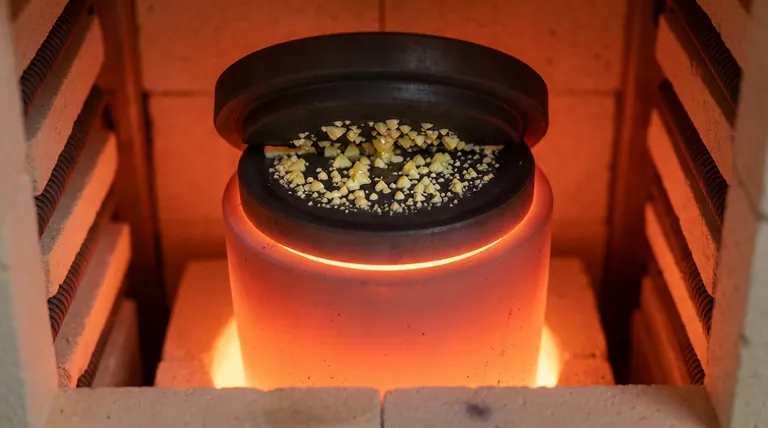
The Role of the Graphite Crucible
Containing the Source Material
The primary function of the crucible is to securely contain the Cu-Al alloy melt. This alloy acts as the source material for the Aluminum species required during the transport process.
Ensuring Thermal Uniformity
The crucible is not merely a container; it is an active participant in thermal regulation.
High-purity graphite is selected for its excellent thermal conductivity. This property ensures that heat is distributed evenly throughout the Cu-Al alloy, preventing temperature gradients that could destabilize the vapor transport.
The Function of the Crucible Lid
Acting as the Growth Substrate
The crucible lid plays the most direct role in crystal formation. It functions as the primary substrate for the process.
During operation, Aluminum Nitride (AlN) crystals spontaneously nucleate and deposit on the lower surface of the lid. This surface dictates the initial formation and subsequent growth of the single crystal.
Providing Chemical Stability
The growth environment for AlN is extreme, involving temperatures of 1700°C and a nitrogen-rich atmosphere.
The graphite lid must remain chemically stable under these conditions. Its ability to withstand high heat and reactive nitrogen without degrading ensures the structural integrity of the growth interface is maintained throughout the cycle.
Critical Considerations and Constraints
The Necessity of High Purity
While graphite is robust, the requirement for "high purity" is non-negotiable.
Any impurities present in the graphite lattice could leach out at 1700°C. This would contaminate the Cu-Al melt or the growing AlN crystal, ruining the semiconductor properties of the final product.
Material Integrity at High Temperatures
Although the reference cites stability at 1700°C, this is near the upper limit for many standard materials in reactive environments.
Operators must ensure the specific grade of graphite selected is rated for these specific thermal loads. Failure to do so can lead to mechanical failure of the lid, causing the growing crystal to detach or the crucible to breach.
Optimizing the Growth Environment
To achieve high-quality AlN crystals, you must select graphite components that align with your specific process controls.
- If your primary focus is melt stability: Prioritize the thermal conductivity specifications of the crucible to ensure the Cu-Al alloy is heated uniformly without hot spots.
- If your primary focus is crystal nucleation: Ensure the crucible lid utilizes the highest available grade of purity to prevent chemical contamination at the growth interface.
By strictly controlling the quality of these graphite components, you establish the stable thermal and chemical foundation necessary for high-quality Aluminum Nitride production.
Summary Table:
| Component | Primary Role | Key Material Property |
|---|---|---|
| Graphite Crucible | Contains Cu-Al melt source | High thermal conductivity |
| Crucible Lid | Acts as growth substrate (nucleation) | Chemical stability at 1700°C |
| High-Purity Graphite | Prevents crystal contamination | Extreme thermal resistance |
Elevate Your Crystal Growth Performance with KINTEK
Precise thermal management and material purity are non-negotiable for high-quality Aluminum Nitride production. Backed by expert R&D and manufacturing, KINTEK offers a wide range of specialized laboratory equipment, including Muffle, Tube, Rotary, Vacuum, and CVD systems. Our high-temp furnaces and components are fully customizable to meet your unique semiconductor and material science needs.
Ready to optimize your growth environment? Contact our experts today to discuss your custom solution!
References
- Xiaochun Tao, Zhanggui Hu. Growth of Spontaneous Nucleation AlN Crystals by Al-Base Alloy Evaporation in Nitrogen Atmosphere. DOI: 10.3390/cryst14040331
This article is also based on technical information from Kintek Furnace Knowledge Base .
Related Products
- MPCVD Machine System Reactor Bell-jar Resonator for Lab and Diamond Growth
- High Temperature Muffle Oven Furnace for Laboratory Debinding and Pre Sintering
- Vertical Laboratory Quartz Tube Furnace Tubular Furnace
- 1400℃ High Temperature Laboratory Tube Furnace with Alumina Tube
- 1400℃ Muffle Oven Furnace for Laboratory
People Also Ask
- What are the essential components of an MPCVD reactor system? Build a Pristine Environment for High-Purity Materials
- How do carbon-containing groups contribute to diamond growth in the MPCVD method? Unlock High-Quality Diamond Synthesis
- How does pressure affect the MPCVD growth process? Master Plasma Control for Superior Film Quality
- What are the key components of an MPCVD system? Unlock High-Purity Crystal Growth
- Why is temperature control important in the MPCVD growth process? Ensure High-Quality, Reliable Diamond Film Deposition