
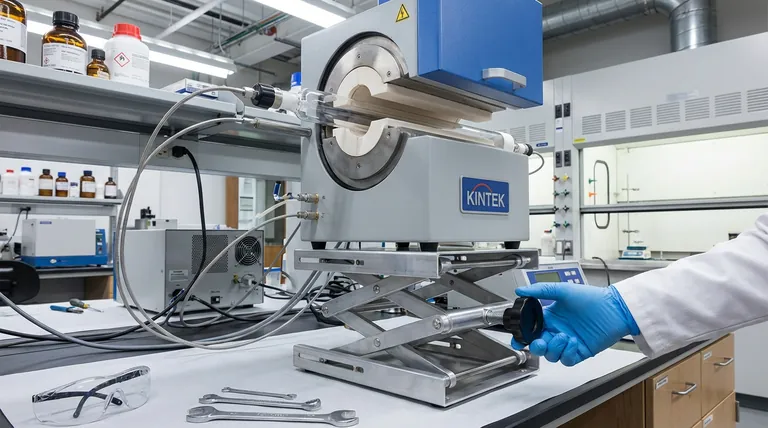
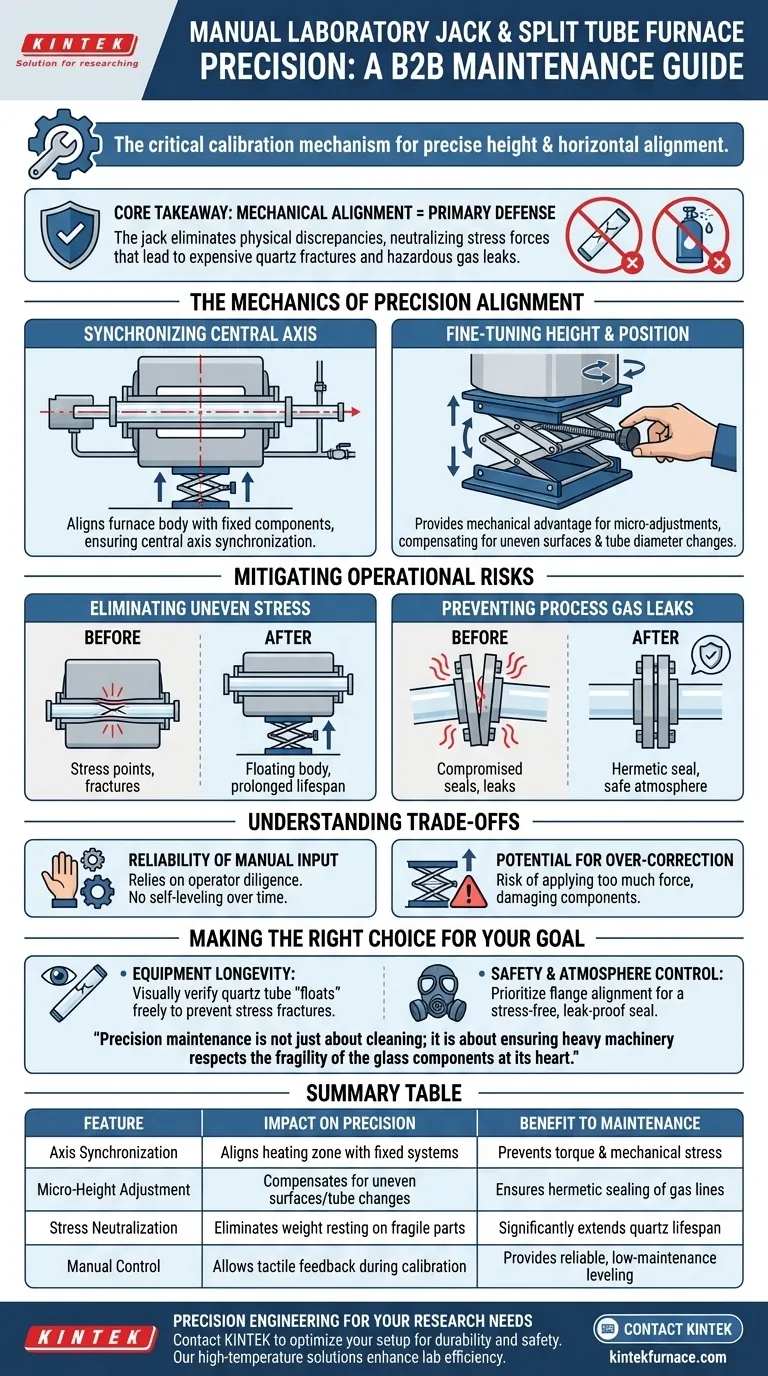
A manual laboratory jack serves as the critical calibration mechanism at the base of a split tube furnace, enabling precise fine-tuning of the furnace body’s height and horizontal position. By manipulating the jack, operators can ensure the furnace's central axis is perfectly synchronized with fixed components, such as quartz tube loading systems and gas delivery lines.
Core Takeaway Mechanical alignment is the primary defense against equipment failure in high-temperature processing. The laboratory jack eliminates physical discrepancies between the furnace body and the reaction tube, neutralizing stress forces that otherwise lead to expensive quartz fractures and hazardous gas leaks.
The Mechanics of Precision Alignment
Synchronizing the Central Axis
In a split tube furnace setup, external components like quartz tube loading systems and gas lines are often fixed in place. The furnace body must accommodate these rigid structures, not the other way around.
The manual jack allows you to adjust the furnace's position relative to these fixed points. This ensures the central axis of the heating zone is strictly aligned with the hardware passing through it.
Fine-Tuning Height and Position
Gross movements are insufficient for high-precision laboratory environments. The jack provides the mechanical advantage needed to make micro-adjustments to the vertical height and horizontal placement.
This capability is essential when the furnace is placed on uneven surfaces or when different diameter tubes are swapped into the system.
Mitigating Operational Risks
Eliminating Uneven Stress
One of the most common causes of failure in tube furnaces is physical stress applied to the quartz tube. If the furnace body is slightly misaligned, it may rest its weight on the tube or apply torque to the ends.
By adjusting the jack, you effectively "float" the furnace body around the tube. This eliminates uneven stress points, significantly prolonging the lifespan of fragile quartz components.
Preventing Process Gas Leaks
The integrity of your experiment relies on a hermetic seal. Misalignment disrupts the connection between the tube ends and the sealing flanges.
Proper use of the laboratory jack ensures that the mating surfaces meet perfectly flat. This reduces the risk of process gas leaks caused by compromised seals or warped O-rings.
Understanding the Trade-offs
The Reliability of Manual Input
While effective, a manual jack relies entirely on operator diligence. Unlike automated self-leveling systems, the jack cannot correct itself if the furnace shifts or settles over time.
Potential for Over-Correction
Because the jack allows for significant force application, there is a risk of over-adjustment. An operator must be careful not to drive the furnace body too high, which could crush the quartz tube against the top of the chassis or upper insulation layers.
Making the Right Choice for Your Goal
To maximize the utility of your manual laboratory jack, focus on the specific needs of your experimental setup.
- If your primary focus is Equipment Longevity: Use the jack to visually verify that the quartz tube "floats" freely within the furnace bore before every heating cycle to prevent stress fractures.
- If your primary focus is Safety and Atmosphere Control: Prioritize the alignment of the end-flanges with gas lines to ensure a stress-free, leak-proof seal for hazardous process gases.
Precision maintenance is not just about cleaning; it is about ensuring that heavy machinery respects the fragility of the glass components at its heart.
Summary Table:
| Feature | Impact on Process Precision | Benefit to Maintenance |
|---|---|---|
| Axis Synchronization | Aligns furnace heating zone with fixed loading systems | Prevents torque and mechanical stress on quartz |
| Micro-Height Adjustment | Compensates for uneven surfaces or tube diameter changes | Ensures hermetic sealing of gas delivery lines |
| Stress Neutralization | Eliminates physical weight resting on fragile components | Significantly extends lifespan of quartz tubes |
| Manual Control | Allows tactile feedback during critical calibration | Provides a reliable, low-maintenance leveling solution |
Precision Engineering for Your Research Needs
Don't let mechanical misalignment compromise your high-temperature results. At KINTEK, we understand that precision is the foundation of scientific discovery. Backed by expert R&D and world-class manufacturing, we provide a comprehensive range of Muffle, Tube, Rotary, Vacuum, and CVD systems, all fully customizable to your unique specifications.
Whether you are looking for advanced split tube furnaces or specialized laboratory equipment, our team is ready to help you optimize your setup for maximum durability and safety. Contact KINTEK today to discuss how our high-temperature solutions can enhance your lab's efficiency and equipment longevity.
Visual Guide
References
- Nina Z. Janković, Desirée L. Plata. Particles in a box: novel design and evaluation of an adaptable engineering control enclosure for a common split tube furnace to eliminate occupational exposure to refractory ceramic insulation fibers. DOI: 10.1039/d3en00041a
This article is also based on technical information from Kintek Furnace Knowledge Base .
Related Products
- 1200℃ Split Tube Furnace Laboratory Quartz Tube Furnace with Quartz Tube
- Laboratory Vacuum Tilt Rotary Tube Furnace Rotating Tube Furnace
- Laboratory Quartz Tube Furnace RTP Heating Tubular Furnace
- Vertical Laboratory Quartz Tube Furnace Tubular Furnace
- Split Chamber CVD Tube Furnace with Vacuum Station CVD Machine
People Also Ask
- What is a split tube furnace? Unlock Easy Access for Complex Lab Experiments
- What are the components of a basic tube furnace design capable of withstanding 1200°C? Essential Parts for High-Temp Labs
- How does gas flow impact the performance of a split tube furnace? Optimize Your Process with Precision Control
- What are the primary benefits of using a split tube furnace? Enhance Lab Efficiency with Unmatched Flexibility
- What safety measures should be followed when operating a split tube furnace? Ensure Safe and Efficient Lab Operations










