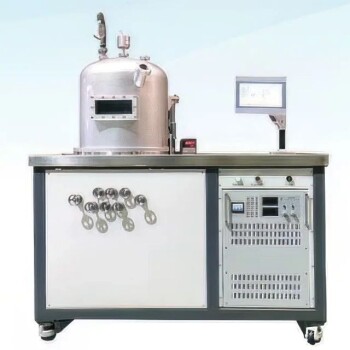
The core distinction is straightforward: Hot pressing furnaces apply uniaxial mechanical pressure through a hydraulic ram and a graphite die, while Hot Isostatic Pressing (HIP) systems envelop the part in omnidirectional, high-pressure inert gas. This divergence directly dictates how you prepare samples. Hot pressing handles simple shapes loaded directly into a die, whereas HIP can densify complex geometries—but only after encapsulation in a gas-tight can or pre-sintering to closed porosity to prevent gas from penetrating open pores.
Hot pressing pushes from one direction using a die, creating beneficial shear for simple shapes; HIP surrounds the component with hydrostatic gas pressure, enabling intricate parts but demanding meticulous sample prep—either vacuum canning or a pre-sintered skin that seals the surface.
Pressure Application: The Fundamental Divide
Uniaxial Force in Hot Pressing Furnaces
- A hydraulic ram drives a graphite die along a single axis, typically generating 20–50 MPa of mechanical pressure.
- The stress state is uniaxial and generates significant shear within the powder compact.
- Die material strength caps the maximum pressure and restricts geometry to simple forms—cylinders, discs, or flat tiles.
Omnidirectional Gas Pressure in HIP Systems
- An inert gas (argon or helium) is compressed inside a cold-wall pressure vessel, surrounding the part.
- The pressure is hydrostatic, acting equally from all directions (Px = Py = Pz), with magnitudes reaching 200–250 MPa.
- This uniform pressure eliminates shear, preserves isotropic shrinkage, and allows near-net-shape processing of intricate shapes that would be impossible in a die.
How the Stress State Affects Densification
- Hot pressing’s shear helps break surface oxide films and agglomerates, accelerating particle rearrangement at relatively low pressure.
- HIP’s absence of shear means particle surfaces must be meticulously clean; any contamination can hinder bonding.
- The hydrostatic condition also prevents the anisotropic dimensional changes common in uniaxial pressing, delivering identical shrinkage in every direction.
Sample Preparation: The HIP Gatekeeper
Hot Pressing: Straightforward Die Loading
- Powder is poured directly into a reusable graphite die; no special pre-treatment is required.
- The shear inherent in the process works to disrupt particle surface layers, tolerating a wider range of powder conditions.
HIP Demands a Gas-Tight Component
- Because high-pressure gas would infiltrate open porosity and collapse the densification drive, HIP samples must present themselves as impermeable.
- Two proven routes exist to meet this requirement.
Encapsulation (Canning)
- A green compact is sealed inside an evacuated metal (mild steel, molybdenum, tantalum) or glass container.
- The flexible can transmits pressure uniformly while blocking gas entry, enabling the processing of porous bodies.
- Post-processing must remove the can, adding cost but allowing truly complex shapes to be consolidated from loose powder.
Pre-Sintering to Closed Porosity (Sinter/HIP Route)
- The component is first sintered conventionally until it reaches >90–92% of theoretical density.
- At this threshold, all surface-connected pores have closed, so the part can be placed directly in the HIP vessel without a can.
- This eliminates container costs and avoids can-material reactions, but demands an extra thermal cycle and works only when the shape is already near-net.
Understanding the Trade-offs
- Geometric freedom vs. simplicity: HIP unlocks intricate, near-net geometries but demands encapsulation know-how or a careful pre-sinter step. Hot pressing trades that freedom for a fast, low-overhead process that is ideal for simple plate stock.
- Shear benefits vs. isotropy: The shear in hot pressing aids densification and can tolerate less-than-perfect powder surfaces, but it can also cause warped, anisotropic parts. HIP’s pure hydrostatic stress yields flawlessly isotropic microstructures and predictable, uniform contraction.
- Cost and productivity: Hot pressing equipment is simpler and cycles faster. HIP requires large, expensive pressure vessels and extended cycle times (often 1–8 hours), making it a higher-cost, lower-throughput option that pays off only when the performance benefit is essential.
How to Apply This to Your Process
- If your primary focus is producing flat, symmetric ceramic tiles or discs with minimal complexity: Hot pressing is your pragmatic choice. Its simple die loading and inherent shear can deliver high density for simple shapes without the overhead of encapsulation or pre-sintering.
- If your primary focus is achieving maximum isotropic density in a complex, near-net-shape component: Invest in HIP. Be prepared to either can the green part or pre-sinter it to closed porosity; the uniform, high-pressure gas environment will then yield fully dense, undistorted geometry.
- If your primary focus is developing textured ceramics with aligned grains for anisotropic properties: Consider sinter forging rather than classic hot pressing or HIP—its unconstrained uniaxial stress can induce texture that hydrostatic pressure cannot replicate.
The dividing line is not which technique is universally superior, but which pressure mode and sample preparation route align with your geometry, density target, and production economics.
Summary Table:
| Feature / Parameter | Hot Pressing Furnace | Hot Isostatic Pressing (HIP) System |
|---|---|---|
| Pressure Type | Mechanical (Uniaxial) | Inert Gas (Hydrostatic / Omnidirectional) |
| Pressure Range | 20–50 MPa | 200–250 MPa |
| Sample Preparation | Direct loading into graphite die | Encapsulation (canning) or pre-sintering to >90% density |
| Geometric Freedom | Simple shapes (discs, tiles, cylinders) | Intricate, near-net-shape components |
| Stress State & Shrinkage | Uniaxial with shear; potential anisotropic shrinkage | Hydrostatic without shear; uniform isotropic shrinkage |
| Process Overhead | Lower equipment cost, faster cycle times | Higher capital cost, longer cycle times |
Choosing the right thermal and pressure equipment is critical to achieving target material densities and precise microstructures. KINTEK specializes in advanced laboratory equipment and consumables, offering a comprehensive range of high-temperature furnaces—including vacuum, atmosphere, tube, muffle, rotary, CVD, dental, and induction melting furnaces—all customizable to meet your unique research and production requirements.
Whether you need robust hot-pressing solutions or specialized controlled-atmosphere systems, our expert team is ready to deliver reliable, high-performance equipment tailored to your application. Contact KINTEK today to discuss your customized furnace requirements!
Related Products
- HFCVD Machine System Equipment for Drawing Die Nano Diamond Coating
- High Pressure Laboratory Vacuum Tube Furnace
- Vacuum Hot Press Furnace Machine Heated Vacuum Press
- Vacuum Hot Press Furnace Machine Heated Vacuum Press Tube Furnace
- 600T Vacuum Induction Hot Press Vacuum Heat Treat and Sintering Furnace
People Also Ask
- What is Hot-filament Chemical Vapor Deposition (HFCVD)? Achieve High-Quality Thin Films with Precision Control
- What are the equipment for chemical vapor deposition? A Guide to the 5 Essential Components
- What is the significance of the vacuum pressure control system in the CVD coating process for powders?
- What is the function of high-purity Argon (Ar) gas during CVD? Optimize Your Thin Film Uniformity and Purity
- What are the advantages of using Chemical Vapor Deposition (CVD) for coating turbine blades? Enhance Life & Performance