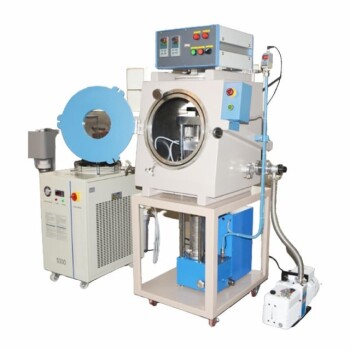
The requirement for a vacuum oven in LiFePO4 (LFP) cathode production is driven by the need to eliminate high-boiling-point solvents and trace moisture that are trapped within the electrode’s microporous structure. By reducing ambient pressure, these ovens facilitate the complete evaporation of N-Methyl-2-pyrrolidone (NMP) and water at temperatures low enough to prevent the thermal degradation of binders and the oxidation of active materials. This process is fundamental to ensuring the mechanical integrity of the cathode and the long-term chemical stability of the battery cell.
Core Takeaway: Vacuum drying is a non-negotiable step that uses low pressure to strip away residual NMP and moisture, thereby preventing electrolyte decomposition and ensuring a strong mechanical bond between the LFP material and the aluminum current collector.
The Challenge of Residual NMP and Trace Moisture
Efficient Removal of High-Boiling-Point Solvents
The cathode slurry typically utilizes N-Methyl-2-pyrrolidone (NMP) as a solvent, which possesses a high boiling point. A vacuum environment significantly reduces the pressure, allowing NMP to evaporate thoroughly at lower temperatures (e.g., 60°C to 120°C) than would be possible under atmospheric conditions.
Eliminating Deep-Seated Trace Moisture
LFP materials are sensitive to moisture, which can be adsorbed onto the surface of the active material or trapped within the coating. Long-term vacuum drying ensures that even trace amounts of water are removed, which is critical because moisture is the primary catalyst for harmful side reactions during battery cycling.
Preserving Structural and Chemical Integrity
Ensuring Strong Mechanical Adhesion
Precise vacuum drying treatment is essential for the formation of a strong mechanical bond between the active LFP materials, conductive agents, and the aluminum foil current collector. Without complete solvent removal, the adhesion strength weakens, leading to delamination of the electrode material during the physical stresses of charging and discharging.
Preventing Material Oxidation
Drying in a standard air oven at high temperatures can lead to the oxidation of catalytic or active materials. The vacuum environment provides an inert-like state by removing oxygen, ensuring that the chemical composition of the FeOx or LFP nanoparticles remains unchanged during the long drying cycle.
Maintaining the Microporous Structure
A vacuum oven allows for a controlled evaporation process that keeps the microporous structure of the cathode coating intact. This ensures that the finished electrode has the necessary porosity for efficient electrolyte infiltration, which is vital for high ionic conductivity and battery performance.
The Chemical Consequences of Incomplete Drying
Preventing Electrolyte Decomposition
If moisture remains in the cathode, it reacts with the electrolyte salt (typically LiPF6) to form hydrofluoric acid (HF). This acid is highly corrosive and leads to the rapid degradation of the internal battery components, significantly shortening the cycle life.
Improving Coulombic Efficiency
Thoroughly drying the electrode sheets is a prerequisite for forming a stable Solid Electrolyte Interphase (SEI) layer. By eliminating impurities and residual solvents, the vacuum process minimizes side reactions, which directly improves the coulombic efficiency and the overall stability of the battery.
Understanding the Trade-offs
Time vs. Throughput
Vacuum drying is often a bottleneck in the manufacturing process, sometimes requiring up to 20 hours to reach the necessary levels of dryness. While faster drying methods exist, they often fail to remove the deep-seated moisture required for long-term cycling stability.
Energy Consumption and Equipment Cost
Maintaining a high-vacuum, high-temperature environment over long durations is energy-intensive. Furthermore, the initial capital investment for high-precision vacuum ovens is significantly higher than that for traditional convection ovens.
Risk of Binder Migration
If the vacuum and temperature are not precisely controlled, the rapid movement of solvent can cause the binder to migrate to the surface of the coating. This creates an uneven distribution that can clog pores and reduce the electrical contact between the active material and the current collector.
How to Apply This to Your Project
Recommendations Based on Your Goals
- If your primary focus is Maximum Cycle Life: Prioritize a longer drying duration (20+ hours) at higher vacuum levels to ensure the absolute removal of moisture and prevent HF formation.
- If your primary focus is Material Purity: Utilize lower temperature vacuum drying (approx. 60°C) to prevent any risk of oxidation or thermal failure of sensitive binders and active catalysts.
- If your primary focus is Efficient Electrolyte Wetting: Ensure the vacuum ramp-up is gradual to preserve the microporous structure of the cathode, allowing for faster and more uniform electrolyte infiltration.
Ultimately, vacuum drying is the bridge between a raw coated foil and a high-performance electrode, providing the chemical cleanliness and mechanical strength necessary for modern lithium-ion standards.
Summary Table:
| Key Factor | Requirement in LFP Production | Impact on Battery Performance |
|---|---|---|
| Solvent Removal | Eliminates high-boiling-point NMP | Prevents binder degradation and improves purity. |
| Moisture Control | Removes deep-seated trace water | Prevents HF formation and electrolyte decomposition. |
| Oxidation Control | Oxygen-free drying environment | Maintains chemical integrity of active LFP materials. |
| Adhesion | Strong bond with aluminum foil | Prevents delamination during charging cycles. |
| Porosity | Preservation of micropores | Ensures efficient and uniform electrolyte infiltration. |
Optimize Your Battery Research with KINTEK Precision
Are you looking to achieve the ultimate material purity and mechanical integrity for your LFP cathodes? KINTEK specializes in high-performance laboratory equipment and consumables, providing the precision required for advanced battery manufacturing.
We offer a comprehensive range of high-temperature furnaces, including:
- Vacuum Ovens for critical moisture and solvent removal.
- Muffle, Tube, and Rotary Furnaces for material synthesis.
- CVD, Atmosphere, and Induction Melting Furnaces for specialized research.
All our systems are fully customizable to meet your unique technical specifications. Whether you are scaling up production or refining your lab processes, our experts are here to help you achieve superior results.
Contact KINTEK today to find the perfect thermal solution for your lab!
References
- Shaozhen Huang, Libao Chen. In Situ Formed Tribofilms as Efficient Organic/Inorganic Hybrid Interlayers for Stabilizing Lithium Metal Anodes. DOI: 10.1007/s40820-023-01210-6
This article is also based on technical information from Kintek Furnace Knowledge Base .
Related Products
- High Temperature Muffle Oven Furnace for Laboratory Debinding and Pre Sintering
- Dental Porcelain Zirconia Sintering Ceramic Vacuum Press Furnace
- Laboratory Vacuum Tilt Rotary Tube Furnace Rotating Tube Furnace
- Vacuum Hot Press Furnace Machine for Lamination and Heating
- Vacuum Heat Treat Sintering Furnace Molybdenum Wire Vacuum Sintering Furnace
People Also Ask
- What thermal phenomena occur during polymer binder burnout in ceramic green bodies? Lab Furnace Guide
- What role does a high-temperature muffle furnace play in STFO synthesis? Achieve Pure Perovskite Results
- Why is controlled heat treatment in a muffle furnace necessary for calcined clay? Achieve Optimal Pozzolanic Activity
- How does a high-temperature muffle furnace facilitate the formation of LaNbxAl1−xO3+δ perovskite structures? Key Roles
- What role does a high-temperature muffle furnace play in the formation of biochar catalysts? Master Catalyst Synthesis