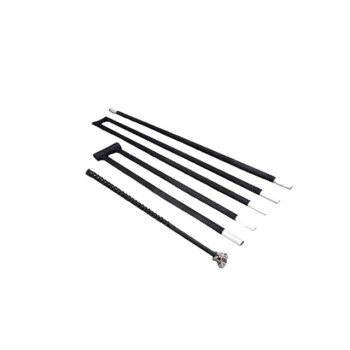
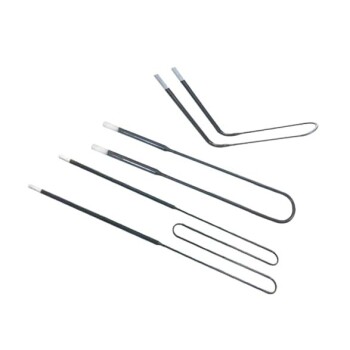
In short, H Type Silicon Carbide (SiC) heating elements are most commonly used in the glass, chemical, and electronic materials industries. Their unique design makes them exceptionally reliable in processes that demand precise temperature control and involve frequent or rapid temperature changes.
The critical factor is not just the high temperatures SiC elements can achieve, but how they handle thermal stress. The H Type's specific construction gives it superior durability against the thermal shock of repeated heating and cooling cycles, defining its ideal use case.
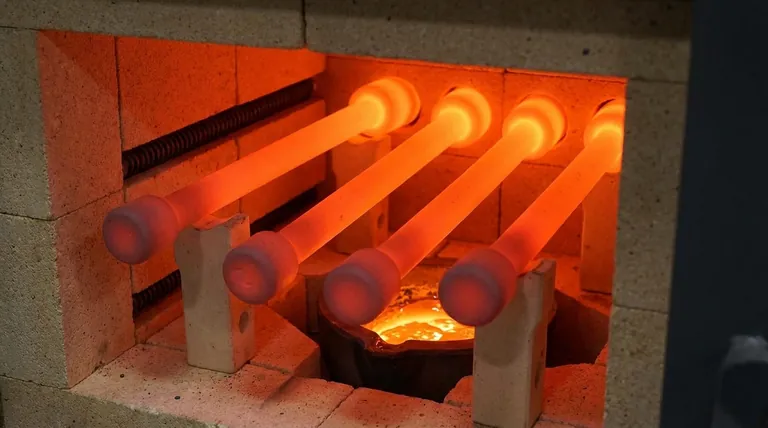
Core Applications of the H Type Element
The H Type's specialization makes it the preferred choice in sectors where thermal cycling is a standard part of the process.
Glass and Quartz Manufacturing
Processes like quartz glass melting require intense, controlled heat. The H Type provides the necessary high temperatures while being robust enough to handle the thermal fluctuations inherent in melting and forming operations.
Electronic Materials and Crystal Growth
Manufacturing semiconductors and high-purity crystals involves precise thermal profiles. The H Type's reliability and resistance to rapid temperature changes are critical for achieving the strict conditions needed for high-temperature crystal growth.
Chemical Processing
Many chemical reactions require consistent and reliable heat to proceed correctly. The H Type delivers this stability, ensuring process integrity in demanding chemical production environments.
What Makes the H Type Unique?
While all SiC elements are durable, the H Type's physical design gives it a distinct advantage in specific scenarios. Its value comes from its structure.
The Structural Design: A Thickened End
The H Type is a hollow tube with a distinctively thickened end. This simple but effective design feature reinforces the element at a critical stress point.
Superior Thermal Shock Resistance
This thickened construction significantly enhances its ability to withstand rapid heating and cooling. Where other elements might deform or fracture under repeated thermal stress, the H Type maintains its integrity.
Reliability in Fluctuating Conditions
This durability makes it ideal for batch furnaces or laboratory equipment where processes are started and stopped frequently. Its resistance to thermal shock translates directly to a longer service life and greater operational reliability in these environments.
Understanding the Trade-offs: H Type vs. Other SiC Elements
Choosing the right element means understanding its specific strengths compared to other available types.
Comparison with the DM Type
The DM Type is a versatile workhorse, widely used for general-purpose applications in industrial furnaces for metal heat treatment, ceramics, and semiconductor manufacturing. It is chosen for its stable, controlled heat in less demanding thermal cycles.
Comparison with the SC Type
The SC Type is designed for spatial temperature uniformity. It is the ideal choice for large-scale furnaces where consistent heat must be applied evenly across the bottom or sides of a large heating chamber.
When to Choose the H Type
You choose the H Type specifically when your process involves cyclic heating. If your furnace or equipment will be turned on and off frequently or undergo rapid temperature ramps, the H Type's superior resistance to thermal shock makes it the most durable and reliable option.
Making the Right Choice for Your Process
Your decision should be driven by the specific thermal demands of your application.
- If your primary focus is durability under thermal cycling: The H Type is engineered specifically for its ability to withstand the stress of rapid heating and cooling.
- If your primary focus is uniform heat across a large area: The SC Type is designed to provide excellent spatial temperature consistency in large furnaces.
- If your primary focus is general high-temperature reliability: The DM Type serves as a robust and versatile option for a wide range of standard industrial processes.
Ultimately, selecting the correct heating element is about matching the component's design strengths to the unique challenges of your thermal process.
Summary Table:
| Application | Key Benefit |
|---|---|
| Glass and Quartz Manufacturing | Handles thermal fluctuations in melting processes |
| Electronic Materials and Crystal Growth | Ensures reliability in rapid temperature changes |
| Chemical Processing | Provides consistent heat for reaction integrity |
Optimize your thermal processes with KINTEK's advanced high-temperature furnace solutions! Leveraging exceptional R&D and in-house manufacturing, we offer Muffle, Tube, Rotary Furnaces, Vacuum & Atmosphere Furnaces, and CVD/PECVD Systems, all with deep customization to meet your unique experimental needs. Contact us today to discuss how our H Type SiC heating elements can enhance durability and efficiency in your lab or production environment!
Visual Guide

Related Products
- Silicon Carbide SiC Thermal Heating Elements for Electric Furnace
- Molybdenum Disilicide MoSi2 Thermal Heating Elements for Electric Furnace
- 1400℃ Muffle Oven Furnace for Laboratory
People Also Ask
- How do the different types of silicon carbide heating elements compare in terms of applications? Find the Best Fit for Your High-Temp Needs
- What are the temperature capabilities and mounting options for silicon carbide heating elements? Unlock High-Temp Flexibility and Durability
- What are the advantages of using silicon carbide heating elements in industrial furnaces? Boost Efficiency and Durability
- How do silicon carbide heating elements enhance the heat treatment of alloys? Achieve Superior Temperature Control
- What are the unique properties of silicon carbide heating elements? Key Benefits for High-Temp Performance