Precision in energy delivery and thermal history is the difference between a flawless, fully dense ceramic film and a cracked, porous coating.
The most critical processing parameters for ceramic thin film thermal and laser sintering are the specific energy input (controlled by laser scanning speed and power density or furnace temperature ramp), binder burnout kinetics, and the management of constrained sintering stresses. For laser-based methods, a too-high scanning speed (e.g., 400 mm/s) starves the layer of thermal energy, allowing pre-existing micro-cracks to grow, while a controlled lower speed (200 mm/s) combined with dual-pass scanning eliminates “shed-like” defects and yields a transparent, dense film with surface roughness around 0.7 µm. In furnace-based thermal treatments, tight control over the heating rate, dwell time, and atmosphere is equally vital to prevent delamination and residual porosity.
Achieving full densification while preventing defect propagation hinges on providing just enough thermal energy to drive atomic diffusion and binder removal, but not so much that tensile stresses from constrained shrinkage tear the film apart. The real art lies in matching the energy delivery mode—whether laser scan trajectory or furnace soak cycle—to the film’s unique shrinkage behavior and substrate interaction.
The Mechanics of Densification in Thin Films
The Driving Force: Surface Energy Reduction
Sintering operates entirely below the material’s melting point. Atomic diffusion transports mass from particle interiors to the curved necks between grains, lowering the system’s total surface free energy.
For single-phase oxide ceramics like alumina, this effectively starts at 0.5 to 0.75 of the absolute melting temperature ($T_m$). The reduction of surface area eliminates internal porosity, but in thin films, this process is physically constrained by the underlying substrate.
The Barrier: Constrained Sintering and Tensile Stresses
When a thin ceramic layer is bonded to a rigid substrate, the film cannot shrink freely in the lateral direction. This constrained sintering generates tensile stresses that reduce the thermodynamic driving force for densification.
These stresses are highest during the intermediate stage of sintering. Near free edges or internal pores, stress relaxation can lead to non-uniform density, warping, and micro-cracking. Preventing defect propagation therefore requires managing not only the total thermal energy but also the rate at which the film tries to contract.
Critical Parameters for Laser Sintering
Scanning Speed and Energy Density: The Thermal Budget
The laser’s scanning speed directly sets the specific energy density delivered to the green film. An excessively high scanning speed (e.g., 400 mm/s) provides insufficient thermal energy for atomic mobility.
The result is incomplete sintering: pre-existing micro-cracks from the drying or debinding step will propagate rather than heal. Lowering the scanning speed to 200 mm/s increases the energy per unit area, enabling full microstructural densification and even optical transparency.
Binder Burnout: More Than Just Heat
Organic additives like methylcellulose require a specific thermal dose to degrade completely. Incomplete burnout leads to detrimental brownish to black discoloration and a fundamental loss of film integrity.
Laser sintering must deliver enough energy for this chemical conversion without causing the decomposed gases to erupt through a prematurely sintered surface skin. The scanning speed must therefore accommodate both the diffusion and the chemical kinetics of binder removal.
Multi-Pass Strategies to Heal Defects
A single laser pass often results in directional, “shed-like” microstructural features that indicate anisotropic stress or incomplete fusion. A dual-pass thermal treatment at a properly adjusted power density (e.g., 3000 W/cm²) smooths out these features.
This second pass redistributes material to eliminate directional defects, ultimately producing a uniform ceramic layer with a surface roughness as low as 0.7 µm. The multi-pass approach effectively anneals out the stress concentrations that would otherwise initiate cracks.
Critical Parameters for Furnace/Thermal Sintering
Heating Rate and Ramp Control
For spin-coated films on substrates like Al₂O₃ or YSZ, the heating rate must allow the film to shrink synchronously with the substrate. A controlled ramp (e.g., 10 °C/min up to 1300 °C) gives the material time to relieve stresses through viscous or diffusional flow.
If the furnace heats too quickly, the top of the film may sinter before the interface, creating a stiff shell that cracks as the underlayer tries to shrink later. Precise, multi-zone laboratory furnaces with exact ramp control prevent such thermal gradients.
Peak Temperature and Dwell Time
The peak hold temperature must be high enough to drive diffusion but not so high that it induces excessive grain coarsening. For solid-state sintering of oxides, a target between 0.70 and 0.85 of $T_m$ yields a significant drop in yield strength, enabling plastic flow to close residual pores.
The dwell time at this temperature completes the final stage of densification. Too short a dwell leaves isolated pores; too long a dwell can trigger pore-boundary separation and coarsening. This parameter must be tested against the specific film thickness and green density.
Atmosphere Control
Trapped gas in closed pores builds a back-pressure that arrests densification. Processing in a vacuum, inert, or controlled reducing atmosphere removes volatile contaminants and surface oxide films before pore closure.
For thin films, even small pockets of trapped gas can cause blistering or delamination. A carefully chosen furnace atmosphere ensures that the pore surface remains clean and that atomic diffusion paths are fully open.
Understanding the Trade-offs
Speed vs. Thermal Stress
Faster laser scanning or furnace ramp rates boost throughput but create sharp thermal gradients. These gradients produce localized constrained-sintering stresses that can exceed the film’s green strength and nucleate cracks.
The deep need is to find the highest processing speed that still maintains stress levels below the critical fracture threshold. This requires iterative optimization for each film-substrate pair and typically results in a processing window, not a single magic number.
Over-sintering and Grain Growth
Feeding excessive energy into the film (too high a power, too long a dwell) causes exaggerated grain coarsening. While density may remain high, the mechanical and optical properties deteriorate due to the coarse, non-uniform microstructure.
In laser sintering, a second pass is beneficial, but a third pass at the same high power can push the material past its optimal microstructural state. The process must balance full density against the onset of abnormal grain growth.
Substrate Compatibility and Film Thickness Limits
Crack growth and delamination depend intimately on the critical film thickness. If the film exceeds this threshold, the accumulated tensile strain energy overcomes interfacial adhesion, causing catastrophic failure.
To prevent this, you must either keep the film thickness below critical limits, use sinter-active powders to enhance densification at lower temperatures, or employ a pre-sintering regime that builds in a compliant intermediate layer. The finest laser control cannot save a film that is simply too thick for its substrate’s stiffness.
Making the Right Choice for Your Goal
- If your primary focus is optical transparency and density: Use laser sintering with a dual-pass strategy at a reduced scanning speed (around 200 mm/s) to ensure complete binder burnout and microstructural healing, targeting a final roughness near 0.7 µm.
- If your primary focus is throughput and large-area uniformity: Optimize furnace sintering with a precise, moderate ramp rate (e.g., 10 °C/min) and multi-zone heating to balance densification speed with stress relaxation, keeping the film thickness below the critical delamination limit.
- If your primary focus is ultra-thin (<1 µm) electrolyte films on porous substrates: Invest in organic-free homogeneous green packing and very low initial sintering rates to prevent early skin formation, then use a high final temperature for rapid pore removal.
- If your primary focus is maximum density at the lowest temperature: Consider pressure-assisted sintering routes (like hot pressing or SPS) that apply a mechanical pressure at least three times the material’s yield strength at the sintering temperature, collapsing pores through plastic flow rather than diffusion alone.
Mastery over ceramic thin film sintering is not about selecting a single “best” parameter, but about orchestrating a thermal profile that respects the delicate interplay of energy, time, and stress—turning a fragile green layer into a flawless, fully dense functional coating.
Summary Table:
| Sintering Method | Critical Parameter | Primary Impact / Mechanism | Optimization Strategy |
|---|---|---|---|
| Laser Sintering | Specific Energy Density & Scan Speed | Controls atomic mobility & binder burnout kinetics | Dual-pass scanning (~200 mm/s) to heal directional micro-cracks |
| Furnace Sintering | Heating Ramp Rate | Regulates constrained sintering tensile stress | Controlled ramp (~10 °C/min) to sync film and substrate contraction |
| Furnace Sintering | Peak Temp & Dwell Time | Drives diffusion, plastic flow, & pore elimination | Hold at 0.70–0.85 $T_m$ to achieve density without grain coarsening |
| Atmosphere Control | Vacuum / Inert / Controlled Gas | Prevents back-pressure from trapped gases | Removes volatile contaminants to stop blistering and delamination |
Achieving flaw-free, fully dense ceramic thin films requires absolute control over heating rates, soak times, and process atmospheres. At KINTEK, we specialize in high-precision laboratory equipment designed to meet the rigorous demands of advanced materials research and production.
Whether you require precise multi-zone tube furnaces, controlled atmosphere and vacuum furnaces, or customizable high-temperature muffle systems, KINTEK delivers the exact thermal history management needed to eliminate stress defects, prevent delamination, and optimize film density.
Ready to optimize your ceramic sintering workflow? Contact KINTEK today to consult with our high-temperature equipment experts and find the ideal solution for your laboratory!
Related Products
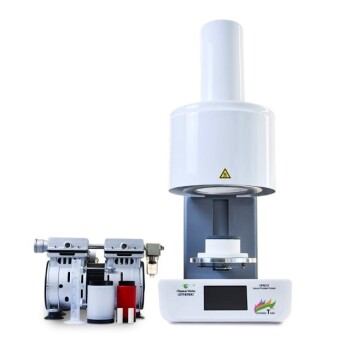
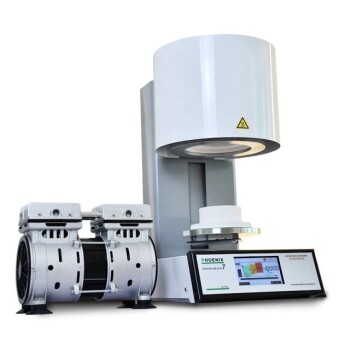
- Dental Porcelain Zirconia Sintering Ceramic Vacuum Press Furnace
- Vacuum Dental Porcelain Sintering Furnace for Dental Laboratories
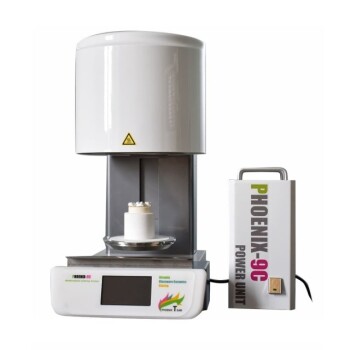
- Chairside Dental Porcelain Zirconia Sintering Furnace with Transformer for Ceramic Restorations
- Spark Plasma Sintering SPS Furnace
- High Temperature Muffle Oven Furnace for Laboratory Debinding and Pre Sintering
People Also Ask
- What factors determine the quality of sintered zirconia restorations? Master Material, Equipment, and Technique
- How do conventional vs rapid sintering in dental furnaces affect zirconia? Optimize Efficiency Without Sacrificing Strength
- What is the purpose of dental sintering furnaces? Transform Zirconia into Durable, High-Quality Dental Restorations
- What precautions should be taken when sintering zirconia in the Fast Slow Dental Sintering Furnace? Master Key Steps for Perfect Results
- What temperature range is used for sintering zirconia ceramics? Achieve Optimal Strength and Translucency