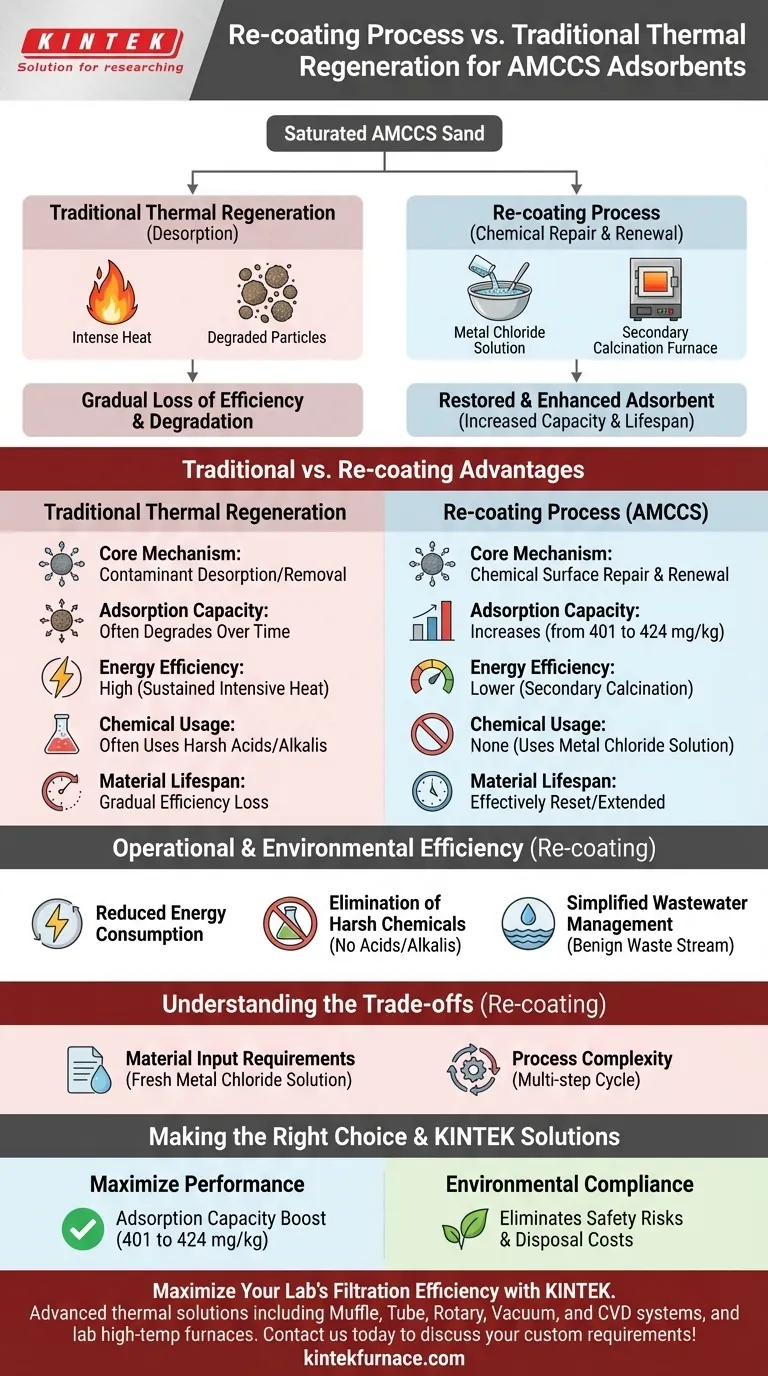
The re-coating process offers a distinct advantage over traditional methods by chemically repairing the adsorbent surface rather than simply desorbing pollutants. By re-mixing saturated sand grains into the original metal chloride solution followed by secondary calcination, this technique renews damaged active sites. This results in a regenerated material that not only recovers its function but can potentially exceed its original performance specifications.
Unlike standard regeneration which often degrades material over time, re-coating acts as a restorative process. It increases adsorption capacity beyond the original baseline while simultaneously reducing energy usage and wastewater treatment burdens.
Enhancing Adsorbent Performance
Restoration of Active Sites
Traditional regeneration methods typically focus on removing the contaminant from the pore structure. However, the re-coating process goes a step further by repairing the active sites on the sand grains.
Increased Adsorption Capacity
The most significant technical advantage is the potential for performance gains. While the original Aluminum-Magnesium-Calcium Coated Sand (AMCCS) has an adsorption capacity of 401 mg/kg, the re-coated material can reach 424 mg/kg.
Extending Material Lifespan
Because the process renews the chemical coating, it effectively resets the lifespan of the media. This prevents the gradual loss of efficiency common in adsorbents subjected to repeated thermal cycling alone.
Operational and Environmental Efficiency
Reduced Energy Consumption
Compared to traditional physical regeneration, which often requires sustained high temperatures to drive off adsorbed compounds, the re-coating method is more energy-efficient. The secondary calcination required for re-coating consumes less energy than the intensive heat treatment used in standard thermal regeneration.
Elimination of Harsh Chemicals
Many chemical regeneration protocols rely on strong acids or alkaline solutions to strip contaminants. The re-coating process avoids these hazardous materials entirely.
Simplified Wastewater Management
By eliminating the need for strong acids and alkalis, the process generates a more benign waste stream. This directly reduces the complexity and cost associated with downstream wastewater treatment.
Understanding the Trade-offs
Material Input Requirements
While energy consumption is lower, this process does introduce a material dependency. Re-coating requires a fresh supply of the metal chloride solution to facilitate the re-mixing stage.
Process Complexity
This is not a simple "bake-out" procedure. It involves a multi-step cycle of re-mixing in solution followed by calcination, which may require more complex handling equipment than a standard thermal desorption unit.
Making the Right Choice for Your Goal
To determine if the re-coating process aligns with your operational objectives, consider the following:
- If your primary focus is maximizing performance: The re-coating process is the superior choice, as it is capable of boosting adsorption capacity from 401 mg/kg to 424 mg/kg.
- If your primary focus is environmental compliance: This method is preferable as it eliminates the safety risks and disposal costs associated with strong acid or alkaline regeneration solutions.
The re-coating process transforms regeneration from a maintenance task into a value-added step that enhances the adsorbent's fundamental capabilities.
Summary Table:
| Feature | Traditional Thermal Regeneration | Re-coating Process (AMCCS) |
|---|---|---|
| Core Mechanism | Contaminant desorption/removal | Chemical surface repair & renewal |
| Adsorption Capacity | Often degrades over time | Increases (from 401 to 424 mg/kg) |
| Energy Efficiency | High (sustained intensive heat) | Lower (secondary calcination) |
| Chemical Usage | Often uses harsh acids/alkalis | None (uses metal chloride solution) |
| Material Lifespan | Gradual efficiency loss | Effectively reset/extended |
Maximize Your Lab’s Filtration Efficiency with KINTEK
Elevate your research and industrial processes with advanced thermal solutions designed for high-performance regeneration. Backed by expert R&D and manufacturing, KINTEK offers a comprehensive range of Muffle, Tube, Rotary, Vacuum, and CVD systems, along with specialized lab high-temp furnaces—all fully customizable to meet your unique AMCCS or material processing needs.
Whether you are looking to boost adsorption capacity or optimize your calcination cycle, our technical team provides the precision equipment required to achieve superior results.
Ready to upgrade your laboratory capabilities? Contact us today to discuss your custom furnace requirements!
Visual Guide
References
- Kiana Modaresahmadi, James M. Wescott. Defluoridation of Water Using Al-Mg-Ca Ternary Metal Oxide-Coated Sand in Adsorption Column Study. DOI: 10.3390/separations12050119
This article is also based on technical information from Kintek Furnace Knowledge Base .
Related Products
- Magnesium Extraction and Purification Condensing Tube Furnace
- Electric Rotary Kiln Small Rotary Furnace for Activated Carbon Regeneration
- 915MHz MPCVD Diamond Machine Microwave Plasma Chemical Vapor Deposition System Reactor
- Cylindrical Resonator MPCVD Machine System for Lab Diamond Growth
- MPCVD Machine System Reactor Bell-jar Resonator for Lab and Diamond Growth
People Also Ask
- What are the advantages of using a condensing tube furnace for magnesium extraction? Achieve High Purity and Efficient Metal Recovery
- How does a tube furnace contribute to the ammonia reduction annealing process for (NiZnMg)MoN catalysts? Optimize Phase Transitions
- What advanced control features do modern tube furnaces have? Precision Temperature, Atmosphere, and Data Control
- What are the benefits of high yield and product concentration in a tube furnace? Boost Efficiency and Purity in Chemical Processes
- What technical challenges are associated with tube furnace cracking? Master Extreme Heat and Material Limits