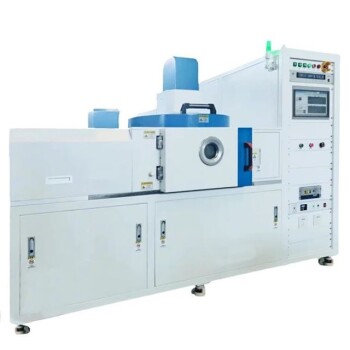
A precision micro-Raman spectrometer characterizes SSBSN ceramics by utilizing a 532 nm laser source to probe the material's internal phonon vibration modes. This optical analysis verifies the short-range order of the crystal structure, allowing researchers to confirm the atomic-scale symmetry without damaging the sample.
The core value of this technique lies in its ability to validate the material's phase structure. By identifying specific ionic vibrations and lattice stretching modes, the spectrometer definitively confirms the presence of the orthorhombic phase essential for the ceramic's performance.
Analyzing Atomic-Scale Structure
The Mechanism of Analysis
The spectrometer employs a 532 nm laser to excite the sample. This specific wavelength allows the instrument to detect phonon vibration modes within the ceramic.
Verifying Short-Range Order
Rather than looking at the surface morphology, this technique looks deeper into the short-range order of the lattice. It provides a fingerprint of how atoms are arranged relative to one another.
Identifying Specific Ionic Components
Tracking A-Site Ions
The spectrometer is tuned to identify the specific vibrations of A-site ions. In the context of SSBSN ceramics, this specifically involves tracking the behavior of Strontium (Sr) and Tin (Sn) atoms.
Examining the Oxygen Octahedra
Beyond individual ions, the instrument analyzes the broader crystal backbone. It specifically detects the symmetric stretching modes of the NbO6 octahedra.
Confirming Microscopic Symmetry
These vibrational signatures are not random; they correlate to specific structural symmetries. The data gathered confirms the microscopic symmetry of the material at the atomic scale.
Understanding the Trade-offs
Structural Identity vs. Morphology
It is critical to understand that Raman spectroscopy is a tool for chemical and structural identification, not physical morphology. While it excels at confirming the orthorhombic phase structure, it does not provide data on grain growth or physical densification.
The Limits of Resolution
Raman analyzes atomic vibrations. It is not suitable for observing plate-like grain patterns or calculating porosity at grain boundaries. For sub-micron imaging of physical features and leakage current analysis, complementary tools like Field Emission Scanning Electron Microscopy (FE-SEM) are required.
Making the Right Choice for Your Goal
To ensure comprehensive characterization of SSBSN ceramics, align your choice of instrumentation with your specific analytical needs:
- If your primary focus is structural verification: Use the micro-Raman spectrometer to confirm the orthorhombic phase and analyze A-site ion vibrations (Sr, Sn) and NbO6 stretching modes.
- If your primary focus is physical morphology: Do not rely on Raman data; instead, utilize FE-SEM to observe grain growth patterns and calculate average grain sizes.
Success in characterization relies on using Raman spectroscopy strictly to validate atomic symmetry while leaving morphological analysis to imaging systems.
Summary Table:
| Feature | Raman Spectroscopy Capability | Analysis Target |
|---|---|---|
| Excitation Source | 532 nm Laser | Internal Phonon Modes |
| Structural Order | Short-range verification | Atomic-scale symmetry |
| Chemical Fingerprint | NbO6 Octahedra stretching | Orthorhombic phase confirmation |
| Ion Tracking | A-site vibration analysis | Strontium (Sr) & Tin (Sn) behavior |
| Limitation | No physical morphology | Grain size & porosity (use FE-SEM) |
Elevate Your Material Analysis with KINTEK
Precision in ceramic characterization requires more than just high-end instrumentation; it demands a partner who understands the nuances of atomic-scale symmetry and phase stability. KINTEK provides the specialized equipment and expertise needed to drive your research forward.
Backed by expert R&D and manufacturing, KINTEK offers a comprehensive range of solutions including Muffle, Tube, Rotary, Vacuum, and CVD systems, along with other laboratory high-temperature furnaces—all fully customizable to meet the unique structural verification needs of your SSBSN ceramics and advanced materials.
Ready to achieve superior results? Contact us today to consult with our experts and find the perfect thermal processing and characterization setup for your lab.
References
- Anurag Pritam, Susanta Sinha Roy. Multiple relaxation mechanisms in SrBi2Nb2O9 ceramic tweaked by tin and samarium incorporation in assistance with single-step microwave sintering. DOI: 10.1007/s00339-024-07482-y
This article is also based on technical information from Kintek Furnace Knowledge Base .
Related Products
- Multi Heating Zones CVD Tube Furnace Machine for Chemical Vapor Deposition Equipment
- High Temperature Muffle Oven Furnace for Laboratory Debinding and Pre Sintering
- Laboratory Quartz Tube Furnace RTP Heating Tubular Furnace
- Multi Zone Laboratory Quartz Tube Furnace Tubular Furnace
- Vertical Laboratory Quartz Tube Furnace Tubular Furnace
People Also Ask
- What is the function of a multi-zone tube furnace in CVD synthesis? Master 2D In2Se3 Nanosheet Precision
- What temperature-related capabilities make multi zone tube furnaces valuable for research? Unlock Precision Thermal Control
- What role do multi zone tube furnaces play in new energy research? Unlock Precise Thermal Control for Innovation
- Why are multi zone tube furnaces particularly useful for nanomaterial research? Unlock Precise Thermal Control for Advanced Synthesis
- What environmental protection applications utilize multi zone tube furnaces? Unlock Precision in Waste Treatment and Green Tech