
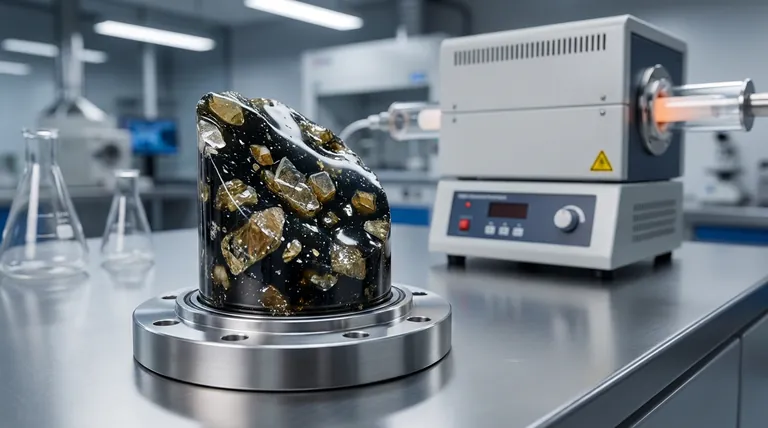
Glass-ceramic composite materials provide superior performance by structurally integrating the manufacturing ease of glass with the exceptional chemical stability of crystals. Unlike single-phase glass, these composites utilize a controlled crystallization process to actively sequester Rare Earth Element-Minor Actinide (REE-MA) components into highly durable phases, ensuring robust long-term containment.
The core advantage lies in selectively enriching long-half-life actinides within corrosion-resistant crystalline phases, such as monazite or zirconolite, which dramatically improves leaching resistance and structural integrity over extremely long timeframes.
The Mechanics of Enhanced Containment
Hybrid Material Properties
Glass-ceramic composites are engineered to capture the best attributes of two distinct material types. They leverage the processing flexibility of glass, allowing for easier manufacturing and shaping of the waste form.
Simultaneously, they incorporate the high chemical stability inherent to crystalline materials. This dual approach addresses the limitations found when using single-phase glass alone.
Controlled Crystallization
The superior performance is achieved through a specific manufacturing step: controlled glass crystallization.
This process is not random; it is tuned to encourage the formation of specific mineral structures within the glass matrix.
Targeted Actinide Enrichment
During crystallization, long-half-life actinides are chemically driven into the crystalline phases.
Rather than remaining dispersed in the less durable glass phase, the hazardous components are enriched within robust structures like monazite or zirconolite.
Advantages Over Single-Phase Glass
Superior Leaching Resistance
The primary failure mode for immobilization matrices is leaching, where groundwater corrodes the material and releases radioactive elements.
The crystalline phases in composites (monazite/zirconolite) are highly corrosion-resistant. By locking the actinides inside these crystals, the composite prevents release even if the surrounding glass matrix degrades.
Long-Term Structural Integrity
Radioactive waste must be stored for geological timeframes. Single-phase glass can suffer from devitrification or instability over these extremely long durations.
Glass-ceramic composites provide enhanced structural integrity, ensuring the waste form remains intact significantly longer than standard glass alternatives.
Critical Processing Considerations
The Necessity of Precision
While glass-ceramics offer superior properties, their performance is strictly dependent on the success of the controlled crystallization process.
If the process is not managed correctly, the actinides may not properly segregate into the durable crystalline phases.
Phase Selectivity
The benefit is specific to the type of crystal formed. The process must ensure the formation of highly stable phases like monazite or zirconolite.
If less stable crystals form due to process variations, the advantage over single-phase glass is diminished.
Making the Right Choice for Immobilization
For projects involving Rare Earth Element-Minor Actinide (REE-MA) components, the choice of matrix dictates long-term safety.
- If your primary focus is Chemical Stability: Prioritize glass-ceramic composites to lock actinides into corrosion-resistant phases like monazite or zirconolite.
- If your primary focus is Long-Term Containment: Utilize composites to leverage the superior structural integrity required for extremely long storage durations.
- If your primary focus is Manufacturing Feasibility: Rely on the processing flexibility of the glass component, but ensure rigorous control over the crystallization step.
By targeting the specific chemistry of long-half-life actinides, glass-ceramic composites offer a robust, scientifically sound solution for permanent waste immobilization.
Summary Table:
| Feature | Single-Phase Glass | Glass-Ceramic Composite |
|---|---|---|
| Structural Matrix | Homogeneous glass | Hybrid (Glass + Crystalline phase) |
| Actinide Localization | Dispersed in glass phase | Enriched in stable crystals (Monazite/Zirconolite) |
| Leaching Resistance | Moderate/Standard | Superior (High corrosion resistance) |
| Durability Type | Chemical/Physical stability | Enhanced long-term geological integrity |
| Processing | Simple melting | Flexible melting + Controlled crystallization |
Secure Your High-Temperature Material Solutions with KINTEK
Precision in controlled crystallization is critical for developing high-performance glass-ceramic composites. At KINTEK, we understand the technical demands of immobilizing hazardous components and engineering advanced materials. Backed by expert R&D and world-class manufacturing, we provide a comprehensive range of lab high-temp furnaces—including Muffle, Tube, Rotary, Vacuum, and CVD systems—all of which are fully customizable to meet your unique research and production needs.
Ready to achieve superior structural integrity and chemical stability in your laboratory? Contact our experts today to discuss how our specialized thermal equipment can optimize your material processing and waste immobilization projects.
References
- S. V. Yudintsev, V. I. Malkovsky. Thermal Effects and Glass Crystallization in Composite Matrices for Immobilization of the Rare-Earth Element–Minor Actinide Fraction of High-Level Radioactive Waste. DOI: 10.3390/jcs8020070
This article is also based on technical information from Kintek Furnace Knowledge Base .
Related Products
- 1400℃ High Temperature Laboratory Tube Furnace with Alumina Tube
- 1800℃ High Temperature Muffle Oven Furnace for Laboratory
- 1700℃ High Temperature Laboratory Tube Furnace with Alumina Tube
- 1700℃ High Temperature Muffle Oven Furnace for Laboratory
- 1700℃ Controlled Inert Nitrogen Atmosphere Furnace
People Also Ask
- How does zone-melting in tube furnaces synthesize bismuth micro-wires? Master Single-Crystal Thermoelectric Growth
- How do high-temperature laboratory tube furnaces ensure environmental stability? Precision Thermal Reduction Tips
- How are high-temperature laboratory tube furnaces applied in long-term vacuum homogenization heat treatments for intermetallic samples?
- How are high-temp tube furnaces used to measure diffusion coefficients per Fick's law? Master Precision Annealing
- How are high-temperature tube furnaces applied in testing ceramic-supported alloy membranes? Insights



















