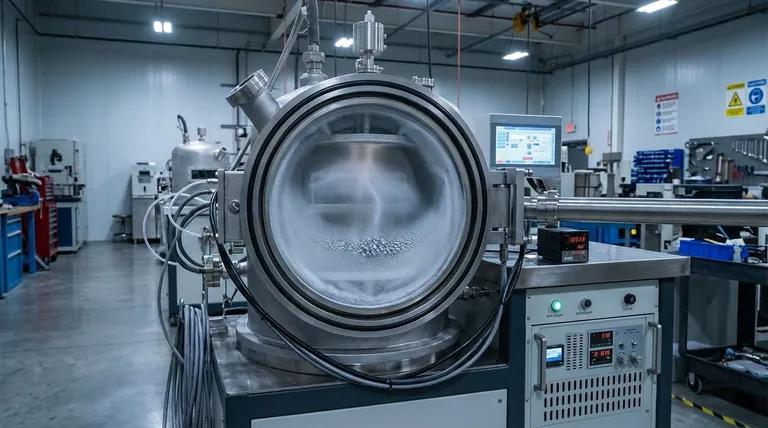
The Moment of Creation
Inside a high-temperature vacuum furnace, the environment is a controlled storm. Raw material, heated under immense vacuum, releases a ghostly cloud of pure magnesium vapor. It's a chaotic, high-energy state.
But in the path of this rising vapor hangs a destination: a calm, intensely cold surface. This is the condensation crystallizer.
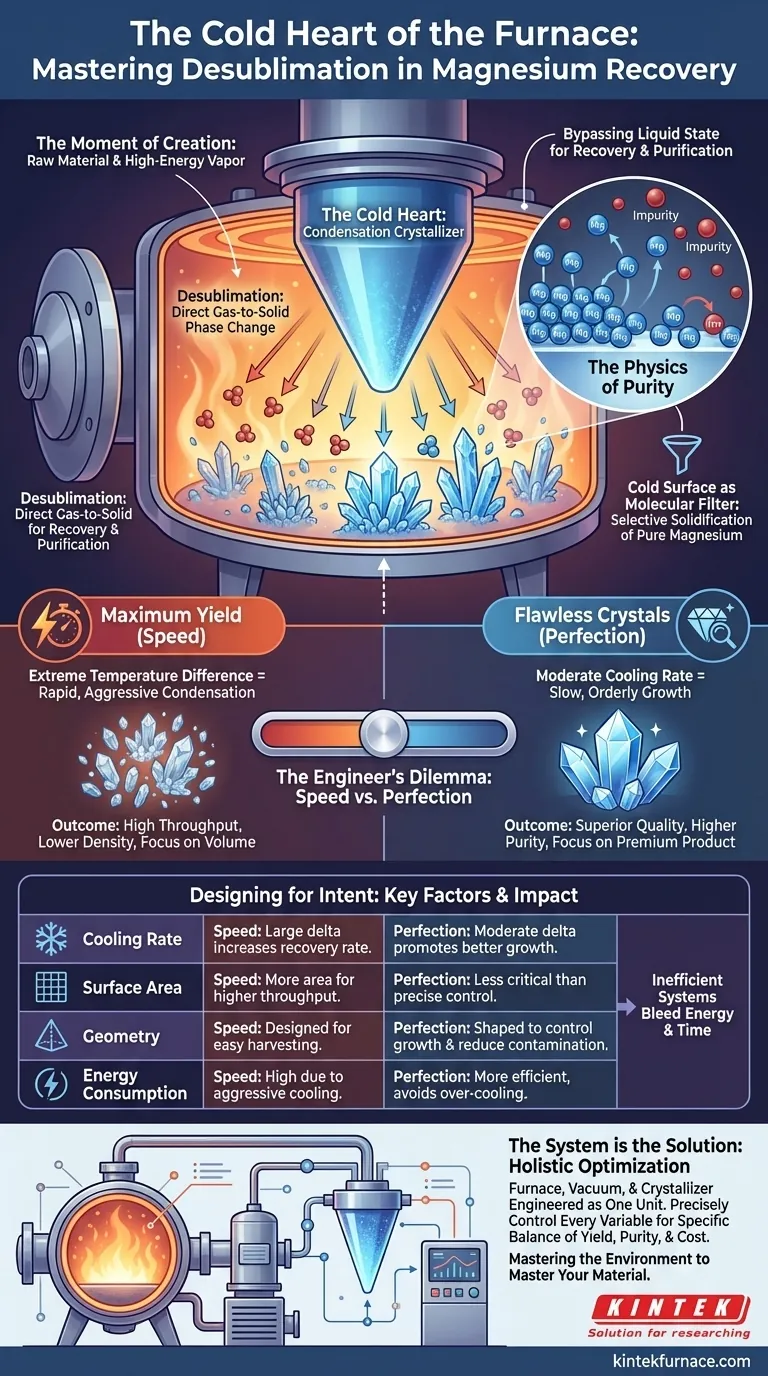
It is not merely a passive component. It is the cold heart of the furnace, the active engine of solidification. When a hot vapor molecule makes contact, its frenetic energy is stripped away in an instant. This is not a gentle cooling; it is a violent, immediate transformation from gas to solid.
Desublimation: An Engineered Act
This direct gas-to-solid phase change is called desublimation. It's a process that bypasses the liquid state entirely, and it is the key to both recovery and purification.
The crystallizer's function is to force this transformation. By maintaining a significant temperature difference, it creates an irresistible attraction for the pure magnesium vapor, compelling it to condense and form a crystalline structure on its surface.
The Physics of Purity
This process is inherently selective. Impurities mixed within the vapor cloud—other elements with different boiling points or vapor pressures—do not share the same affinity for the cold surface. They tend to remain in their gaseous state, ignored by the crystallizer.
The cold surface acts like a filter at the molecular level, allowing only the pure magnesium to solidify. The result is a harvest of high-purity metallic crystals, grown directly from a purified vapor.
The Engineer's Dilemma: Speed vs. Perfection
The design and operation of a crystallizer are a study in trade-offs. The parameters you choose are a physical manifestation of your strategic goals. It's a classic conflict between quantity and quality.
The Allure of Maximum Yield
To capture the most magnesium possible, you can create an extreme temperature difference. A brutally cold surface forces vapor to condense rapidly and aggressively.
This strategy maximizes recovery rates and throughput. The psychological driver is efficiency and volume. However, this speed comes at a cost: the resulting crystals are often smaller and less dense. It's an industrial approach focused on the bottom line.
The Pursuit of Flawless Crystals
Alternatively, you can moderate the cooling rate. A less extreme temperature differential encourages slower, more orderly crystal growth.
This patient approach yields larger, denser, and often purer crystals. The driver here is quality and precision, aiming for a premium product. It may slightly reduce the overall recovery rate, but what is harvested is of superior quality.
Designing for Intent
Choosing between these two paths isn't just about turning a dial. The ideal outcome is governed by the physical design of the system itself.
| Factor | Impact on Speed (Yield) | Impact on Perfection (Purity) |
|---|---|---|
| Cooling Rate | A large temperature delta increases the recovery rate. | A stable, moderate delta promotes better crystal growth. |
| Surface Area | More area allows for higher throughput. | Can be less critical than precise temperature control. |
| Geometry | Designed for easy harvesting of large quantities. | Shaped to control growth patterns and reduce contamination. |
| Energy Consumption | High, due to the need for aggressive cooling. | More efficient, as it avoids wasteful over-cooling. |
An inefficient system, one not tailored to your primary goal, doesn't just produce a suboptimal product; it constantly bleeds energy and operational time.
The System is the Solution
The crystallizer does not exist in isolation. Its performance is inextricably linked to the vacuum furnace it serves. Optimizing the process requires a holistic approach where the furnace, vacuum system, and crystallizer are engineered as a single, cohesive unit.
This is where mastery of the entire thermal environment becomes critical. The ability to customize a system—from a Tube or Rotary Furnace for processing to a complex CVD system—is what allows you to escape the simple trade-off between speed and perfection. By precisely controlling every variable, you can achieve the specific balance of yield, purity, and operational cost your application demands.
At KINTEK, our expertise isn't just in building high-temperature furnaces; it's in engineering the precise conditions needed to achieve a desired outcome. We design and manufacture integrated systems where the crystallizer is perfectly matched to the furnace's capabilities and your strategic goals.
To truly master your material, you must first master the environment that creates it. Contact Our Experts
Visual Guide
Related Products
- Magnesium Extraction and Purification Condensing Tube Furnace
- MPCVD Machine System Reactor Bell-jar Resonator for Lab and Diamond Growth
- Cylindrical Resonator MPCVD Machine System for Lab Diamond Growth
- 915MHz MPCVD Diamond Machine Microwave Plasma Chemical Vapor Deposition System Reactor
Related Articles
- Mastering the Void: How Tube Furnaces Forge the Atoms of Innovation
- Why Your Crystal Growth Experiments Are Failing: The Hidden Culprit in Your Tube Furnace
- Beyond Heat: Mastering the Controlled Universe Inside a Tube Furnace
- More Than a Dial: The Psychology of Precision in Tube Furnace Control
- Mastering the Void: How Tube Furnaces Engineer Predictable Outcomes



