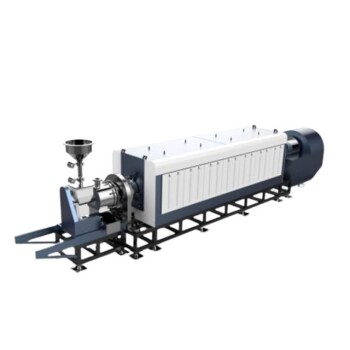
The combination of a sealed steel container and a muffle furnace creates a controlled micro-environment for biomass pyrolysis. The steel container enforces a strict anaerobic or oxygen-limited state, while the furnace provides the precise, high-temperature heat necessary to transform organic matter into carbon-rich biochar without it catching fire.
This experimental setup transforms a standard heating device into a specialized thermochemical reactor. By separating the heat source from the oxygen supply, it allows researchers to precisely control the carbonization process and dictate the final physical properties of the biochar.
Engineering the Pyrolysis Micro-Environment
The Role of the Sealed Steel Container
The primary function of the steel container is to isolate the biomass from the oxygen-rich atmosphere inside the furnace. This creates a strict anaerobic or oxygen-limited micro-environment that is essential for pyrolysis.
Without this barrier, the biomass would undergo direct combustion (burning) at high temperatures, resulting in ash rather than biochar. The container ensures that the raw materials decompose thermally rather than oxidizing.
The Role of the Muffle Furnace
The muffle furnace acts as a stable thermodynamic heat source that can be precisely regulated. While the container manages the atmosphere, the furnace manages the energy, typically maintaining temperatures between 350°C and 750°C.
This precision allows researchers to control the heating rate and retention time. These factors are the primary drivers behind the chemical transformation of cellulose and lignin into a stable carbon skeleton.
Influencing Physicochemical Characteristics
Developing Porous Structures
The high-precision heating of the furnace drives off volatile components from the biomass, leaving behind a complex pore structure. This porosity is what gives biochar its high surface area and strong adsorption capacity.
The specific temperature used (e.g., 500°C or 650°C) determines how these pores develop. A controlled environment ensures the pores do not collapse, which is vital for applications like wastewater treatment or soil amendment.
Regulating Surface Functional Groups
The combination of heat and lack of oxygen facilitates the formation of specific functional groups, such as carboxyl, carbonyl, and keto groups. These groups determine how the biochar will interact chemically with pollutants or soil nutrients.
By maintaining a constant temperature for a set duration, the furnace ensures the complete physicochemical transformation of the material. This results in a stable substance with high alkalinity and carbon stability.
Understanding the Trade-offs
The Risk of Pressure Buildup
Using a "sealed" container in a high-heat environment presents a significant safety challenge regarding internal gas pressure. As biomass decomposes, it releases syngas and vapors that can cause a completely airtight container to rupture.
Temperature Lag and Uniformity
There is often a thermal gradient between the furnace's internal thermometer and the actual biomass inside the steel container. The steel walls and the air gap between the furnace and the container can cause the biomass to reach the target temperature slower than the furnace display indicates.
Scalability Limitations
This setup is ideal for laboratory-scale research but does not translate easily to industrial production. The manual process of sealing containers and the energy required to heat the secondary vessel make it inefficient for large-scale biochar manufacturing.
How to Apply This to Your Research
Making the Right Choice for Your Goal
- If your primary focus is maximizing adsorption capacity: Utilize higher temperatures (600°C+) to drive off more volatiles and create a more extensive, high-porosity structure.
- If your primary focus is soil nutrient retention: Target lower temperatures (around 350°C) to preserve specific functional groups and ensure a slower, more stable carbonization.
- If your primary focus is consistent experimental replication: Ensure the biomass is tightly packed and the container is placed in the exact center of the furnace to minimize temperature variance.
By mastering the balance between the container's atmosphere and the furnace's heat, you can tailor the resulting biochar to meet specific environmental or agricultural needs.
Summary Table:
| Component | Primary Function | Key Laboratory Outcome |
|---|---|---|
| Sealed Steel Container | Creates anaerobic/oxygen-limited environment | Prevents biomass combustion; ensures pyrolysis over ash production |
| Muffle Furnace | Provides stable, regulated thermodynamic heat | Enables precise control over heating rates and retention times |
| Combined System | Engineers a controlled micro-environment | Allows for tailored pore structures and surface functional groups |
| Temperature Range | Typically 350°C to 750°C | Determines final physical properties and carbon stability |
Elevate Your Biochar Research with KINTEK Precision
Precision is the difference between ash and high-quality biochar. KINTEK specializes in advanced laboratory equipment and consumables, offering a comprehensive range of high-temperature furnaces—including muffle, tube, rotary, vacuum, CVD, and atmosphere furnaces—all fully customizable to meet your unique research specifications.
Whether you are optimizing pore structures for wastewater treatment or preserving functional groups for soil science, our equipment provides the thermodynamic stability and atmospheric control your experiments demand.
Ready to refine your pyrolysis process? Contact our technical experts today to find the perfect high-temperature solution for your lab!
References
- Nuwandhya S. Dissanayaka, Anjana J. Atapattu. Utilization of Coconut Plantation Weeds as a Sustainable Feedstock for Biochar Production. DOI: 10.2478/contagri-2024-0017
This article is also based on technical information from Kintek Furnace Knowledge Base .
Related Products
- Laboratory Muffle Oven Furnace with Bottom Lifting
- 1200℃ Muffle Oven Furnace for Laboratory
- 1400℃ Muffle Oven Furnace for Laboratory
- High Temperature Muffle Oven Furnace for Laboratory Debinding and Pre Sintering
- Electric Rotary Kiln Small Rotary Furnace Biomass Pyrolysis Plant Rotating Furnace
People Also Ask
- What function does a muffle furnace perform in Ba0.75Ca0.25TiO3 calcination? Ensure Phase Purity & Synthesis
- Why is a high-temperature muffle furnace required for FeOx-MOx/TiO2? Engineering High-Performance Nanocomposites
- What is the importance of the calcination process? Master High-Purity Calcium Phosphate Nanopowder Production
- Why is a high-temperature laboratory muffle furnace essential for the alkali fusion process in zeolite synthesis?
- What are the primary functions of a high-temperature laboratory muffle furnace in the preparation of biosorbent materials?