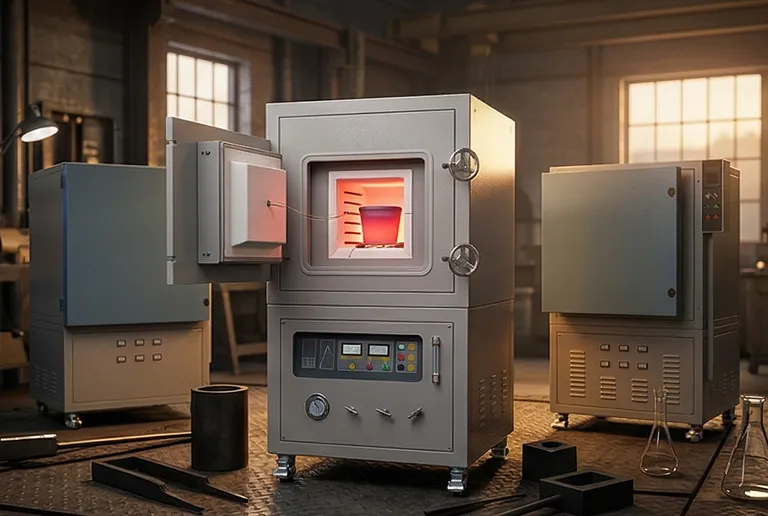
The Invisible Gap in Your High-Temperature Data
Imagine you are running a critical thermal cycling experiment on a zirconium alloy. Your furnace is programmed to ramp at a blistering 100°C per second. On your monitor, the curve looks smooth. But when you analyze the microstructure of the cooled sample, the results don't match the temperature profile you recorded.
The phase transformations you expected are missing, or they occurred at the wrong time. This frustrating discrepancy is a common "ghost" in high-temperature metallurgy. Often, the problem isn't your furnace or your sample—it’s the invisible lag between what is happening to the metal and what your sensors are telling you.
The Cost of "Good Enough" Sensors
In many lab environments, Type K or Type N thermocouples are the workhorses. They are affordable and durable for general use. However, when pushed into the "Extreme Zone"—temperatures exceeding 1000°C combined with rapid heating and cooling—these standard tools begin to falter.
Researchers often try to compensate for poor data by:
- Slowing down the heating rate, which fails to simulate real-world conditions like nuclear reactor transients or aerospace re-entry.
- Using thicker thermocouple sheaths for "protection," which inadvertently increases thermal mass and creates massive lag.
- Applying mathematical offsets to "guess" the real temperature.
These workarounds lead to more than just bad data. They result in project delays, wasted expensive alloys, and a fundamental lack of reproducibility that can stall a research program for months.
The Science of the Lag: Why Standard Sensors Fail
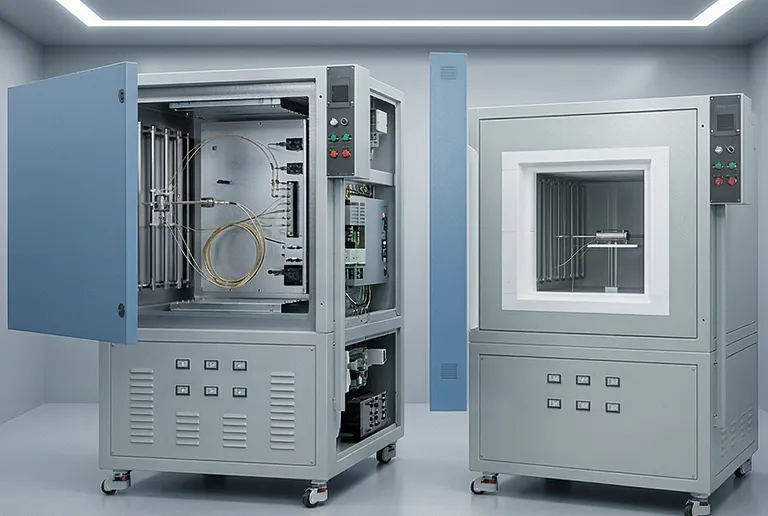
Why is it so hard to get an accurate reading at 100°C/s? The answer lies in two areas: Material Stability and Thermal Inertia.
First, at temperatures above 1000°C, base-metal thermocouples (like Type K) undergo rapid oxidation and "drift." The chemistry of the wire literally changes, meaning the voltage it produces no longer corresponds to the correct temperature. You might think you are at 1050°C, but the sensor is actually reporting 1030°C.
Second, there is the issue of "sensor mass." If a thermocouple is too thick, it acts like a heat sink. In a rapid 100°C/s ramp, the sample heats up instantly, but the bulky sensor is still "warming up." By the time the sensor registers the target temperature, the sample has already overshot it or moved into a different phase. To capture a snapshot of a zirconium alloy's behavior, you need a sensor that moves as fast as the atoms in the metal.
The Solution: R-Type Precision and Direct Integration
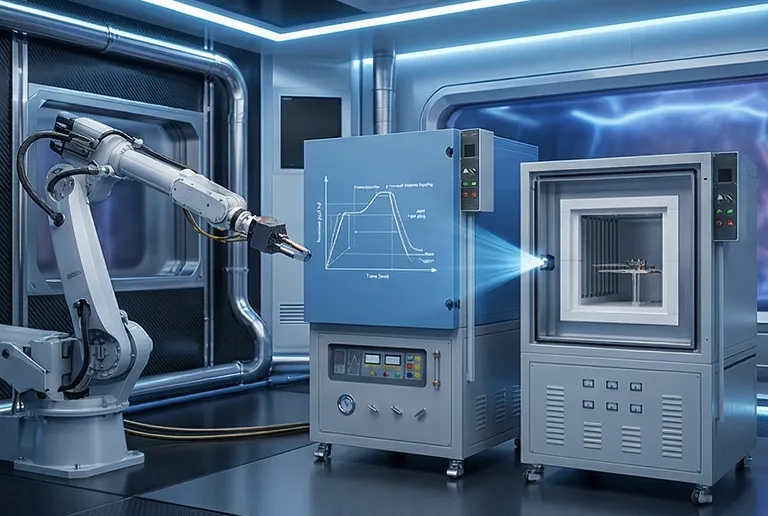
To bridge this gap, the industry standard for high-precision zirconium testing has shifted to R-type thermocouples (Platinum and 13% Rhodium). This isn't just an incremental upgrade; it is a fundamental shift in how temperature is captured.
1. Unmatched Chemical Stability Because R-type thermocouples are made of noble metals, they do not oxidize or degrade at 1000°C+. They provide a rock-solid baseline that remains accurate cycle after cycle, eliminating the "drift" that ruins long-term experiments.
2. Eliminating Thermal Inertia By using fine-diameter R-type wires (as thin as 0.15 mm) and spot-welding them directly to the center of the zirconium sample, we eliminate the air gaps and sheathing that cause lag. This creates a "near-zero mass" measurement system. When the sample gains energy, the sensor responds in milliseconds, allowing for the precise recording of those ultra-fast 100°C/s curves.
At KINTEK, we design our high-temperature vacuum and atmosphere furnaces to accommodate these high-precision setups. We understand that a furnace is only as good as the control system driving it. Our equipment provides the stable thermal environment required to let R-type sensors perform at their theoretical limits.
Beyond the Fix: What Becomes Possible?
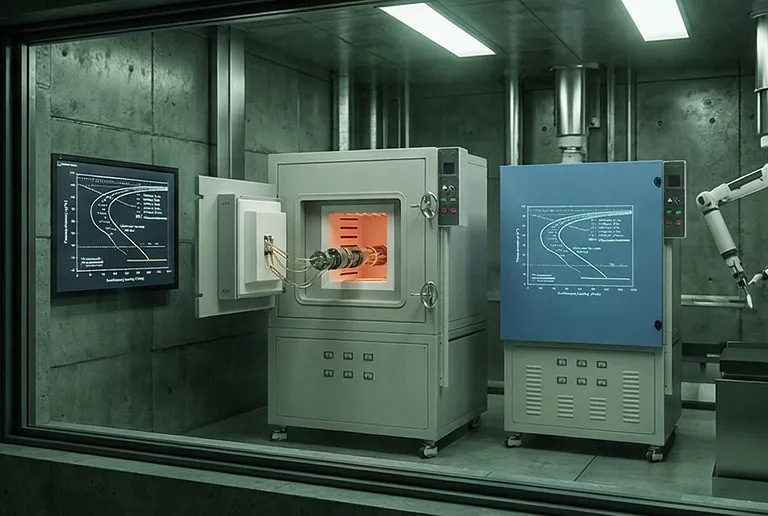
When you solve the problem of thermal lag, you aren't just getting "better numbers"—you are unlocking new capabilities in material science.
With the precision of R-type sensing integrated into a high-performance KINTEK furnace, you can accurately map the Continuous Cooling Transformation (CCT) diagrams of new alloys with absolute confidence. You can simulate emergency cooling scenarios for nuclear fuel cladding with millisecond accuracy, or optimize the heat treatment of aerospace components to reduce weight without sacrificing safety.
By removing the guesswork, you move from "observing" problems to "controlling" outcomes.
Solving complex thermal challenges requires a combination of the right sensor physics and the right furnace engineering. At KINTEK, we specialize in bridging that gap, providing the specialized high-temperature tools that turn difficult experiments into repeatable successes. Whether you are dealing with zirconium alloys or advanced ceramics, our team is ready to help you optimize your thermal processing.
Contact Our Experts to discuss your specific high-temperature requirements today.
Related Products
Related Articles
- Mastering the Micro-Environment: The Art and Science of the Laboratory Tube Furnace
- Clarity Under Fire: The Psychological Case for Quartz Tube Furnaces
- The Alchemy of Control: Mastering the Micro-Environment in a Lab Tube Furnace
- Beyond Heat: Mastering the Controlled Universe Inside a Tube Furnace
- Mastering the Void: How Tube Furnaces Forge the Atoms of Innovation
