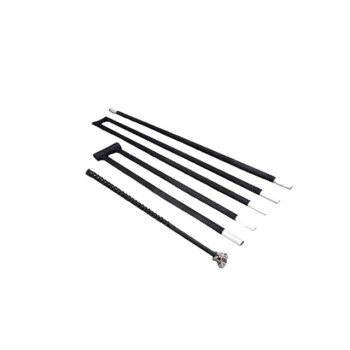
Graphite electric heaters are the standard heating equipment used in high-vacuum resistance furnaces for calibrating Carbon-Carbon Composite Material (CCCM) thermoresistive converters.
These specialized heaters are capable of operating stably under high-vacuum conditions to generate a uniform radiant heat field. They can achieve temperatures up to 2500 °C, which is essential for establishing the precise functional relationship between the converter's electrical resistance and the temperature.
Core Takeaway: To accurately calibrate CCCM thermoresistive converters, high-vacuum furnaces must utilize graphite heaters to provide the extreme temperatures and thermal uniformity required to define the material's resistance-to-temperature curve.
The Role of Graphite in High-Temperature Calibration
Superior Thermal Stability in Vacuum
Graphite is a non-metallic material that maintains its structural integrity at extreme temperatures where most metals would soften or fail. In a high-vacuum environment, it provides a consistent heat source without the risk of the heating element melting or significantly degrading.
Precision through Radiant Heat Uniformity
Calibration requires a highly stable and uniform environment to ensure the sensor is reacting to a known temperature. Graphite heaters excel at producing a uniform radiant heat field, which is critical for minimizing thermal gradients that could lead to inaccurate calibration data.
Bridging the Temperature Gap to 2500 °C
While metallic elements like resistance wires or molybdenum have specific use cases, they often have lower temperature ceilings. Graphite is uniquely suited for the 2500 °C threshold required to simulate the extreme operational environments that CCCM materials are designed to withstand.
Technical Considerations for CCCM Calibration
Establishing the Resistance-Temperature Relationship
The primary goal of using these furnaces is to map how the electrical resistance of the CCCM converter changes as temperature increases. Graphite heaters provide the steady-state conditions necessary to record these data points with high resolution and repeatability.
Material Compatibility and Contamination
Using graphite heaters when calibrating Carbon-Carbon composites is often advantageous because both the heater and the workpiece are carbon-based. This reduces the risk of metallic vapor contamination that could potentially alter the electrical properties of the CCCM converter during the heating process.
Operational Efficiency in High-Vacuum
Graphite's high emissivity makes it an efficient radiator of heat in a vacuum, where convective heat transfer is non-existent. This efficiency allows the furnace to reach and stabilize at target temperatures more effectively than many alternative materials.
Understanding the Trade-offs
Sensitivity to Oxygen
The most significant limitation of graphite heating elements is their extreme sensitivity to oxygen at high temperatures. If the vacuum integrity is compromised or if even trace amounts of oxygen are present, the graphite will undergo oxidation, leading to the rapid depletion of the heating element.
Comparison with Metallic Elements
While molybdenum and tungsten heaters are also used in high-temperature vacuum applications, they can become brittle after heating (recrystallization). Graphite remains relatively robust through thermal cycling, though it is more susceptible to mechanical damage and requires careful handling.
Maintenance and Outgassing
New graphite elements or those exposed to atmosphere may require a "bake-out" period to remove absorbed moisture and gases. Failure to properly manage this outgassing can temporarily degrade the vacuum levels required for high-precision calibration.
Applying This to Your Calibration Process
Making the Right Choice for Your Goal
Choosing the right heating configuration depends on your specific accuracy requirements and the material properties of your sensors.
- If your primary focus is reaching temperatures above 2000 °C: Utilize graphite electric heaters, as they provide the most stable and durable performance at these extreme thermal limits.
- If your primary focus is preventing metallic cross-contamination: Choose graphite heating elements and insulation to ensure a chemically compatible carbon-based environment for your CCCM converters.
- If your primary focus is lower temperature precision (below 1200 °C): Consider metallic resistance wires or molybdenum elements, which may offer more cost-effective solutions for less demanding thermal profiles.
By leveraging the unique properties of graphite heaters, you can ensure the highest level of accuracy and reliability in the calibration of high-performance composite thermal sensors.
Summary Table:
| Feature | Graphite Heating Element | Benefit for CCCM Calibration |
|---|---|---|
| Max Temperature | Up to 2500 °C | Simulates extreme operational environments. |
| Heat Transfer | High Radiant Emissivity | Ensures thermal uniformity in vacuum conditions. |
| Material Compatibility | Carbon-based | Prevents metallic vapor contamination of sensors. |
| Structural Integrity | High Thermal Stability | Maintains shape and performance at extreme heat. |
| Atmosphere | High Vacuum Required | Prevents oxidation and ensures high-purity testing. |
Elevate Your Material Testing Precision with KINTEK
Achieving accurate calibration for Carbon-Carbon composites requires a furnace engineered for extremes. KINTEK specializes in high-performance laboratory equipment and consumables, offering a comprehensive range of high-temperature furnaces—including vacuum, muffle, tube, rotary, CVD, atmosphere, and induction melting systems—all fully customizable to your specific research needs.
Don't compromise on thermal uniformity or material purity. Whether you are calibrating advanced converters or developing next-gen composites, our technical experts are ready to help you design the perfect thermal environment.
Ready to upgrade your lab? Contact KINTEK today for a tailored consultation!
References
- I.V. Gurin, О. Токарєва. USING OF CARBON-CARBON COMPOSITE MATERIALS FOR CREATION OF THERMAL-RESISTIVE CONVERTER OF THERMAL RADIATION. DOI: 10.46813/2024-149-125
This article is also based on technical information from Kintek Furnace Knowledge Base .
Related Products
- 2200 ℃ Graphite Vacuum Heat Treat Furnace
- Silicon Carbide SiC Thermal Heating Elements for Electric Furnace
- Molybdenum Disilicide MoSi2 Thermal Heating Elements for Electric Furnace
People Also Ask
- Why are vacuum heat treating furnaces essential for aerospace? Ensure Superior Material Integrity for High-Stakes Applications
- What is the primary application of vacuum heat treating furnaces in aerospace? Enhance Component Performance with Precision
- What is the process of vacuum heat treating? Achieve Superior Metallurgical Properties
- How does a vacuum heat treating furnace improve the condition of metal alloys? Achieve Superior Metal Performance
- How does vacuum heat treating work in terms of temperature and time control? Master Precise Material Transformations