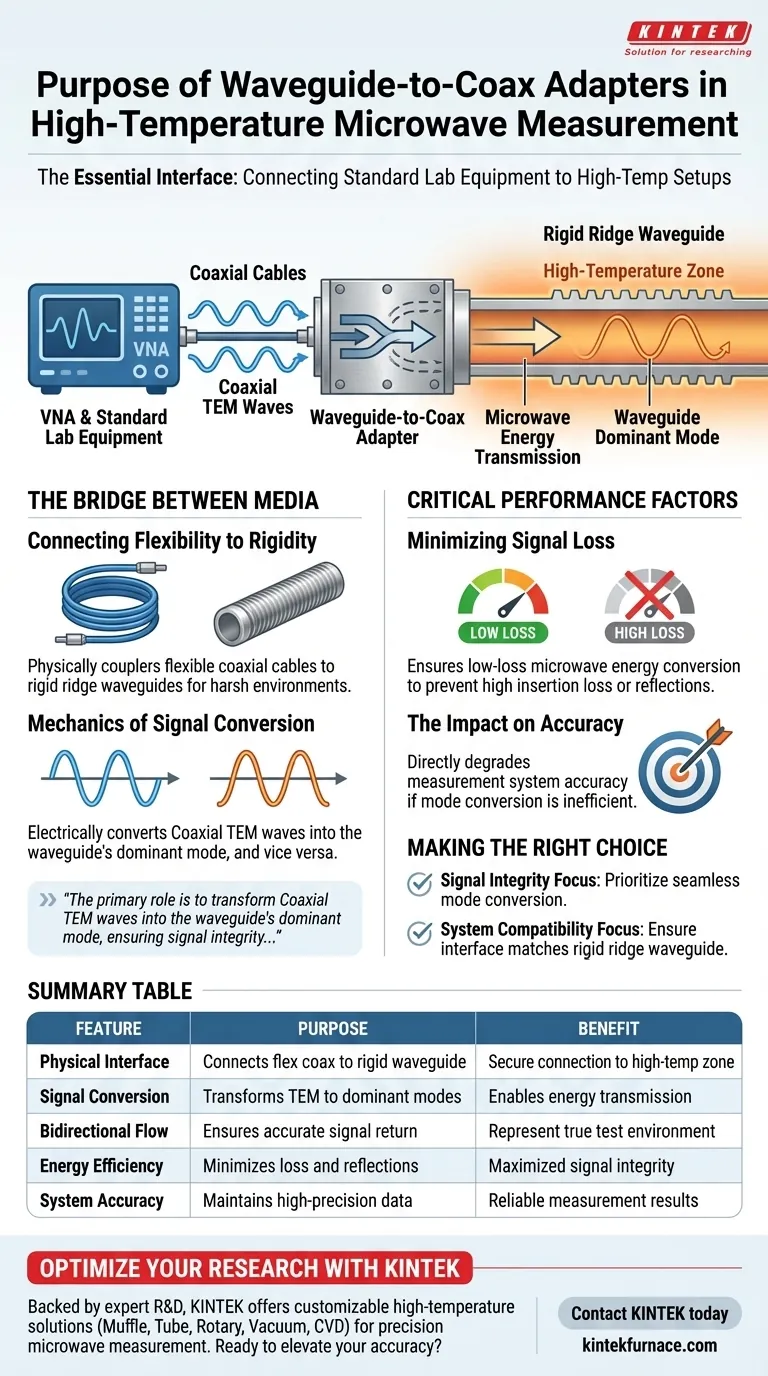
Waveguide-to-coax adapters function as the essential interface connecting standard laboratory equipment to specialized high-temperature measurement setups. They physically join flexible coaxial cables to rigid ridge waveguides while electrically converting signals between the two media. This conversion is necessary to transmit microwave energy from a Vector Network Analyzer (VNA) into the waveguide with minimal loss.
The primary role of these adapters is to transform Coaxial TEM waves into the waveguide's dominant mode, ensuring signal integrity and measurement accuracy across different transmission environments.
The Bridge Between Media
Connecting Flexibility to Rigidity
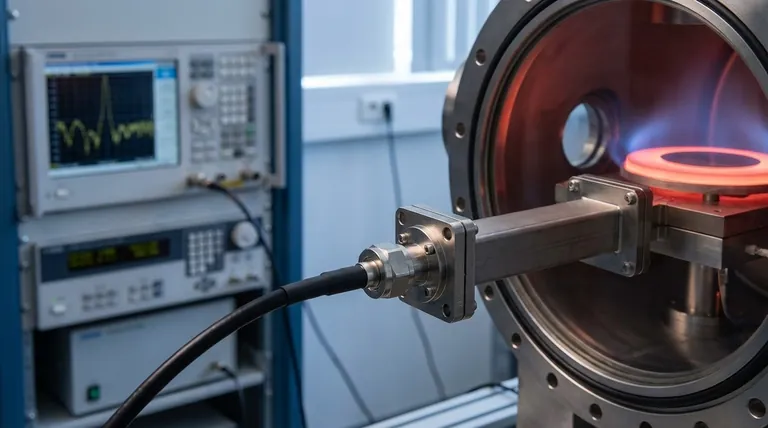
In a measurement chain, you often have two distinct physical environments. You have the flexible coaxial cables attached to your test equipment, and the rigid ridge waveguides designed for the high-temperature zone.
The adapter serves as the physical coupler between these two disparate hardware types. It allows standard, ambient-temperature lab measuring tools to interface securely with the specialized, rigid structures required for harsh environments.
Mechanics of Signal Conversion
Transforming Wave Modes
Beyond the physical connection, the adapter performs a critical electromagnetic function. Coaxial cables transmit signals using TEM (Transverse Electromagnetic) waves.
However, waveguides operate using a specific dominant mode distinct from TEM. The adapter is responsible for converting the signal from one mode to the other as it passes through.
Bidirectional Functionality
This process is not one-way. The adapter converts signals traveling from the VNA into the waveguide, and effectively converts them back for the return path.
This ensures that the data received by the VNA is an accurate representation of the test environment, rather than an artifact of the connection itself.
Understanding Critical Performance Factors
Minimizing Signal Loss
Every transition point in a microwave chain presents a risk of energy loss. The effectiveness of a waveguide-to-coax adapter is measured by its ability to perform low-loss microwave energy conversion.
The Impact on Accuracy
If the mode conversion is inefficient, the measurement system suffers from high insertion loss or reflections. This directly degrades the accuracy of the overall measurement system, making high-quality adapters vital for precise data collection.
Making the Right Choice for Your Goal
To ensure your high-temperature measurement chain functions correctly, consider the following regarding your adapters:
- If your primary focus is Signal Integrity: Prioritize adapters designed for seamless mode conversion to minimize energy loss between the coax and waveguide.
- If your primary focus is System Compatibility: Ensure the adapter matches the specific interface requirements of your rigid ridge waveguide to physically connect with your VNA's flexible cabling.
Select the right adapter to transform a disjointed setup into a cohesive, high-precision measurement system.
Summary Table:
| Feature | Purpose in Measurement Chain |
|---|---|
| Physical Interface | Connects flexible coaxial cables to rigid ridge waveguides |
| Signal Conversion | Transforms Coaxial TEM waves into waveguide dominant modes |
| Bidirectional Flow | Ensures accurate signal return from test environment to VNA |
| Energy Efficiency | Minimizes insertion loss and reflections at transition points |
| System Accuracy | Maintains signal integrity for high-precision data collection |
Optimize Your High-Temperature Research with KINTEK
Precision in microwave measurement starts with high-quality components. Backed by expert R&D and manufacturing, KINTEK offers a comprehensive range of high-temperature solutions, including Muffle, Tube, Rotary, Vacuum, and CVD systems, all customizable to your unique laboratory needs. Whether you are refining signal integrity or scaling thermal processing, our team is ready to provide the technical expertise you require.
Ready to elevate your measurement accuracy? Contact KINTEK today to discuss your custom furnace and microwave measurement requirements.
Visual Guide
References
- Rui Xiong, Qian Chen. A High-Temperature and Wide-Permittivity Range Measurement System Based on Ridge Waveguide. DOI: 10.3390/s25020541
This article is also based on technical information from Kintek Furnace Knowledge Base .
Related Products
- Multi Zone Laboratory Quartz Tube Furnace Tubular Furnace
- Multi Heating Zones CVD Tube Furnace Machine for Chemical Vapor Deposition Equipment
- Vertical Laboratory Quartz Tube Furnace Tubular Furnace
- High Temperature Muffle Oven Furnace for Laboratory Debinding and Pre Sintering
- 1700℃ High Temperature Muffle Oven Furnace for Laboratory
People Also Ask
- Why are multi zone tube furnaces particularly useful for nanomaterial research? Unlock Precise Thermal Control for Advanced Synthesis
- What role do multi zone tube furnaces play in new energy research? Unlock Precise Thermal Control for Innovation
- What environmental protection applications utilize multi zone tube furnaces? Unlock Precision in Waste Treatment and Green Tech
- What temperature-related capabilities make multi zone tube furnaces valuable for research? Unlock Precision Thermal Control
- What are the main applications of multi zone tube furnaces in university laboratories? Unlock Precision in Material Science and Energy Research