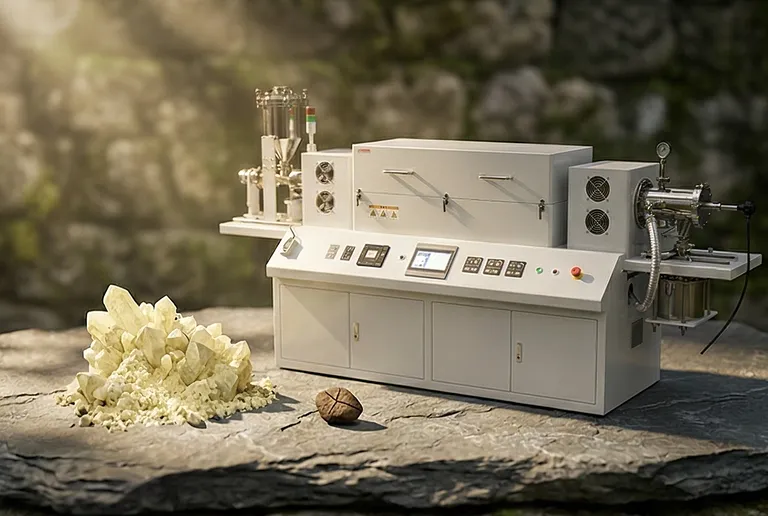
The Frustration of the "Perfect" Sintering Cycle Gone Wrong
You have spent weeks meticulously preparing your $(Tb_xY_{1-x})_2O_3$ magneto-optical ceramic samples. You have calculated the ratios perfectly and set your furnace to the precise sintering temperature. But when you open the chamber, the result is a heartbreak: the ceramic samples are riddled with cracks, or worse, they have completely pulverized into a useless powder.
This isn't just a minor setback; it is a costly drain on your laboratory’s resources. Every failed batch represents lost high-purity raw materials, wasted energy, and weeks of delayed research or production timelines. If you have tried adjusting your ramp rates or extending your dwell times only to see the same mechanical failures, you are likely fighting a battle that cannot be won at the sintering stage. The problem started long before the final heat was applied.
The Common Struggle: Why Traditional Sintering Fails
When working with Terbium-based ceramics, many researchers assume that the raw $Tb_4O_7$ (Terbium Oxide) powder can be integrated directly into the sintering process. It seems logical—after all, it is a high-purity oxide.
However, this approach often leads to "unexplained" mechanical stress. You might notice the material behaving erratically as the temperature rises. Conventional solutions, such as adding binders or changing the pressure of the press, rarely work. This is because the failure isn't caused by your technique; it is caused by a violent chemical and structural transformation happening inside the material itself.
The business consequence is clear: unreliable yields and inconsistent material properties make it impossible to scale up production for high-end applications like Faraday rotators or laser isolators.
The Root of the Problem: An Internal "Structural Earthquake"
The dark brown $Tb_4O_7$ powder many labs start with is inherently unstable for high-temperature sintering. To understand why, we have to look at the chemistry and the crystal structure.
As $Tb_4O_7$ is heated, it undergoes a forced "de-oxygenation." It wants to shed oxygen to reach a more stable state ($Tb_2O_3$). This release of oxygen gas inside a densifying ceramic creates internal pressure. But the real "killer" is the phase transition.
$Tb_4O_7$ typically exists in an orthorhombic crystal system. As it loses oxygen and transforms into $Tb_2O_3$, it shifts into a hexagonal system. This isn't just a name change; it represents a massive change in volume and atomic arrangement. Imagine trying to renovate a building while the foundation is physically shifting and expanding—the walls (the ceramic grains) will inevitably crack under the mechanical stress. This "structural earthquake" is what turns your solid ceramic into a pile of pale yellow dust.
The Solution: Precision Hydrogen Atmosphere Reduction
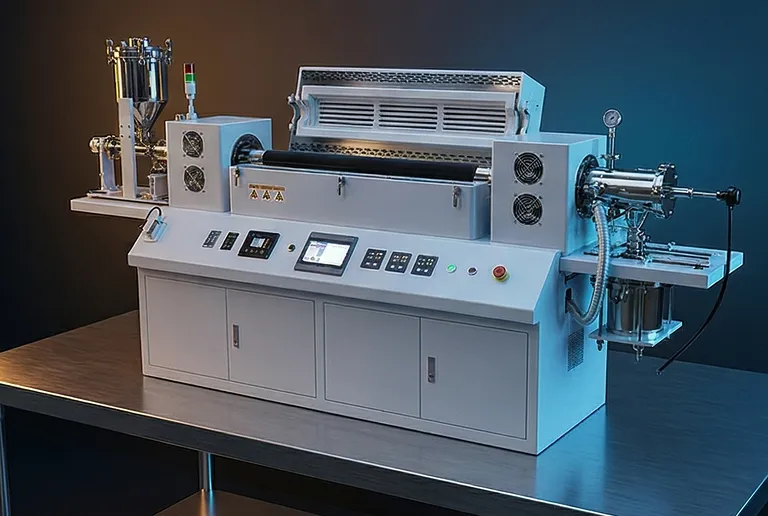
To solve this, you must separate the chemistry from the sintering. The solution is a hydrogen atmosphere pre-treatment.
By processing the dark brown $Tb_4O_7$ in a high-temperature hydrogen furnace before you ever attempt to form the ceramic, you create a controlled environment for the reduction. The hydrogen reacts with the "excess" oxygen in the $Tb_4O_7$, stripping it away safely and converting the powder into the pale yellow, stable $Tb_2_O_3$ form.
This is where the tool becomes as important as the science. A KINTEK hydrogen atmosphere furnace is specifically designed to handle this delicate balance. It provides:
- Active Reduction: Hydrogen doesn't just sit there; it actively drives the chemical change, ensuring every particle of powder is converted.
- Thermal Consistency: Hydrogen has excellent heat transfer properties, ensuring the reduction happens uniformly throughout the batch, preventing "pockets" of unreduced material that could cause later failure.
- Atmosphere Integrity: Precisely controlled gas flow prevents residual oxygen from interfering with the reduction process.
By starting with pre-reduced $Tb_2O_3$, you enter the sintering phase with a material that is structurally "calm," allowing you to focus on density and transparency rather than survival.
Beyond the Fix: Opening New Doors in Optical Performance
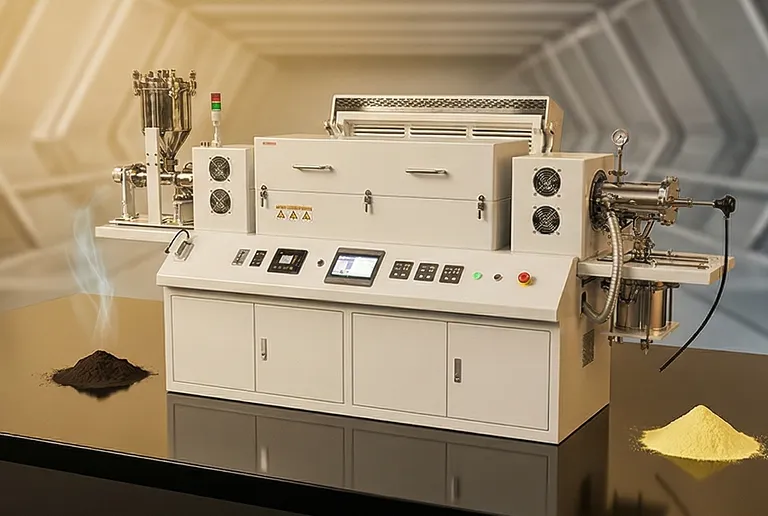
When you eliminate the mechanical stress of phase transitions, the "impossible" becomes routine. By mastering the hydrogen reduction step, you aren't just preventing cracks; you are unlocking the full potential of your magneto-optical materials.
With a stable starting powder, you can achieve higher optical transparency, lower light scattering, and more consistent Faraday rotation constants. You move from a state of "hoping the batch survives" to a state of "optimizing for performance." This reliability allows your team to move faster from the lab to the market, delivering the high-precision components required for the next generation of high-power lasers and optical sensors.
Solving complex material challenges requires more than just high heat—it requires the right environment for chemistry to happen safely and predictably. At KINTEK, we provide the specialized atmosphere furnaces and technical expertise to help you overcome these foundational hurdles. Whether you are dealing with terbium reduction or complex CVD processes, our team is ready to help you optimize your thermal workflows and eliminate the root causes of material failure.
Related Products
- Controlled Inert Nitrogen Hydrogen Atmosphere Furnace
- 1700℃ Controlled Inert Nitrogen Atmosphere Furnace
- 1200℃ Controlled Inert Nitrogen Atmosphere Furnace
- 2200 ℃ Tungsten Vacuum Heat Treat and Sintering Furnace
- Mesh Belt Controlled Atmosphere Furnace Inert Nitrogen Atmosphere Furnace
Related Articles
- The Invisible Contaminant: Why Your Furnace Atmosphere is Sabotaging Your Results
- Why Your High-Temperature Materials Fail: The Hidden Enemy in Your Furnace
- Why Your High-Temp Experiments Fail: It’s Not the Heat, It’s the Atmosphere
- Why Your Silicon Carbide Ceramics Are Brittle: The Invisible Role of Argon Atmosphere
- Why Your Galfenol Sheets Fail to Recrystallize—And How Precise Atmosphere Control Unlocks High Performance




