The Perfectionist’s Paradox: When High Purity Leads to Poor Results
You have meticulously sourced high-purity raw materials, calculated the exact stoichiometry for your Cerium-doped Yttrium Aluminum Garnet (Ce:YAG) powders, and invested in a state-of-the-art vacuum sintering furnace. Yet, when the cooling cycle ends, the result is disappointing: instead of a crystal-clear, vibrant yellow ceramic, you find a material that is opaque, gray-tinged, or riddled with microscopic dark spots.
In the world of advanced ceramics, high-temperature vacuum sintering is often seen as the ultimate solution for density. However, many researchers discover the hard way that what happens before and after the vacuum stage is what actually determines the optical fate of the material.
The Common Struggle: Chasing Transparency in the Dark
When facing poor light transmittance, the instinctive reaction is often to "turn up the heat" or extend the vacuum duration. Researchers might assume the issue is insufficient densification or lingering gas trapped in pores.
While logical, these adjustments often fail to fix the underlying haziness. Worse, they can lead to abnormal grain growth, which further scatters light and degrades the ceramic’s mechanical properties. The hidden cost isn't just a ruined sample; it’s weeks of wasted lab time, excessive energy consumption, and the depletion of expensive precursors like Tetraethyl orthosilicate (TEOS). The real "killer" of clarity isn't a lack of heat—it's a lack of oxygen at the right moment.
The Hidden Saboteurs: Carbon Residue and Oxygen Vacancies
To solve the mystery of the cloudy ceramic, we must look at the chemistry of the precursors. The sintering of Ce:YAG typically involves additives like TEOS and solvents like ethanol. While these aid in forming the right structure, they leave behind organic shadows.
1. The Carbon Trap
During the heating process, if you transition straight to a vacuum or inert environment, the organic components of TEOS and residual ethanol don't fully escape. Instead, they decompose and leave behind fine carbon particles trapped within the powder compact. Once the high-temperature vacuum sintering begins, these carbon impurities become permanent "ink spots" or cause microscopic pores that bridge the grain boundaries, effectively killing the ceramic's light transmittance.
2. The $F$-Center Phenomenon
Even if the powder is clean, the vacuum environment itself creates a second problem: oxygen loss. Under high-heat and low-pressure, oxygen atoms escape the crystal lattice, creating "oxygen vacancies" or $F$-centers (color centers). These defects absorb light, causing the ceramic to turn black or dark brown, stripping it of its characteristic scintillation performance.
The Solution: Why a 600°C Pre-Step and Post-Annealing Are Non-Negotiable
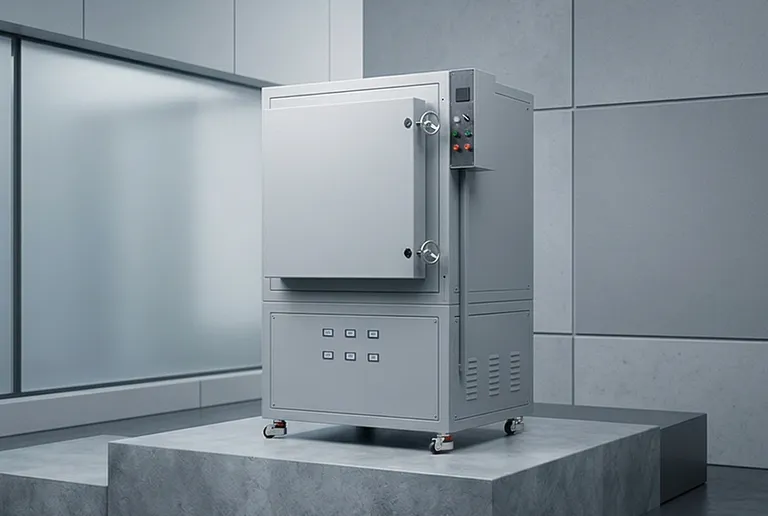
To bridge the gap between "dense" and "transparent," you need a tool that masters the atmosphere. This is where a high-precision Atmosphere Furnace becomes the most critical asset in your workflow.
Step 1: The 600°C Air "Cleanse" By performing a dedicated air annealing step at 600°C before final pressing and sintering, you utilize an oxygen-rich environment to chemically "burn away" residual ethanol and organic impurities. This ensures that when the powder enters the vacuum furnace, it is chemically pristine, leaving no carbon behind to contaminate the lattice.
Step 2: Restoring the Lattice at 1300°C After vacuum sintering, the material must return to an atmosphere furnace. At temperatures ranging from 900°C to 1300°C in an oxidizing environment, oxygen atoms diffuse back into the ceramic. This "bleaching" process repairs the oxygen vacancies, eliminates $F$-centers, and restores the material’s intrinsic color and transparency.
Precision Control: The KINTEK Advantage
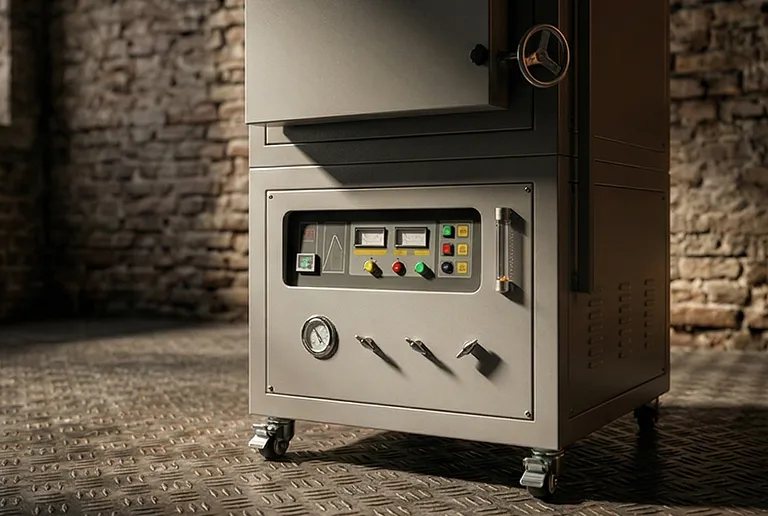
At KINTEK, we don't just build furnaces; we build environments for material transformation. Our atmosphere furnaces are designed specifically to handle these delicate transition points.
- Atmospheric Integrity: Our systems allow for the precise introduction of air, oxygen, or inert gases, ensuring that your Ce:YAG samples receive the exact molarity of oxygen needed to repair the lattice without over-oxidizing the Cerium ions.
- Multi-Segment Programming: Achieving transparency requires subtle heating and cooling rates to eliminate residual thermal stress. KINTEK’s advanced controllers allow for complex, multi-stage temperature profiles that prevent micro-cracking during the transition from 600°C to room temperature.
- Unrivaled Uniformity: Whether you are using a box-type atmosphere furnace for bulk powders or a tube furnace for targeted thin-film annealing, our heating elements ensure a uniform thermal field, so every grain of your Ce:YAG ceramic matures at the same rate.
Unlocking the Potential of Optical Ceramics
When you master the atmosphere, you stop fighting your materials and start perfecting them. By integrating a dedicated air annealing protocol, you unlock the ability to produce ceramics with near-theoretical transmittance, optimized scintillation performance, and absolute consistency. This precision opens doors to higher-efficiency LED lighting, advanced laser gain media, and more sensitive medical imaging components.
Don't let invisible impurities and oxygen defects limit the performance of your advanced materials. Our team of specialists is ready to help you configure a thermal solution tailored to the specific chemical requirements of your research or production line. Whether you need a customizable tube furnace for AZO films or a robust atmosphere furnace for Ce:YAG, KINTEK provides the precision you need to achieve total clarity. Contact Our Experts.
Related Products
Related Articles
- Cracked Zirconia, Inconsistent Shades: The Real Reason Your Sintering Furnace Is Failing You
- Beyond the Program: Why Your Sintering Fails and How to Guarantee Uniformity
- Beyond Maintenance: The Real Reason Your Dental Furnace Delivers Inconsistent Results
- How Vacuum Pressure Sintering Furnaces Elevate Material Performance Across Industries
- Why Your Stainless Steel Parts Fail Pressure Tests—and How Vacuum Sintering Fixes the Density Gap
