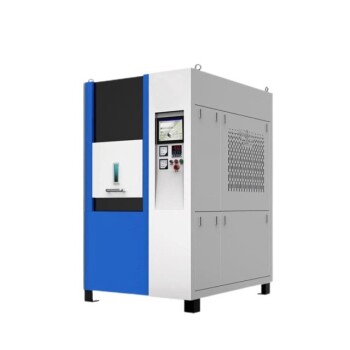
Surface-coated composite powders revolutionize heating uniformity during Spark Plasma Sintering. By applying a continuous, highly conductive skin—such as a cobalt film on tungsten carbide—the electrical current flows preferentially through the coating, generating uniform self-Joule heating across the entire sample. This eliminates the random hot spots and unbonded regions typical of mixed powders, leading to faster densification and a homogeneous, high-density bulk material with superior mechanical integrity.
The core advantage of surface-coated powders is the creation of a continuous, low-resistance percolation network the moment compaction begins. Instead of relying on inconsistent particle-to-particle contacts, the coating becomes a built‑in heating element that distributes current evenly, delivering predictable thermal energy and eliminating the primary source of microstructural heterogeneity in SPS.
How Conductive Coatings Transform Current Flow
The Problem with Uncoated Mixed Powders
In standard powder blends, electrical contact between particles is random and unpredictable. Some regions carry a much higher current density while others remain nearly insulating.
This uneven current distribution creates localised overheating—hot spots that can cause grain growth or even melt—and simultaneously leaves other areas under‑sintered. The result is a part with density gradients, residual porosity, and mechanical weak points.
The Coated Powder Solution
A surface coating of a high‑conductivity material gives every particle a dedicated electron pathway. When the SPS pulse is applied, the current seamlessly channels through this continuous conductive phase.
Because the coating forms a three‑dimensional network of identical low‑resistance paths, the Joule heating generated per unit volume becomes essentially uniform throughout the compact. Thermal gradients are drastically reduced, even in large or complex shapes.
Accelerated Densification and Homogeneity
Uniform heating means the entire powder mass reaches the optimal sintering temperature simultaneously. Plastic flow, atomic diffusion, and pore closure all initiate in unison, eliminating the scenario where outer regions densify first and trap porosity inside.
This synchronised densification slashes the time needed to reach >97% relative density and produces a bulk material with no weak, under‑consolidated pockets. The resulting microstructure is equiaxed, fine‑grained, and flaw‑tolerant.
Practical Implications for High‑Temperature SPS
Superior Mechanical Properties
A homogeneous microstructure directly translates into reproducible, predictable mechanical performance. Parts made from coated powders consistently show higher hardness, fracture toughness, and strength because there are no unbonded regions to serve as crack initiators.
Synergy with Furnace Thermal Management
While the coating drives internal uniformity, external factors like graphite die wall thickness and insulation layer placement still matter. However, the burden on these external controls is greatly reduced. You no longer need extreme thermal compensation strategies just to overcome fundamental contact resistance variation.
When combined with low‑thermal‑conductivity shields between electrodes and the die, coated powders help achieve near‑perfect temperature homogeneity across tall or large‑diameter samples, making the process scalable.
Lower Sintering Temperatures, Shorter Cycles
The same principle seen in ceramic matrix composites applies here: coated inclusion powders reach higher relative density at significantly lower temperatures compared to mechanically mixed equivalents. Because heat is generated exactly where it is needed—at every particle interface—you can often reduce the setpoint by 50–100 °C or shorten the holding time without sacrificing full consolidation.
Understanding the Trade‑offs
Coating Continuity and Thickness Control
The coating must be truly continuous to form the percolation network. Even nano‑scale gaps break the conductive path and reintroduce uneven heating. Achieving this uniformity on irregular powder shapes can be challenging and adds a sensitive process step.
Too thin a coating may be insufficiently robust; too thick, and the coating itself could melt preferentially or alter the overall bulk composition. Precision deposition methods are essential, and they increase processing cost.
Interfacial Reactions at High Temperature
High‑temperature SPS can trigger interdiffusion or reactive phase formation between the coating and the core particle. If the coating diffuses into the matrix too quickly, the conductive network may collapse during the cycle, causing a sudden increase in local resistivity.
This is especially relevant when the coating and base metal have markedly different diffusion rates—a situation that can lead to Kirkendall‑type pore formation at the interface, compromising density. Coating selection must be guided by both conductivity and thermochemical stability.
Economic and Complexity Considerations
Adding a wet‑chemical or vapour‑phase coating step raises raw‑material cost and extends process development time. For high‑volume, non‑critical applications, these penalties may outweigh the gain in uniformity. However, when part performance and reliability are paramount—such as in aerospace or biomedical implants—the trade‑off nearly always favours the coated powder route.
Making the Right Choice for Your SPS Goal
The answer is not universal, but the decision framework is clear. Use the following priorities to guide your approach.
- If your primary focus is achieving maximum density and flaw‑free, uniform mechanical properties: A continuous conductive coating is the most reliable path. It erases the root cause of thermal heterogeneity and consistently produces near‑theoretical density parts.
- If your primary focus is prototyping or cost‑sensitive production runs: Uncoated, mechanically mixed powders may be acceptable if you can tolerate some microstructural variation and invest in extensive thermal management (insulation, tailored die geometries) to mitigate gradients.
- If your primary focus is engineering functionally graded microstructures: Consider using selectively coated or shape‑engineered particles to deliberately create controlled resistivity differences, then fine‑tune the die design to exploit those gradients rather than fight them.
- If your primary focus is scaling to larger parts: Coated powders dramatically reduce the need for external thermal compensation, making it easier to maintain homogeneity across greater volumes—pair them with thin‑walled graphite tooling and CFRC insulator plates for best results.
By addressing the electrical architecture at the particle level, surface coatings give you direct command over the very mechanism that defines SPS success—transforming a once stochastic heating process into a predictable, engineering‑friendly consolidation strategy.
Summary Table:
| Characteristic / Metric | Uncoated Mixed Powders | Surface-Coated Composite Powders |
|---|---|---|
| Current Distribution | Random, unpredictable paths | Continuous 3D low-resistance network |
| Heating Mechanism | Hot spots & localized overheating | Uniform self-Joule heating across compact |
| Densification Rate | Slower; prone to internal residual porosity | Synchronized, rapid (>97% relative density) |
| Sintering Parameters | Standard high temperatures & longer hold | 50–100 °C lower setpoint & shorter cycles |
| Microstructure & Quality | Density gradients & mechanical weak points | Fine-grained, equiaxed, flaw-tolerant bulk |
Maximize Your Material Density & Thermal Control with KINTEK
Achieving precise microstructural control and flaw-free densification in high-temperature processing starts with reliable thermal management. KINTEK specializes in premium laboratory equipment and consumables, supplying an extensive lineup of high-temperature furnaces—including muffle, tube, rotary, vacuum, CVD, atmosphere, induction melting, and specialized dental furnaces—all fully customizable to meet your unique research and production demands.
Whether you are optimizing Spark Plasma Sintering (SPS) setups, developing advanced composite powders, or scaling up thermal processing, KINTEK provides engineered furnace solutions that deliver unmatched temperature stability and uniformity.
Ready to enhance your lab's heating performance and product yields? Contact KINTEK today to discuss your customized high-temperature furnace needs with our technical experts!
Related Products
People Also Ask
- How does the heating mechanism of Spark Plasma Sintering (SPS) function? Enhance TiC/SiC Composite Fabrication
- Why is it necessary to maintain a high vacuum environment during the SPS of SiC? Key to High-Density Ceramics
- What are the technical advantages of using an SPS sintering furnace? Elevate Al2O3-TiC Material Performance
- What are the advantages of Spark Plasma Sintering (SPS)? Achieve Superior Microstructures
- What are the steps in the discharge plasma sintering process? Master Fast, High-Density Material Consolidation