
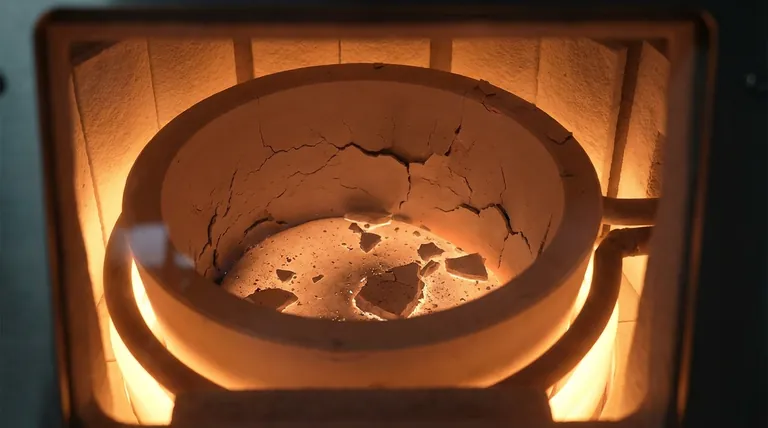
Crucible base spalling fundamentally compromises the purity and structural reliability of nickel-base superalloys by introducing large, foreign contaminants into the melt. When the crucible surface physically peels due to prolonged exposure to high temperatures or chemical reactions, it releases millimeter-sized fragments—specifically magnesium oxide (MgO) or MgO·Al2O3 spinels—that become permanently trapped in the alloy.
Spalling introduces "exogenous inclusions" that are significantly more detrimental than microscopic impurities. These large ceramic fragments act as primary initiation sites for fatigue cracks, directly threatening the safety and lifespan of critical aerospace components.
The Mechanism of Contamination
The Physical Peeling Process
Spalling is not merely surface roughness; it is the physical detachment of the crucible material. This typically occurs after extended periods of high-temperature service or repeated heating cycles.
Formation of Reaction Products
As the crucible interacts with the melt environment, interfacial reaction products accumulate on the crucible base. These products create structural weaknesses, eventually leading to the peeling of the magnesium oxide (MgO) base.
Nature of the Inclusions
The debris released into the melt consists of millimeter-sized particles. These are identified as either fragments of the original MgO crucible or complex MgO·Al2O3 spinels formed during the reaction process.
Impact on Mechanical Integrity
Exogenous vs. Endogenous Inclusions
It is critical to distinguish these spalling defects from standard impurities. Spalling creates exogenous inclusions—contaminants entering from an external source.
The Severity of Large Particles
Because these inclusions are millimeter-sized, they are significantly more harmful than the naturally occurring (endogenous) microscopic inclusions found in alloys. Their large size disrupts the material's continuity more strictly.
Fatigue Crack Initiation
The primary danger of these inclusions is their role in mechanical failure. They serve as stress concentration points within the solidified alloy. Under cyclic loading, such as in an aerospace engine, these points become the origin of fatigue cracks, leading to premature catastrophic failure.
Understanding the Trade-offs: Material Stability
Vulnerabilities of Magnesium Oxide (MgO)
While widely used, MgO crucibles are susceptible to the accumulation of reaction products. This chemical interaction is the root cause of the spalling that introduces harmful spinels into the melt.
The Stability of High-Purity Alumina
In contrast, high-purity alumina (Al2O3) crucibles offer distinct advantages regarding spalling resistance. With the ability to withstand temperatures exceeding 1700°C, they maintain chemical stability and do not readily react with nickel-based melts.
Thermal Shock Resistance
Alumina possesses a low thermal expansion coefficient. This property ensures the crucible can endure repeated heating and cooling cycles without the physical degradation that leads to spalling, thereby preserving the alloy's purity.
Making the Right Choice for Alloy Integrity
To ensure the reliability of nickel-base superalloys, you must align your crucible selection and maintenance with your specific performance requirements.
- If your primary focus is Fatigue Life: You must eliminate sources of exogenous inclusions by selecting crucible materials with high chemical stability, such as high-purity alumina, to prevent particle detachment.
- If your primary focus is Process Monitoring: You must rigorously inspect MgO crucibles for the accumulation of interfacial reaction products, as this is the leading indicator of imminent spalling.
Ultimately, the mechanical integrity of a superalloy is defined not just by its chemistry, but by the physical stability of the vessel in which it is melted.
Summary Table:
| Feature | MgO Crucibles | High-Purity Alumina (Al2O3) |
|---|---|---|
| Spalling Risk | High (due to reaction product buildup) | Low (chemically stable) |
| Inclusion Type | Large exogenous (millimeter-sized) | Minimal to none |
| Thermal Stability | Susceptible to interfacial reactions | Stable up to 1700°C+ |
| Primary Failure Mode | Fatigue crack initiation | Maintained mechanical integrity |
| Thermal Shock | Moderate resistance | High (low expansion coefficient) |
Secure the Integrity of Your Superalloys with KINTEK
Don't let crucible spalling compromise your critical aerospace and industrial components. KINTEK provides high-performance, customizable thermal solutions designed to eliminate exogenous inclusions and maximize material purity.
Why choose KINTEK?
- Expert Engineering: Backed by industry-leading R&D and manufacturing.
- Premium Materials: Specialized in high-purity Alumina and advanced ceramic systems.
- Versatile Systems: From Muffle and Vacuum furnaces to Tube, Rotary, and CVD systems.
- Tailored Solutions: Every furnace is customizable to meet your specific temperature and stability requirements.
Contact our material experts today to optimize your melting process!
References
- Lihui Zhang, Min Xia. The Formation Mechanism of Oxide Inclusions in a High-Aluminum Ni-Based Superalloy during the Vacuum Induction Remelting Process. DOI: 10.3390/met14060654
This article is also based on technical information from Kintek Furnace Knowledge Base .
Related Products
- 1400℃ High Temperature Laboratory Tube Furnace with Alumina Tube
- 1700℃ High Temperature Laboratory Tube Furnace with Alumina Tube
- Magnesium Extraction and Purification Condensing Tube Furnace
- Vacuum Induction Melting Furnace
People Also Ask
- How does zone-melting in tube furnaces synthesize bismuth micro-wires? Master Single-Crystal Thermoelectric Growth
- How are high-temperature laboratory tube furnaces applied in long-term vacuum homogenization heat treatments for intermetallic samples?
- How do high-temperature laboratory tube furnaces ensure environmental stability? Precision Thermal Reduction Tips
- How are high-temp tube furnaces used to measure diffusion coefficients per Fick's law? Master Precision Annealing
- How are high-temperature tube furnaces applied in testing ceramic-supported alloy membranes? Insights



