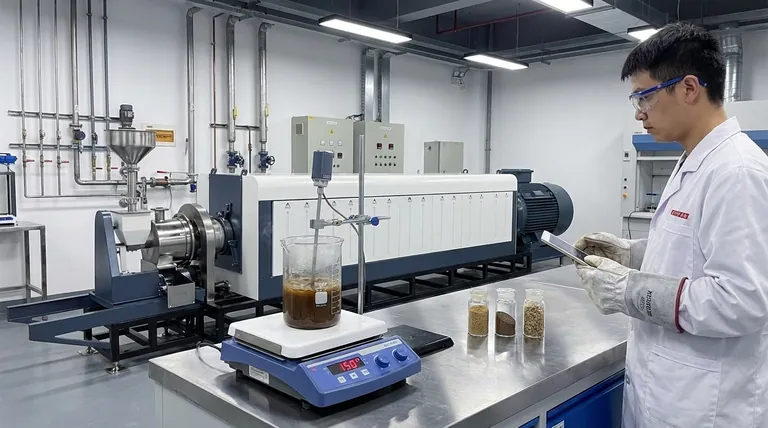
The primary function of heating the mixture to 150°C is to drive off the solvent and trigger the in-situ deposition of nickel nitrate directly onto the biomass surface. This controlled thermal step is essential for establishing a uniform distribution of the metal precursor across the carbon carrier, which directly dictates the quality of the final catalyst.
By effectively evaporating the solvent, this process locks the nickel nitrate onto the biomass structure. This ensures high dispersion and prevents the active components from clumping together (aggregating) prior to the high-temperature calcination stage.
The Mechanism of Deposition
Inducing In-Situ Deposition
The 150°C treatment is not merely a drying phase; it is an active deposition process. As the solvent evaporates, the nickel nitrate is forced out of the solution.
Because this happens in the presence of the biomass, the metal precursor deposits in-situ (in place) directly onto the carrier material. This creates an intimate contact between the nickel source and the carbon source.
Achieving High Dispersion
The performance of a catalyst relies heavily on how well the active metal is spread out. This heating step ensures high dispersion of the nickel nitrate.
Instead of forming large, isolated crystals, the precursor is distributed evenly across the surface of the biomass. This maximizes the surface area available for future reactions.
Protecting Catalyst Integrity
Preventing Pre-Calcination Aggregation
A major risk in catalyst preparation is the natural tendency of metal particles to clump together. If the solvent is not removed correctly, the nickel nitrate components may aggregate.
Heating to 150°C prevents this aggregation before the material ever reaches the high-temperature calcination furnace. It stabilizes the distribution of the components early in the process.
Setting the Stage for Calcination
This treatment is a preparatory prerequisite for the subsequent high-temperature calcination. By fixing the dispersion now, you ensure the final metal particles formed during calcination remain small and highly active.
Understanding the Process Variables
Temperature Precision
The specific target of 150°C is chosen to ensure complete solvent evaporation without effectively degrading the biomass carrier yet.
Failing to reach this temperature may leave residual solvent, leading to poor adhesion of the nitrate to the biomass. Conversely, uncontrolled heating could disrupt the uniform spread of the precursor.
The Risk of Inconsistent Drying
If the evaporation is not uniform, the nickel nitrate may migrate and pool in specific areas. This leads to "hot spots" of high concentration and other areas with no metal at all, ruining the catalyst's overall efficiency.
Optimizing Your Catalyst Preparation
To ensure the highest quality results from your synthesis, consider the following strategic focus areas:
- If your primary focus is maximizing surface area: Verify that the 150°C step is maintained long enough to fully evaporate the solvent, guaranteeing maximum dispersion of the nickel nitrate.
- If your primary focus is minimizing defects: Monitor the mixture to ensure the deposition is uniform, preventing the aggregation of active components before the calcination stage.
Mastering this precursor treatment is the key to producing a highly dispersed, aggregation-free catalyst.
Summary Table:
| Stage | Action at 150°C | Outcome for Catalyst Quality |
|---|---|---|
| Deposition | In-situ deposition onto biomass | Establishes intimate contact between metal and carrier |
| Dispersion | Controlled solvent evaporation | Maximizes surface area and prevents precursor clumping |
| Stabilization | Pre-calcination fixing | Prevents metal aggregation before high-temp processing |
| Carrier Integrity | Moderate thermal treatment | Removes solvent without degrading the biomass structure |
Precision Heat Treatment for High-Performance Catalysts
Producing highly active and dispersed catalysts requires absolute temperature precision and uniform heating. KINTEK provides the specialized equipment needed to master your precursor treatments and calcination stages. Backed by expert R&D and world-class manufacturing, we offer a comprehensive range of Muffle, Tube, Rotary, Vacuum, and CVD systems—all fully customizable to meet the unique demands of your biomass and metal-precursor research.
Ready to optimize your synthesis workflow? Contact KINTEK today to discover how our high-temperature lab furnaces can enhance your material integrity and catalytic efficiency.
Visual Guide

References
- Sunshine D. Kurbah, Ndege Simisi Clovis. Lignocellulosic Biomass Derived Carbon Supported Nickel Nanoparticles as an Efficient Catalyst for Reduction of Nitroarenes. DOI: 10.17807/orbital.v16i4.21957
This article is also based on technical information from Kintek Furnace Knowledge Base .
Related Products
- Multi Heating Zones CVD Tube Furnace Machine for Chemical Vapor Deposition Equipment
- Silicon Carbide SiC Thermal Heating Elements for Electric Furnace
- Molybdenum Disilicide MoSi2 Thermal Heating Elements for Electric Furnace
- Electric Rotary Kiln Continuous Working Small Rotary Furnace Kiln for Pyrolysis Plant Heating
- Custom Made Versatile CVD Tube Furnace Chemical Vapor Deposition CVD Equipment Machine
People Also Ask
- What is the function of a multi-zone tube furnace in CVD synthesis? Master 2D In2Se3 Nanosheet Precision
- What role do multi zone tube furnaces play in new energy research? Unlock Precise Thermal Control for Innovation
- What environmental protection applications utilize multi zone tube furnaces? Unlock Precision in Waste Treatment and Green Tech
- Why are multi zone tube furnaces particularly useful for nanomaterial research? Unlock Precise Thermal Control for Advanced Synthesis
- What temperature-related capabilities make multi zone tube furnaces valuable for research? Unlock Precision Thermal Control