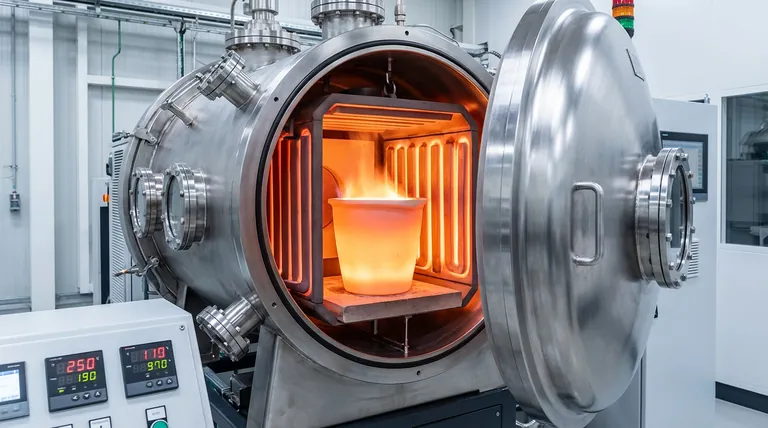
The Unseen Battle in the Heart of the Furnace
Imagine the environment inside a vacuum furnace. The air is gone, removing the buffer of atmospheric pressure. The temperature soars to levels where solid metals surrender and flow like water. In this hostile, high-energy world, one component stands as the silent guardian between a pristine molten alloy and catastrophic contamination: the crucible.
The selection of a crucible material is not a simple preference; it is a profound engineering decision. It’s a test of foresight, a prediction of chemical behavior under the most extreme stress. Choosing correctly leads to a perfect cast. Choosing poorly guarantees failure.
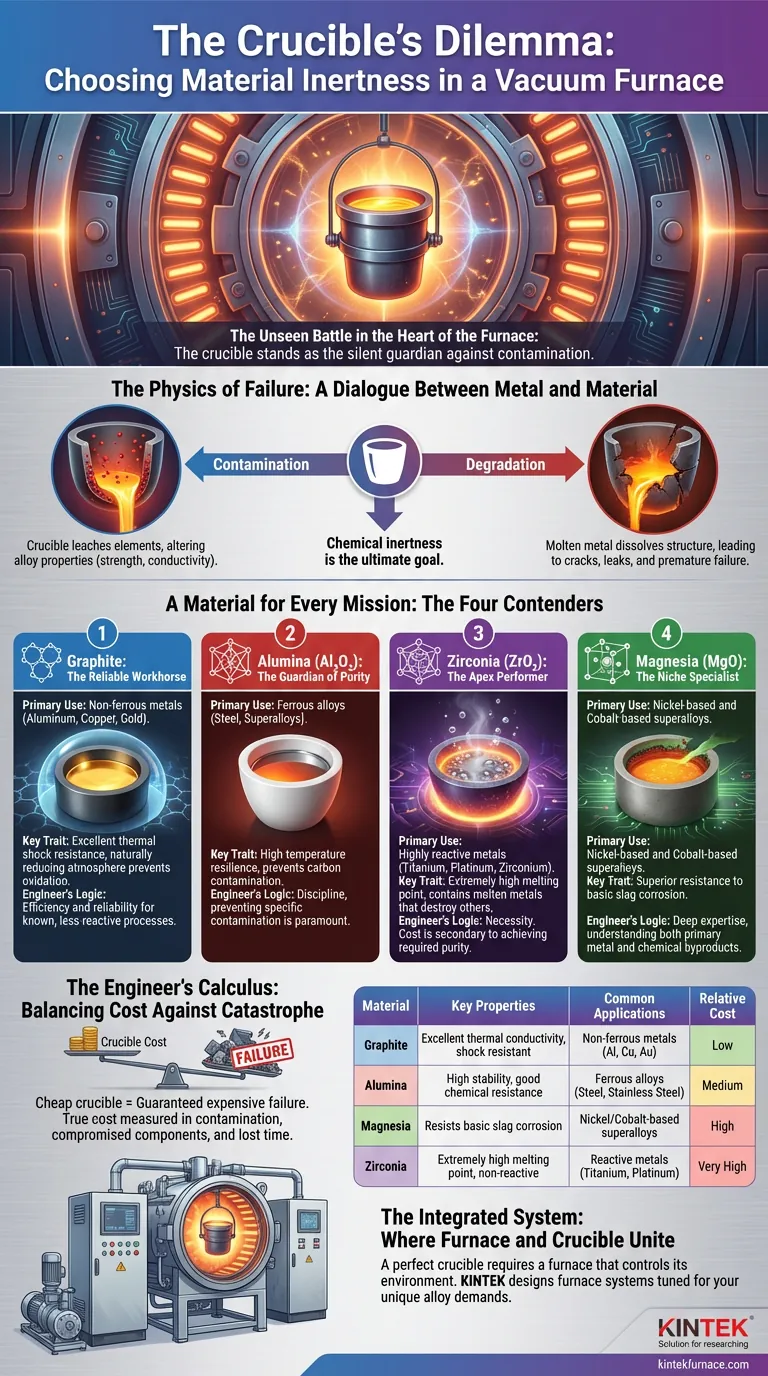
The Physics of Failure: A Dialogue Between Metal and Material
At its core, the challenge is one of chemical inertness. A molten metal is not just hot; it is chemically aggressive, desperately seeking atoms to bond with. The crucible's one and only job is to be profoundly uninteresting to the liquid fury it contains.
A failure here isn't a dramatic explosion. It’s a silent, insidious corruption.
- Contamination: The crucible leaches elements into the melt, fundamentally altering the alloy's final properties—its strength, its conductivity, its very identity.
- Degradation: The molten metal attacks the crucible itself, dissolving its structure, leading to cracks, leaks, and premature, costly failure.
The crucible must win this chemical standoff, every single time.
A Material for Every Mission: The Four Contenders
The choice of material is dictated entirely by the metal being melted. Each option offers a unique profile of resistance, thermal properties, and cost.
H3: Graphite: The Reliable Workhorse
Graphite is valued for its exceptional thermal conductivity and resistance to thermal shock. It heats evenly and withstands rapid temperature changes without cracking.
- Primary Use: Non-ferrous metals like aluminum, copper, and precious metals (gold, silver).
- Key Trait: Its naturally reducing atmosphere helps prevent oxidation of the melt, acting as a chemical shield.
- The Engineer's Logic: This is the choice of efficiency and reliability for known, less-reactive processes.
H3: Alumina (Al₂O₃): The Guardian of Purity
High-purity alumina is an incredibly stable ceramic, known for its high-temperature resilience and broad chemical resistance.
- Primary Use: Ferrous alloys like steel and various superalloys.
- Key Trait: It is the go-to material when carbon from a graphite crucible would be an unacceptable contaminant.
- The Engineer's Logic: This is the choice of discipline, where preventing a specific type of contamination is the paramount goal.
H3: Zirconia (ZrO₂): The Apex Performer
Zirconia sits at the peak of performance and cost. With one of the highest melting points of any ceramic, it is exceptionally non-reactive.
- Primary Use: Highly reactive metals such as titanium, platinum, and zirconium alloys.
- Key Trait: It can contain molten metals that would destroy almost any other material.
- The Engineer's Logic: This is the choice of necessity. When casting the most demanding modern alloys, cost becomes secondary to achieving the required purity. There is no other option.
H3: Magnesia (MgO): The Niche Specialist
Magnesia offers superior resistance to corrosion from the basic slags often produced when melting specific high-performance alloys.
- Primary Use: Nickel-based and cobalt-based superalloys.
- Key Trait: Its specific chemical inertness offers an advantage over alumina in these niche applications.
- The Engineer's Logic: This is the choice of deep expertise, reflecting an understanding of not just the primary metal, but the chemical byproducts of the melting process itself.
The Engineer's Calculus: Balancing Cost Against Catastrophe
There is a direct relationship between a crucible's performance and its cost. It is tempting to see this as a simple budget line item, but it is more accurately a risk calculation. Using a cheaper, incorrect crucible is not saving money; it is guaranteeing a more expensive failure.
The true cost is measured in contaminated batches, compromised components, and lost time. The decision-making process is therefore an exercise in chemical foresight.
| Material | Key Properties | Common Applications | Relative Cost |
|---|---|---|---|
| Graphite | Excellent thermal conductivity, shock resistant | Non-ferrous metals (Al, Cu, Au) | Low |
| Alumina | High stability, good chemical resistance | Ferrous alloys (Steel, Stainless Steel) | Medium |
| Magnesia | Resists basic slag corrosion | Nickel/Cobalt-based superalloys | High |
| Zirconia | Extremely high melting point, non-reactive | Reactive metals (Titanium, Platinum) | Very High |
The Integrated System: Where Furnace and Crucible Unite
A perfect crucible is only as good as the furnace that controls its environment. The furnace provides the stable vacuum, the precise temperature ramps, and the controlled atmosphere that allow the crucible to perform its critical function. The two are not separate components; they are a single, integrated system for material transformation.
This is where deep customization becomes essential. At KINTEK, we understand that a standard furnace is often insufficient for cutting-edge research and manufacturing. Our expertise in Muffle, Tube, Vacuum, and CVD systems is built on a foundation of R&D and in-house manufacturing that allows for precise customization. We design furnace systems that accommodate the specific crucible and process your unique alloy demands, ensuring the environment is perfectly tuned for success.
Achieving this level of precision requires more than just the right crucible; it requires a system engineered for it. If you're navigating these complex material challenges, Contact Our Experts.
Visual Guide
Related Products
- Vacuum Heat Treat Sintering Furnace with Pressure for Vacuum Sintering
- Vacuum Dental Porcelain Sintering Furnace for Dental Laboratories
- Small Vacuum Heat Treat and Tungsten Wire Sintering Furnace
- Vacuum Heat Treat Sintering Furnace Molybdenum Wire Vacuum Sintering Furnace
- 2200 ℃ Tungsten Vacuum Heat Treat and Sintering Furnace
Related Articles
- Why Your Sintered Parts Fail: It’s Not Just About Heat, But Pressure and Purity
- Why Your Stainless Steel Parts Fail Pressure Tests—and How Vacuum Sintering Fixes the Density Gap
- Why Your Electrochromic Electrodes Fail During Sintering—And How Vacuum Control Restores Transparency
- Why Your 3D-Printed Maraging Steel Parts Aren't Performing—And How to Fix the Structural Weakness
- How Vacuum Pressure Sintering Furnaces Elevate Material Performance Across Industries



















