The Illusion of Simplicity
At first glance, the simplest path seems the most efficient. Why not feed raw material powder directly into a smelting furnace? It’s an intuitive thought that mistakes a lack of steps for a lack of complexity.
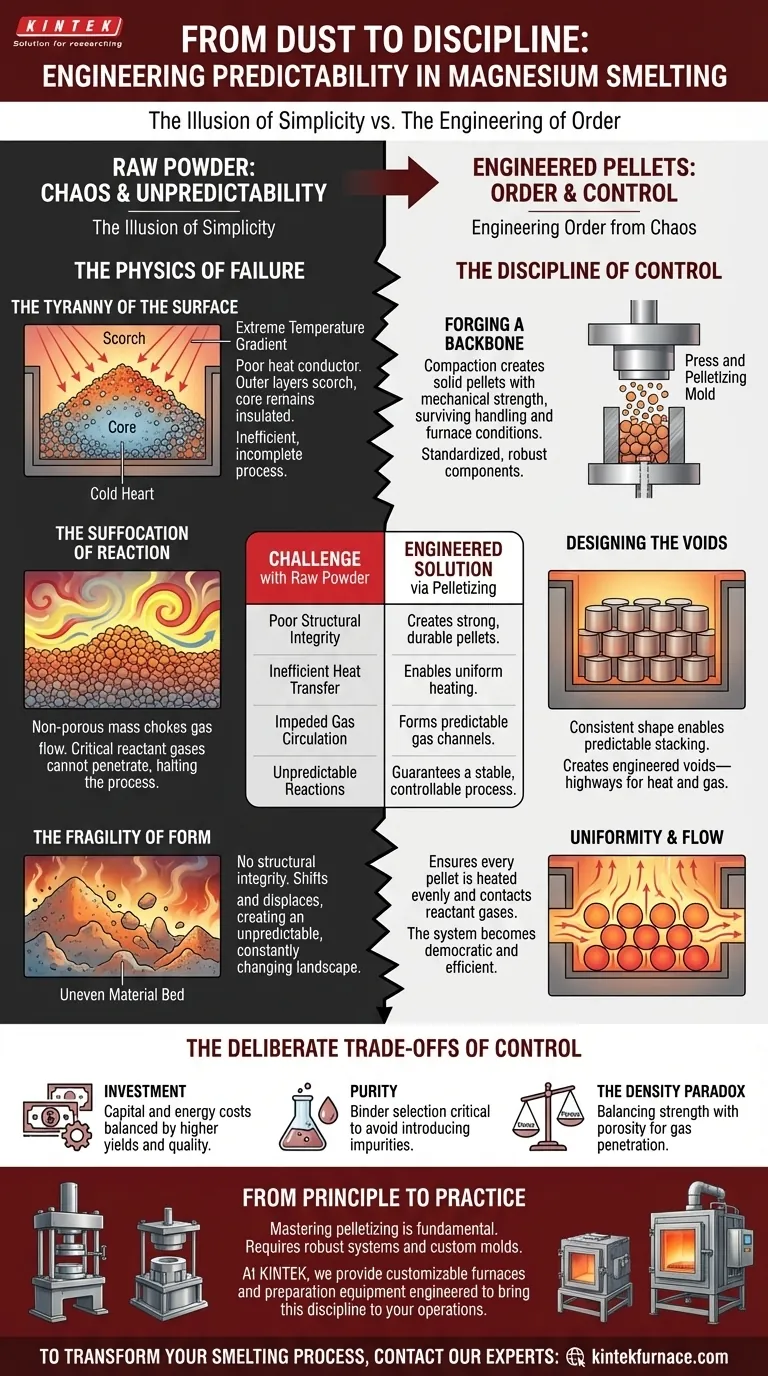
But in high-stakes thermal processes like magnesium smelting, control is not a luxury; it is the entire goal. Unprocessed powder is not a simple ingredient; it is a system of chaos. Its behavior under extreme heat is a story of inefficiency, unpredictability, and failure. The pursuit of a stable reaction begins long before the furnace is lit. It begins by taming the dust.
The Physics of Powder's Failure
The core problem is that a loose pile of powder behaves like a crowd, not a disciplined unit. Its collective failings prevent the precise chemical transformations required for smelting.
The Tyranny of the Surface
A mound of powder is a poor conductor of heat. The outer layers are scorched while the core remains insulated and cool, a phenomenon engineers call a "cold heart." This extreme temperature gradient means the reaction is fierce on the surface and non-existent within. The result is an incomplete, inefficient process that wastes both energy and material.
The Suffocation of Reaction
Chemical reactions at this scale depend on communication—specifically, the flow of hot gases. Powder packs into a dense, non-porous mass that suffocates this exchange. Critical reactant gases cannot penetrate the material, effectively choking the process and bringing it to a halt.
The Fragility of Form
Inside the turbulent environment of a furnace, loose powder has no structural integrity. It shifts and displaces, creating an uneven, unpredictable material bed. A process that demands uniformity is instead handed a constantly changing landscape, making any form of control impossible.
Engineering Order from Chaos
This is where a press and pelletizing mold cease to be simple tools. They become instruments for imposing a deliberate architecture on the raw material, transforming an unpredictable powder into an engineered unit.
Forging a Backbone
The press compacts loose particles into a solid pellet, imparting the mechanical strength needed to survive handling and the intense conditions of the furnace. Each pellet is no longer a random particle but a standardized, robust component.
Designing the Voids
Because pellets have a consistent shape, they stack in a predictable pattern. This creates a bed of material with uniform gaps and channels.
Suddenly, the empty space between the pellets becomes as important as the pellets themselves. These engineered voids are highways for heat and gas, ensuring that every pellet is heated evenly and comes into consistent contact with reactant gases. The system becomes democratic; every part of the material participates equally in the reaction.
| Challenge with Raw Powder | Engineered Solution via Pelletizing |
|---|---|
| Poor Structural Integrity | Creates strong, durable pellets. |
| Inefficient Heat Transfer | Enables uniform heating throughout the bed. |
| Impeded Gas Circulation | Forms predictable channels for gas flow. |
| Unpredictable Reactions | Guarantees a stable, controllable process. |
The Deliberate Trade-offs of Control
Achieving this level of discipline is an engineering decision, and every decision involves trade-offs. They are not problems, but the calculated costs of predictability.
- Investment: The machinery for pressing and pelletizing represents a capital and energy cost that must be justified by higher yields and improved quality.
- Purity: Binders may be needed for strength, but their selection is critical. The wrong agent can introduce impurities, compromising the final product.
- The Density Paradox: A pellet must be dense enough to be strong, yet porous enough for gases to penetrate and react with its interior. This balance is the heart of process optimization.
From Principle to Practice
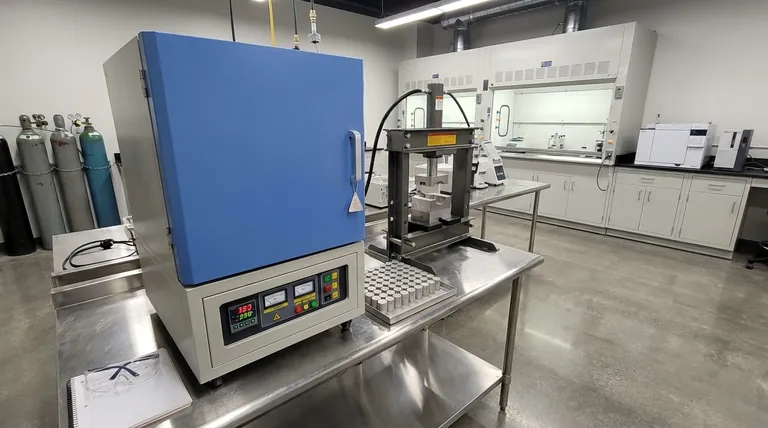
The theoretical need for strength, density, and purity must be met with practical, high-performance equipment. The integrity forged in a press is ultimately tested in the crucible of a high-temperature furnace—whether it's a Muffle, Tube, or custom CVD system. The two stages are inseparable.
This is why mastering the pelletizing stage is fundamental. It requires robust pressing systems and custom molds designed to create pellets with the precise characteristics your process demands. Optimizing for efficiency, purity, or structural integrity starts with equipment capable of delivering consistent, repeatable results. At KINTEK, we provide the customizable furnaces and preparation equipment engineered to bring this discipline to your operations.
To transform your smelting process from a game of chance to an act of engineering, Contact Our Experts
Visual Guide