Your team has spent weeks designing a next-generation catheter. The multi-layer shaft is a marvel of engineering, promising unparalleled torque and pushability. But during a critical bench test simulating a tortuous anatomical path, it fails. The inner Polytetrafluoroethylene (PTFE) liner has delaminated from the outer jacket. Again.
This frustrating scenario is a familiar story in medical device R&D. You've chosen PTFE for all the right reasons—its incredible lubricity, unmatched biocompatibility, and chemical inertness make it the undisputed gold standard. So why does the "perfect" material so often feel like the weakest link in your assembly?
The Familiar Struggle: When the 'Perfect' Liner Won't Stick
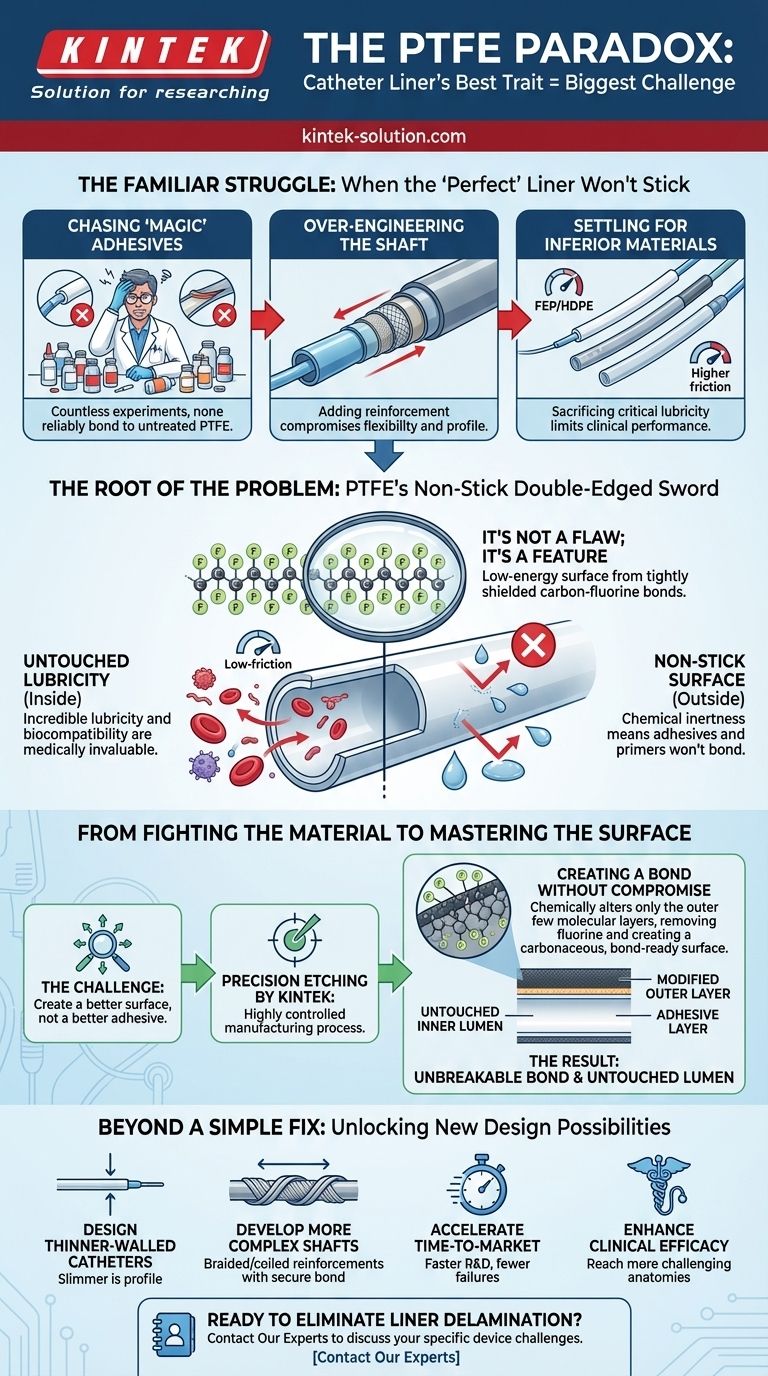
The challenge of liner delamination triggers a costly and time-consuming cycle. Teams often react by:
- Chasing a "Magic" Adhesive: Experimenting with countless adhesives, only to find that none will reliably form a strong bond with an untreated PTFE surface.
- Over-engineering the Shaft: Adding thickness or reinforcement to the outer layers to mechanically "trap" the liner, which can compromise the catheter's flexibility and profile.
- Settling for Inferior Materials: Switching to an alternative liner material like FEP or HDPE that bonds more easily, but sacrifices the critical lubricity needed for navigating complex vasculature, ultimately limiting the device's clinical performance.
These compromises don't just delay project timelines and inflate R&D budgets; they place a ceiling on innovation. A device is only as good as its weakest component, and a persistent fear of liner failure can force engineers to abandon more ambitious and effective designs.
The Root of the Problem: PTFE's Non-Stick Double-Edged Sword
The breakthrough comes when we stop treating liner bonding as a manufacturing problem and start seeing it as a materials science principle. The very properties that make PTFE medically invaluable are the exact same properties that make it so difficult to work with.
It’s Not a Flaw; It’s a Feature
PTFE’s legendary non-stick quality comes from its molecular structure. Long carbon chains are tightly shielded by fluorine atoms, creating an incredibly stable, low-energy surface. This is why it has one of the lowest coefficients of friction of any solid material. Nothing wants to stick to it—not blood cells, not proteins, and not aggressive chemicals.
But this non-stick nature is absolute. The liner’s surface cannot distinguish between a blood clot in an artery and the adhesive you're using on the assembly line. Its profound chemical inertness means that common primers and surface activators that work on other plastics simply have no effect.
The "problem" of poor adhesion isn't a defect in the material; it is the direct consequence of the very features you selected it for. The common workarounds fail because they are fighting against the fundamental physics of the material.
From Fighting the Material to Mastering the Surface
If you can't change the nature of PTFE, how do you solve the bonding paradox?
The solution isn't to find a better adhesive; it's to create a better surface. To achieve a robust, permanent bond, you need a PTFE liner whose outermost surface has been precisely modified to be receptive to bonding, while its critical inner surface remains pristine and lubricious.
This is not a simple task—it is a highly controlled manufacturing process. It requires a partner who understands that a catheter liner isn't just an extruded tube; it's a critical performance component.
Precision Etching: Creating a Bond Without Compromise
At KINTEK, we specialize in the precision fabrication of PTFE components. We have mastered the critical surface treatment processes that transform PTFE from a challenging material into a reliable and predictable asset.
Our chemical etching process, for example, is meticulously controlled to alter only the outer few molecular layers of the PTFE liner. This removes the fluorine atoms on the exterior surface, creating a carbonaceous layer with a higher surface energy that is chemically ready to form a powerful, covalent bond with adhesives and other polymer layers.
The result is the best of both worlds:
- An unbreakable bond on the outside of the liner.
- An untouched, ultra-low-friction lumen on the inside.
By delivering liners with this bond-ready surface and holding them to exceptionally tight dimensional tolerances, we eliminate the root cause of delamination.
Beyond a Simple Fix: Unlocking New Design Possibilities
When your PTFE liner is no longer a point of failure, it becomes a foundation for innovation. With a reliable bond guaranteed, your design possibilities expand significantly.
You can now confidently:
- Design Thinner-Walled Catheters: With a secure liner bond, you don't need to over-engineer the outer shaft for mechanical support, enabling lower-profile devices with larger internal lumens.
- Develop More Complex Shafts: Integrate sophisticated braided or coiled reinforcements, knowing the foundational bond to the PTFE liner is secure.
- Accelerate Your Time-to-Market: Drastically reduce the number of failed prototypes and shorten the R&D cycle by eliminating delamination as a common development hurdle.
- Enhance Clinical Efficacy: Create devices that can reach more challenging anatomies, improving procedural outcomes and opening the door to new therapeutic possibilities.
Stop fighting the PTFE paradox and start leveraging it. By partnering with a component specialist who has mastered the material's unique properties, you can transform your biggest manufacturing headache into your most significant competitive advantage.
Ready to eliminate liner delamination from your project's risk profile? Our team is ready to discuss the specific challenges of your device and demonstrate how precision-fabricated PTFE components can elevate your design from concept to clinical success. Contact Our Experts.
Visual Guide
Related Products
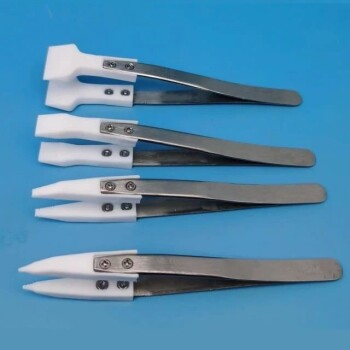
- Custom PTFE Parts Manufacturer for Teflon Parts and PTFE Tweezers
- Custom PTFE Sleeves and Hollow Rods for Advanced Applications
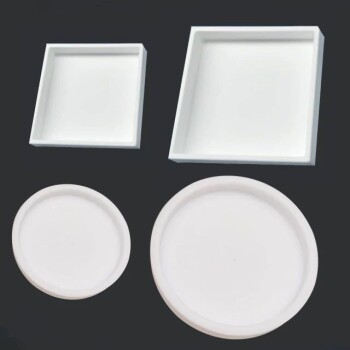
- Custom PTFE Parts Manufacturer for Teflon Containers and Components
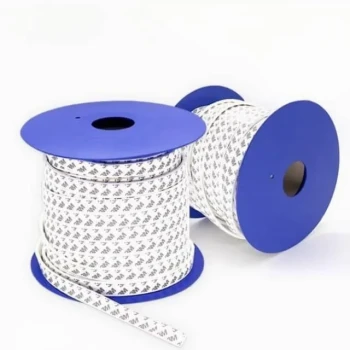
- Custom PTFE Sealing Tapes for Industrial and High Tech Applications
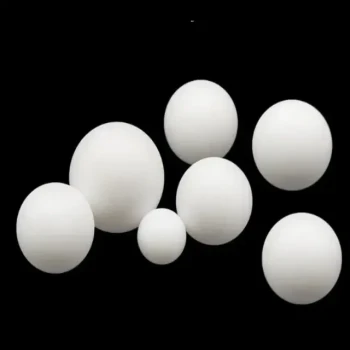
- Custom PTFE Teflon Balls for Advanced Industrial Applications
Related Articles
- The Unseen Guardian: How PTFE's Molecular Shield Protects Our Most Critical Systems
- When "Chemically Inert" Isn't Enough: The Hidden Cause of PTFE Component Failure
- Beyond "Non-Stick": Why Your PTFE Components Fail and How to Fix It for Good
- The PTFE Paradox: Why the 'Perfect' Material Fails—And How to Make It Work
- The Physics of Trust: Why PTFE Is the Bedrock of High-Stakes Electronics