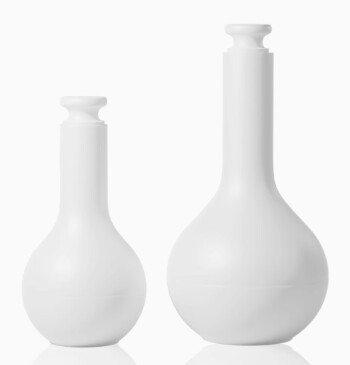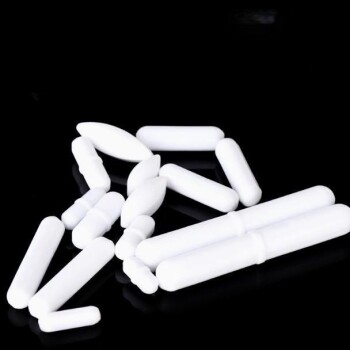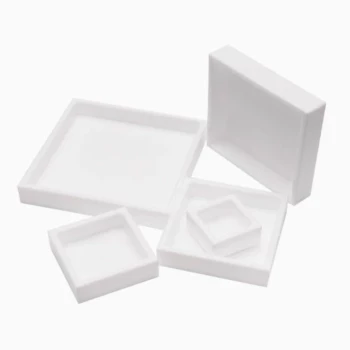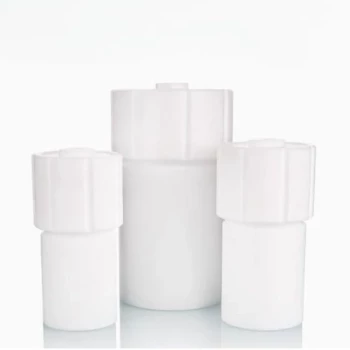
It’s a scenario that plays out in high-stakes environments everywhere: a multi-million dollar semiconductor production line grinds to a halt. A critical batch of pharmaceutical product is contaminated. A long-term chemical experiment is ruined. The culprit? A single, inexpensive component—a seal, a liner, a piece of labware—made of PTFE.
You check the chemical compatibility charts. Everything looks fine. The material is Teflon™ (PTFE), the gold standard for chemical inertness. It shouldn't have failed. Yet, it did. And now you’re facing costly delays, wasted resources, and a problem you can't seem to diagnose.
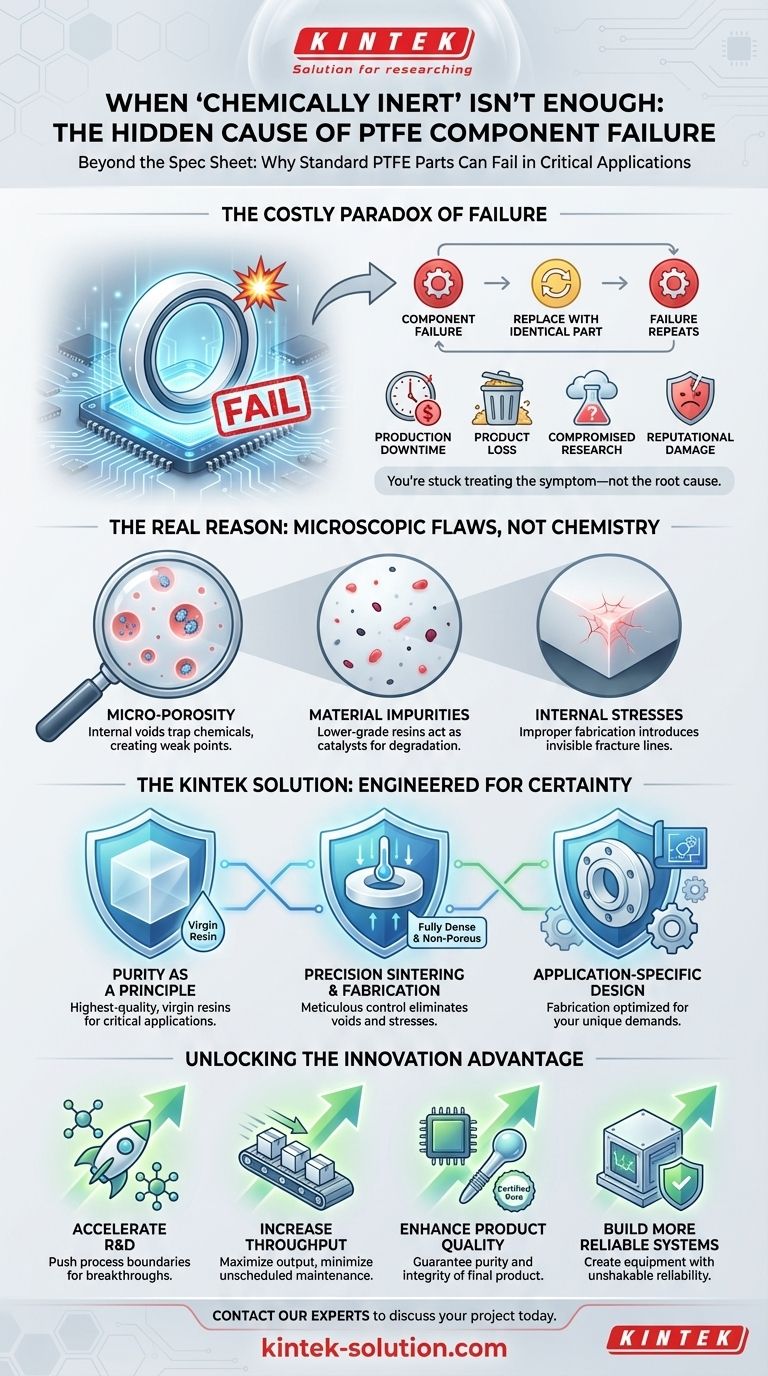
The Costly Cycle of Blame and Replacement
This isn't an isolated incident. Engineers and lab managers in the most demanding industries—from semiconductor fabrication to medical device manufacturing—have faced this frustrating paradox. The immediate response is often a predictable, yet flawed, troubleshooting process.
First, you might question the chemical purity or the process parameters. Then, you replace the failed component with an identical one from the same supplier, hoping it was just a one-off defect. The system runs smoothly for a while, but eventually, the failure repeats.
This cycle does more than just waste time. It erodes confidence and creates significant business risks:
- Production Downtime: In a semiconductor fab, a single hour of downtime can cost hundreds of thousands of dollars.
- Product Loss: An entire batch of a complex chemical or biologic can be lost, wiping out weeks of work and significant investment.
- Compromised Research: In a lab, component failure can introduce contaminants, invalidating data and forcing researchers to restart sensitive experiments.
- Reputational Damage: For medical devices, material failure is not an option. It can lead to recalls and a complete loss of market trust.
You're stuck treating the symptom—a failed part—because the true root cause remains hidden.
Beyond the Spec Sheet: The Real Reason Your PTFE Parts Fail
If you look up the chemistry of PTFE, you'll find it’s one of the most resilient polymers ever created. Its strength comes from the powerful carbon-fluorine (C-F) bonds, shielded by a tight sheath of fluorine atoms. It’s a microscopic suit of armor.
Only a handful of exotic and extremely aggressive substances, like molten alkali metals and chlorine trifluoride, can break these bonds. These are chemicals you are almost certainly not using. So, what’s the real problem?
The failure isn't in the chemistry of pure, perfectly formed PTFE. It's in the physical reality of the component sitting in your equipment. The "invincibility" of PTFE is compromised long before it ever touches a chemical, due to subtle flaws introduced during manufacturing:
- Micro-Porosity: If the raw PTFE resin isn't sintered (fused with heat and pressure) under precise control, it can leave microscopic voids in the material. These voids become weak points, trapping chemicals and creating sites for mechanical failure.
- Material Impurities: Not all PTFE is created equal. Lower-grade or recycled resins can contain impurities that act as catalysts for degradation under thermal or chemical stress.
- Internal Stresses: Improper machining techniques can introduce invisible stress fractures into the component. Over time, these stresses can lead to cracking and catastrophic failure, even under normal operating conditions.
Simply specifying "PTFE" on a purchase order is not enough. You’re not buying a chemical formula; you’re buying a finished component whose performance is dictated by the quality of its fabrication. This is why replacing a poorly made part with another one just resets the clock on the next failure.
From Raw Material to Reliable Performance: Engineering the Right Solution
To truly solve this problem, you need to shift your focus from the material's theoretical properties to the component's real-world integrity. You need a part that is not just made from PTFE, but is engineered for your specific application.
This requires a manufacturing process that honors the material's potential by eliminating the vulnerabilities that lead to failure. This is where KINTEK's expertise becomes critical. We don't just sell PTFE parts; we deliver engineered components built on a foundation of precision and material science.
Our approach directly counters the root causes of failure:
- Purity as a Principle: We use only the highest-quality, virgin PTFE resins, ensuring the material integrity required for sensitive semiconductor, medical, and laboratory applications.
- Precision Sintering and Fabrication: Our production processes are meticulously controlled to create fully dense, non-porous components that are free from internal voids and stresses.
- Application-Specific Design: We work with you to understand the unique chemical, thermal, and mechanical demands of your environment, fabricating custom components from prototype to high-volume production that are optimized for performance and longevity.
A KINTEK component isn't just another part. It's the physical embodiment of a solution designed from the ground up to prevent the very failures that plague standard-grade PTFE.
The Innovation Advantage: What's Possible with Failure-Proof Components
When you eliminate the recurring headache of component failure, you don't just fix a problem—you unlock new potential. The resources once spent on troubleshooting and downtime can now be invested in innovation.
With the confidence that your components will perform flawlessly, you can:
- Accelerate R&D: Push your process boundaries with more aggressive chemistries or higher temperatures to achieve scientific breakthroughs.
- Increase Throughput: Run your production lines longer and harder, maximizing output without the constant fear of unscheduled maintenance.
- Enhance Product Quality: Guarantee the purity and integrity of your final product, whether it's a next-generation microchip or a life-saving medical implant.
- Build More Reliable Systems: Design and build equipment that carries a reputation for unshakable reliability, giving you a powerful competitive edge.
Stop the cycle of unexplained failures and unpredictable downtime. It's time to move beyond the spec sheet and invest in components engineered for certainty. Let our team show you how precision-fabricated PTFE can transform your most challenging applications from a source of risk into a platform for growth. Contact Our Experts to discuss your project today.
Visual Guide
Related Products
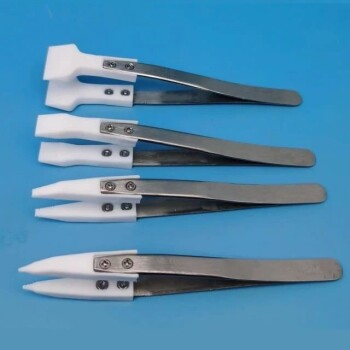
- Custom PTFE Parts Manufacturer for Teflon Parts and PTFE Tweezers
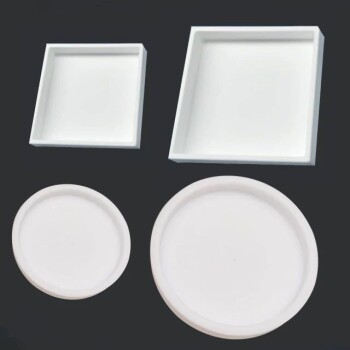
- Custom PTFE Parts Manufacturer for Teflon Containers and Components
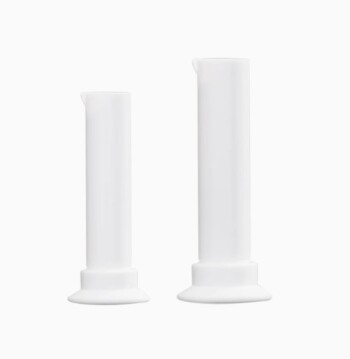
- Custom PTFE Measuring Cylinders for Advanced Scientific and Industrial Applications
- Customizable PTFE Rods for Advanced Industrial Applications
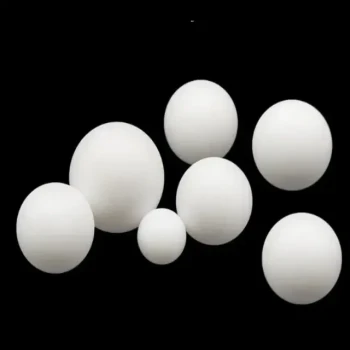
- Custom PTFE Teflon Balls for Advanced Industrial Applications
Related Articles
- The Physics of a Perfect Fit: How PTFE Eliminates an Athlete's Hidden Distractions
- The Unseen Guardian: How PTFE's Molecular Shield Protects Our Most Critical Systems
- How PTFE Solves Critical Industrial Challenges Through Material Superiority
- The Unseen Workhorse: Why PTFE Is the Default Choice for Impossible Problems
- The Physics of Trust: Why PTFE Is the Bedrock of High-Stakes Electronics